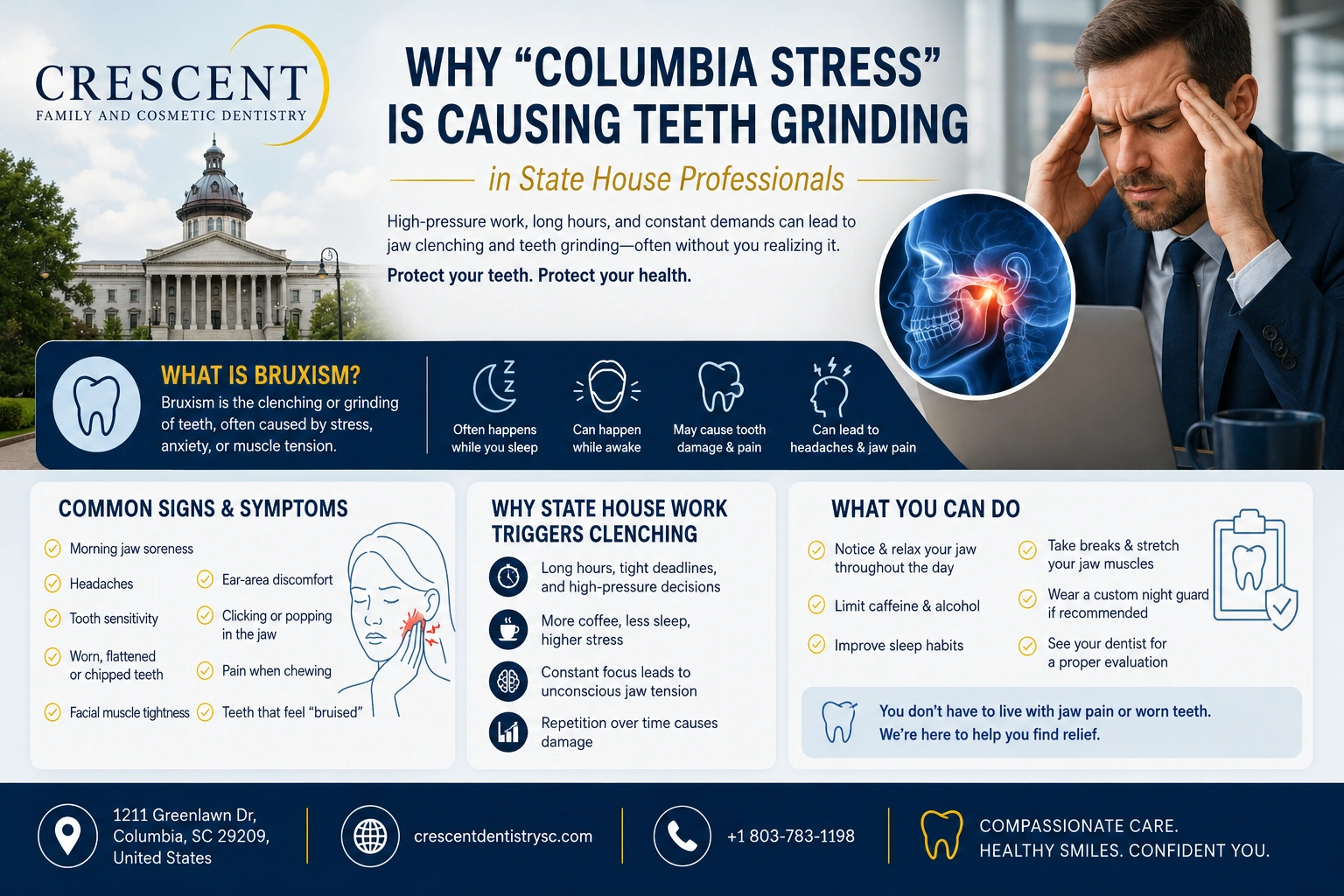
Why “Columbia Stress” Is Causing Teeth Grinding in State House Professionals
If you work around the South Carolina State House, you probably do not need someone to explain stress to you.
Legislative deadlines. Committee meetings. Lobbying pressure. Public scrutiny. Long days. Late emails. Fundraising events. Constant decision-making. Too much coffee. Not enough sleep.
Then one morning you wake up with a sore jaw, a dull headache, or a tooth that feels strangely tender.
That may not be random.
Stress does not just live in your calendar. It often shows up in your mouth. For many Columbia professionals, especially people working in and around government, law, policy, advocacy, and public affairs, that stress can turn into teeth grinding or jaw clenching.
Dentists call this bruxism.
And no, it is not just a harmless bad habit.
Jaw Pain, Headaches, or Worn Teeth?
Get help for teeth grinding before it causes lasting damage. Call today.
The direct answer
“Columbia stress” can contribute to teeth grinding because high-pressure work often increases jaw clenching, poor sleep, caffeine intake, muscle tension, and unconscious stress habits.
The American Dental Association notes that many people grind their teeth without realizing it, and stress is one of the common contributors. Mayo Clinic also lists stress, anxiety, anger, frustration, and tension as possible risk factors for bruxism.
For State House professionals, the pattern is easy to recognize:
You are focused all day.
You hold tension in your jaw.
You drink more coffee than water.
You answer emails late.
You sleep lightly.
Your teeth take the hit.
At Crescent Family & Cosmetic Dentistry in Columbia and Sumter, SC, we often think of grinding as a pressure problem before we think of it as a tooth problem. The tooth pain is real—but the source may be workload, sleep, bite forces, muscle tension, or a combination of all four.
What teeth grinding feels like
Not everyone hears themselves grind. In fact, many people only find out because a spouse, partner, or dentist notices signs.
Common symptoms include:
- Morning jaw soreness
- Headaches near the temples
- Tooth sensitivity
- Flattened or worn teeth
- Chipped enamel
- Cracked fillings or crowns
- Facial muscle tightness
- Ear-area discomfort
- Clicking or popping in the jaw
- Teeth that feel “bruised”
- Pain when chewing
Mayo Clinic notes that bruxism can happen while awake or asleep, and when it is frequent or severe, it may contribute to jaw problems, headaches, damaged teeth, and other issues.
A key clue: if your jaw feels worse in the morning, nighttime grinding may be involved. If your jaw feels worse at the end of the workday, daytime clenching may be part of the problem.
Many professionals have both.
Why State House work is a perfect setup for clenching
This is not a judgment. It is anatomy plus environment.
Your jaw is one of the places your body stores tension. When you are concentrating, bracing for conflict, reading dense material, preparing testimony, negotiating, or sitting through long meetings, your teeth may come together without you noticing.
That matters because your teeth are not supposed to be touching all day.
At rest, your lips can be closed, but your teeth should usually be slightly apart. The tongue rests lightly. The jaw muscles are relaxed.
During a stressful workday, that changes.
You may clench during:
- Budget discussions
- Hearings
- Depositions
- Campaign planning
- Press calls
- Legislative session deadlines
- Public speaking
- Traffic around downtown Columbia
- Late-night email catch-up
- High-stakes client or constituent conversations
The problem is not one intense day. It is repetition.
A single stressful week may leave you sore. A whole session of clenching can start wearing down teeth, irritating jaw joints, and breaking dental work.
Coffee, sleep, and alcohol can make it worse
Stress is not the only factor.
Cleveland Clinic notes that bruxism can be associated with stress and that lifestyle factors such as caffeine, alcohol, and smoking may also play a role. It also explains that frequent grinding can strain teeth and jaws, contributing to dental damage, headaches, and jaw pain.
For busy professionals, this combination is common:
More coffee to get through the day.
More screen time at night.
Less sleep.
More stress.
More jaw tension.
That does not mean you have to quit coffee tomorrow. But if your jaw is sore and your teeth are sensitive, your daily habits are worth reviewing honestly.
A practical first step: stop caffeine earlier in the day and see whether morning jaw symptoms improve.
Is it grinding or something else?
This is where people get into trouble.
Not every sore tooth is from grinding. A cracked tooth, cavity, gum infection, sinus pressure, failing crown, or bite problem can feel similar.
Teeth grinding can cause tooth tenderness. But it can also hide other problems.
For example:
| Symptom | Could be grinding | Could also be |
| Morning jaw pain | Yes | TMJ disorder, sleep issue |
| Tooth sensitivity | Yes | Gum recession, cavity, cracked tooth |
| Pain when biting | Yes | Cracked tooth, high filling, infection |
| Headaches | Yes | Tension headache, migraine, sleep apnea |
| Chipped teeth | Yes | Weak enamel, old fillings, trauma |
| One tooth hurts | Sometimes | Cavity, crack, abscess, failing crown |
Cleveland Clinic lists toothache causes that include cavities, abscesses, cracked teeth, damaged restorations, gum disease, and teeth grinding or clenching.
That is why “I’m just stressed” should not become a permanent self-diagnosis.
If one tooth hurts more than the others, get it checked.
The signs your grinding is no longer harmless
Occasional clenching during a stressful week may calm down on its own.
But you should call a dentist if you notice:
- Teeth feel shorter or flatter
- You keep chipping teeth
- Fillings or crowns crack repeatedly
- Jaw pain lasts more than a few days
- Morning headaches are becoming common
- You wake up with sore teeth
- You have pain when biting
- Your jaw locks or gets stuck
- You hear clicking with pain
- Tooth sensitivity keeps getting worse
- Your partner hears grinding at night
The National Institute of Dental and Craniofacial Research explains that bruxism can involve clenching or grinding while awake or asleep, and treatment may include behavior changes, stress management, mouthguards, or other approaches depending on the case.
The earlier you catch it, the more likely you are protecting teeth—not rebuilding them.

Top 5 “Dental Anxiety” Hacks for Your Next Visit
Does your heart start beating a little faster the moment someone mentions a dental appointment? Maybe it is the sound…
What a nightguard can and cannot do
A custom nightguard is one of the most common dental tools for grinding.
But it is important to understand what it does.
A nightguard does not cure stress.
It does not stop every grinding episode.
It does not fix sleep deprivation.
It does not make legislative session easier.
What it can do is help protect teeth and dental work from excessive force while you sleep.
Mayo Clinic notes that splints and mouthguards are designed to keep teeth separated to avoid damage from clenching and grinding, though they may not stop bruxism itself.
That distinction matters.
A nightguard is like a helmet. It protects you during impact. It does not remove the reason you are bracing.
Store-bought guard vs. custom nightguard
A store-bought guard may be reasonable as a very short-term experiment for some people. But it is not always ideal.
Over-the-counter guards can be bulky, poorly fitting, easy to chew through, or uncomfortable. Some can make jaw symptoms worse if they change the bite awkwardly.
A custom dental nightguard is made to fit your teeth and bite more precisely. It usually costs more upfront, but it may last longer and feel better.
Ask your dentist:
- Is my wear pattern mild, moderate, or severe?
- Do I need a hard guard, soft guard, or hybrid guard?
- Is my jaw joint involved?
- Do I have signs of sleep apnea?
- Could my bite be contributing?
- How often should the guard be checked?
- What happens if I grind through it?
Do not buy the thickest guard online and assume it is the safest answer.
What about Botox for grinding?
Botox can help some patients with severe jaw muscle overactivity, especially when masseter muscles are overworked and painful.
But it is not the first step for everyone.
Cleveland Clinic lists botulinum toxin injections as one treatment option in severe cases of teeth grinding, noting that injections temporarily relax jaw muscles and usually need repeat treatment to maintain results.
Botox may be worth discussing if:
- You have significant jaw muscle pain
- You clench heavily despite a nightguard
- Your masseter muscles feel enlarged or overactive
- Conservative approaches have not helped enough
- A dentist or qualified clinician has evaluated your bite and symptoms
But Botox does not protect tooth surfaces the way a guard does. It also does not replace diagnosis.
The right answer may be a guard, Botox, stress changes, sleep evaluation, dental repair, or a combination.
The sleep apnea question
This part is important.
Some nighttime grinding may be connected with sleep disruption. If you snore, wake up gasping, feel exhausted despite sleeping, or have morning headaches, tell your dentist and physician.
A nightguard alone may not be enough if a sleep-related breathing disorder is contributing.
This does not mean every grinder has sleep apnea. It means grinding is sometimes a clue, not just a dental habit.
What Columbia professionals can do during the workday
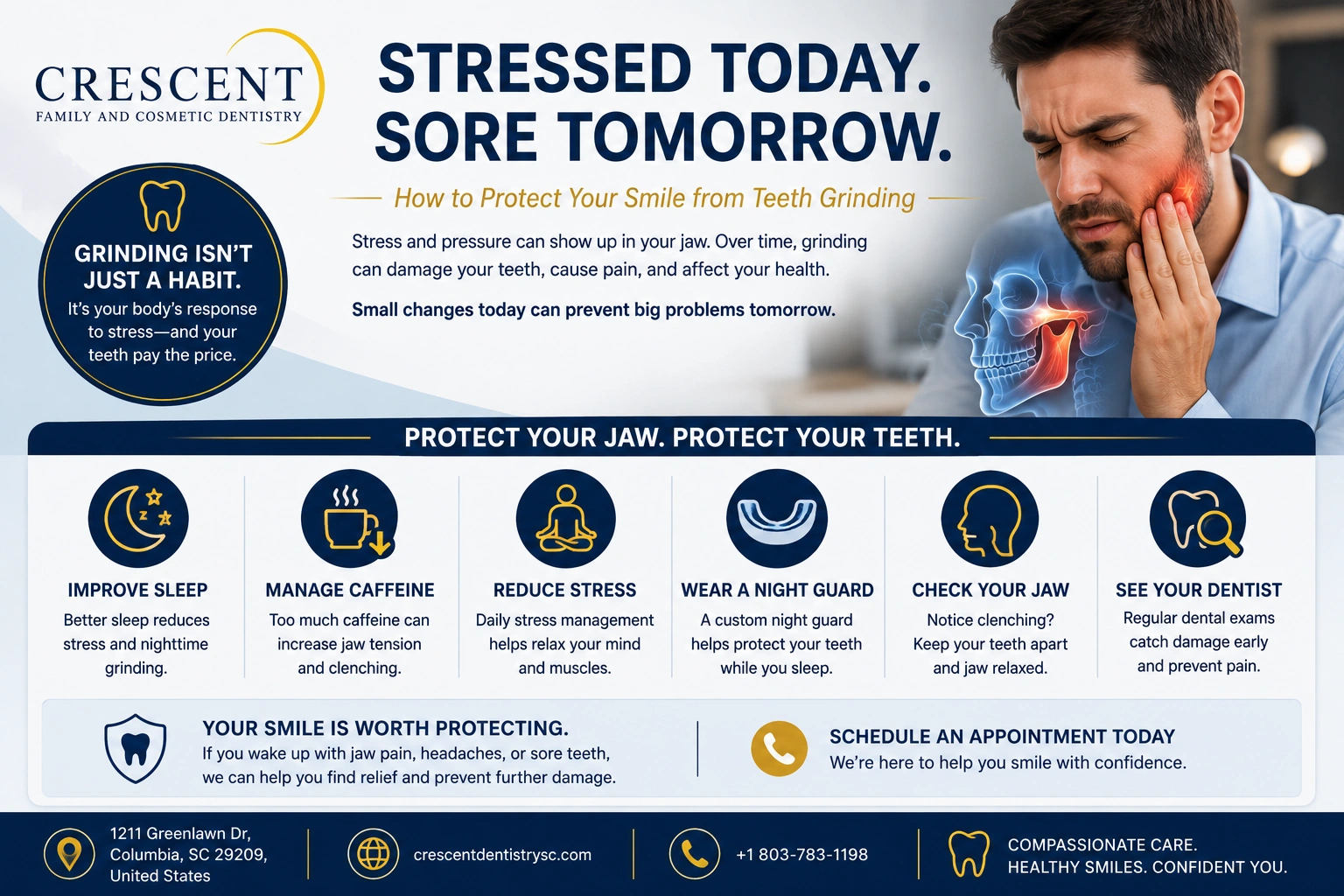
You may not be able to remove stress from your job. But you can interrupt the clenching loop.
Try this:
1. Use the “lips together, teeth apart” rule
Your teeth should not be touching unless you are chewing or swallowing.
Put a small note on your monitor, laptop, or phone:
Teeth apart.
It sounds too simple. It works because most daytime clenching is unconscious.
2. Set jaw checks before stressful meetings
Before hearings, calls, negotiations, or presentations:
- Drop your shoulders
- Relax your tongue
- Let your teeth separate
- Breathe through your nose if possible
- Unclench your hands and jaw together
Jaw tension often travels with shoulder and hand tension.
3. Stop chewing ice, pens, or fingernails
If your teeth are already overloaded, do not add extra abuse.
4. Watch the afternoon caffeine stack
Coffee in the morning is one thing. Coffee all day during high stress is another.
If your jaw symptoms are worse during session, your caffeine pattern may be part of the story.
5. Do not ignore hydration
Dry mouth plus stress plus coffee is not a great combination for teeth or gums.
6. Protect sleep like treatment
Bruxism is often worse when sleep is poor. Sleep is not a luxury if your teeth are cracking.
When dental repair is needed
If grinding has already damaged teeth, a guard alone may not be enough.
Treatment may include:
- Smoothing small rough edges
- Replacing cracked fillings
- Repairing chipped teeth with bonding
- Crowns for weakened teeth
- Bite adjustment in select cases
- Treating gum recession or sensitivity
- Nightguard therapy
- Referral for TMJ or sleep evaluation when needed
The goal is not to crown every worn tooth. That is overtreatment.
The goal is to identify which teeth are at risk, protect them from further force, and repair only what truly needs repair.
The cost question
Grinding can be cheap to address early and expensive to ignore.
A nightguard is usually less expensive than replacing cracked crowns, repairing broken teeth, or treating a tooth fracture that reaches the nerve.
That does not mean every person with stress needs a guard. It means if your dentist sees wear, cracks, or muscle symptoms, ask for a clear plan.
Good questions:
- Is this active damage or old wear?
- Can we monitor it?
- Do I need a nightguard now?
- What type of guard do you recommend?
- Which teeth are most at risk?
- What will happen if I wait six months?
- Is this tooth pain from grinding or decay?
- Is Botox appropriate, or is that overkill?
A dentist should be able to explain the “why,” not just sell you an appliance.
The honest bottom line
“Columbia stress” is not just a phrase. For many State House professionals, stress shows up as clenched jaws, worn teeth, cracked fillings, morning headaches, and sore facial muscles.
But grinding is not always just stress. It can overlap with tooth decay, cracked teeth, gum recession, bite problems, sleep disruption, caffeine habits, and existing dental work.
If your jaw is sore after long days downtown, or you wake up with headaches and tender teeth, Crescent Family & Cosmetic Dentistry in Columbia and Sumter can help you figure out whether you are dealing with bruxism, a tooth problem, a bite issue, or something that needs a broader look.
The best treatment is not always the most aggressive one.
Sometimes it is awareness.
Sometimes it is a nightguard.
Sometimes it is repairing a damaged tooth.
Sometimes it is protecting your sleep and reducing the forces your teeth are taking every night.
The goal is simple: keep your career from grinding down your teeth.
FAQs
Can stress really make me grind my teeth?
Yes. Stress and anxiety are common contributors to bruxism, and many people clench or grind without realizing it.
How do I know if I grind my teeth at night?
Common signs include morning jaw soreness, headaches, tooth sensitivity, worn teeth, chipped enamel, and a partner hearing grinding sounds.
Will a nightguard stop me from grinding?
Not always. A nightguard mainly protects the teeth from damage. It may not stop the grinding habit itself.
Is Botox good for teeth grinding?
It can help selected patients with severe jaw muscle overactivity, but it is not the right first step for everyone. A dental evaluation should come first.
Why does only one tooth hurt if I grind?
Grinding can make one tooth sore if it takes more force than the others, but one-tooth pain can also mean a cavity, crack, abscess, or failing filling. Have it checked.
When should I call a dentist?
Call if you have jaw pain lasting more than a few days, morning headaches, tooth sensitivity, biting pain, chipped teeth, cracked fillings, or a partner who hears grinding at night.
Grinding Your Teeth After Long State House Days?
Protect your smile with trusted treatment for stress-related teeth grinding.