Why 2026 Dental Insurance Premiums Are Rising — and How Crescent’s Membership Plan Can Help You Save 20%
If your dental insurance premium increased for 2026, you are not imagining it.
Across South Carolina and the rest of the country, many patients are seeing higher monthly premiums, larger deductibles, reduced employer contributions, and more out-of-pocket dental costs.
And for a lot of families in Sumter and Columbia, the frustration is not just the price increase.
It is the feeling that they are paying more while still dealing with:
- annual maximums that barely cover major treatment
- waiting periods
- denied claims
- confusing coverage rules
- shrinking provider networks
- rising copays
Most people assume dental insurance works like medical insurance.
It usually does not.
In reality, many dental insurance plans function more like a discount coupon with limitations than true comprehensive coverage.
That is one reason more dental practices — including Crescent Family & Cosmetic Dentistry — are offering membership plans designed to make preventive and routine dental care simpler and more predictable.
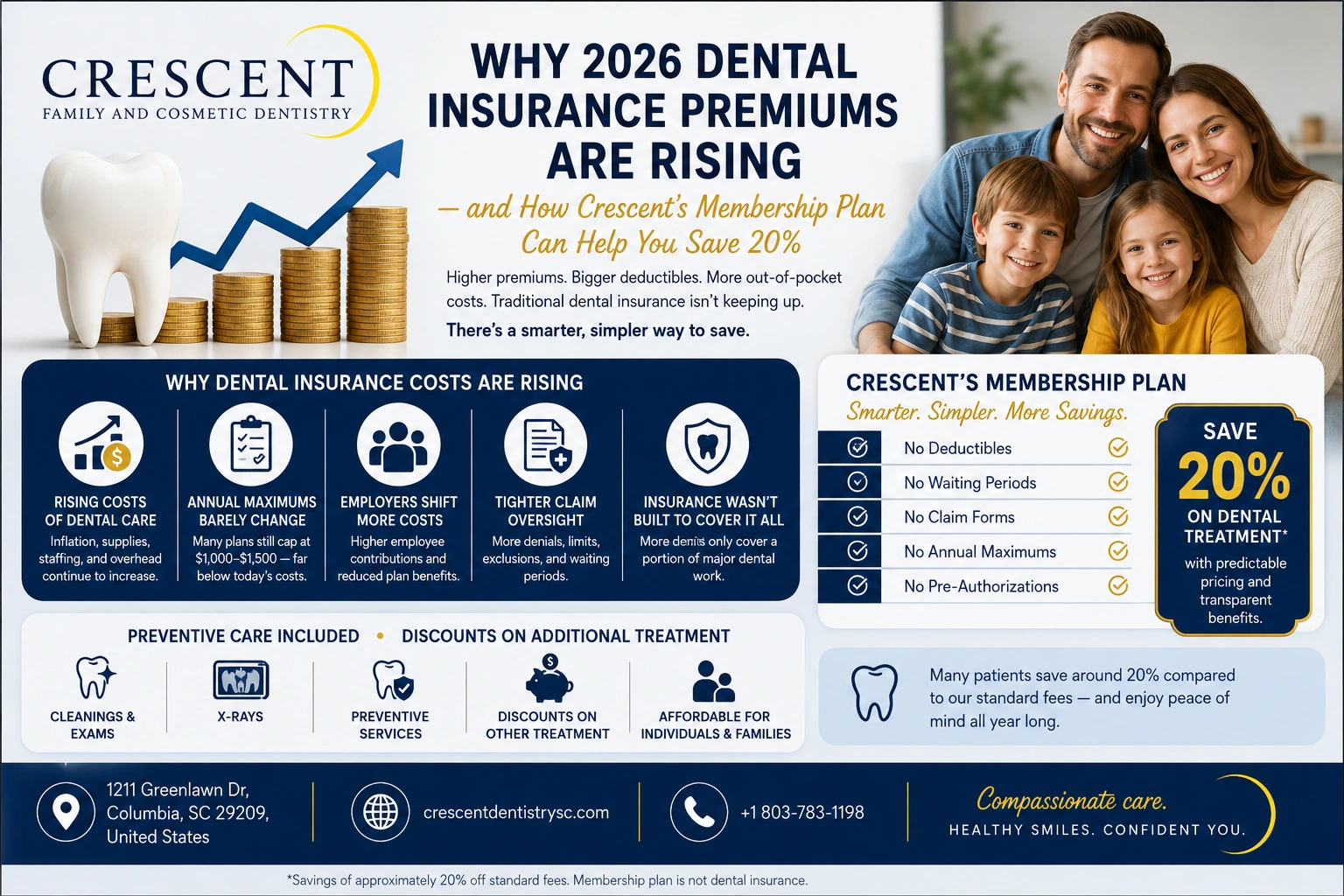
For many patients, Crescent’s in-house membership plan can reduce dental costs by around 20% while eliminating many of the frustrations tied to traditional insurance.
Here is what is driving 2026 dental insurance increases, who is being affected most, and when a membership plan may actually make more financial sense.
Dental Insurance Premiums Going Up? We Can Help.
Join Crescent’s Membership Plan today and get affordable dental care with 20% off eligible services.
Why Are Dental Insurance Premiums Increasing in 2026?
Several things are happening at the same time.
Some are economic. Others are structural problems that have existed in dentistry for years.
1. Dental Care Costs Are Rising
Like nearly every healthcare field, dentistry has experienced significant cost increases over the past few years.
Dental offices are paying more for:
- staffing
- dental supplies
- lab work
- technology
- sterilization systems
- rent and utilities
- insurance and compliance costs
Those costs eventually affect insurance carriers.
When insurance companies pay out more claims while operating costs increase, premiums usually rise.
This is not unique to South Carolina.
But patients in growing areas like Columbia are especially feeling the impact as healthcare and labor costs continue increasing regionally.
2. Many Annual Maximums Have Barely Changed in Decades
This is one of the biggest frustrations dentists and patients share.
Many dental insurance plans still have annual maximums between $1,000 and $1,500.
That may have sounded reasonable 20 or 30 years ago.
Today, it often covers only a portion of major dental work.
For example:
- A single crown may cost $1,200 to $1,800.
- A root canal and crown together can exceed $2,000.
- Multiple fillings or periodontal treatment can quickly consume annual benefits.
Meanwhile, premiums continue increasing.
So many patients are paying more every month for coverage limits that have barely moved with inflation.
That disconnect is causing many people to question whether traditional dental insurance is still worth it.
3. Employers Are Shifting More Costs to Employees
Many employer-sponsored dental plans are changing in 2026.
Some businesses are:
- increasing employee contributions
- reducing coverage tiers
- narrowing provider networks
- offering lower-cost plans with fewer benefits
This means patients may technically still “have insurance” while actually paying much more out of pocket.
We see this often with families trying to budget for cleanings, fillings, crowns, or cosmetic work.
They assume insurance will handle most of it.
Then they discover annual maximums, exclusions, or waiting periods limit what is actually covered.
4. Insurance Companies Are Tightening Claim Oversight
Another growing issue is claim scrutiny.
Patients are increasingly running into:
- denied claims
- downgraded procedures
- frequency limitations
- missing tooth clauses
- waiting periods for major treatment
This creates frustration for both patients and dental offices.
Sometimes a patient genuinely needs treatment, but the insurance company still limits reimbursement.
That does not necessarily mean the treatment is unnecessary.
It often means the insurance policy has restrictions designed to control payouts.
Most dentists would tell you the insurance company is not sitting chairside evaluating your pain, infection, or long-term oral health.
They are evaluating policy limitations.
The Bigger Problem: Dental Insurance Was Never Designed to Cover Everything
This surprises a lot of patients.
Dental insurance was originally designed to encourage preventive care and offset some treatment costs.
It was not designed to fully pay for major restorative dentistry.
That is why many plans:
- cap yearly benefits
- pay only percentages
- exclude cosmetic procedures
- limit replacement frequency
- require waiting periods
For example, insurance may cover:
- 100% of preventive cleanings
- 80% of basic fillings
- 50% of crowns or dentures
But that still leaves substantial out-of-pocket costs.
And once the annual maximum is reached, the patient pays the rest.
That is one reason many people in Sumter and Columbia are exploring alternatives like dental membership plans.
What Is Crescent’s Membership Plan?
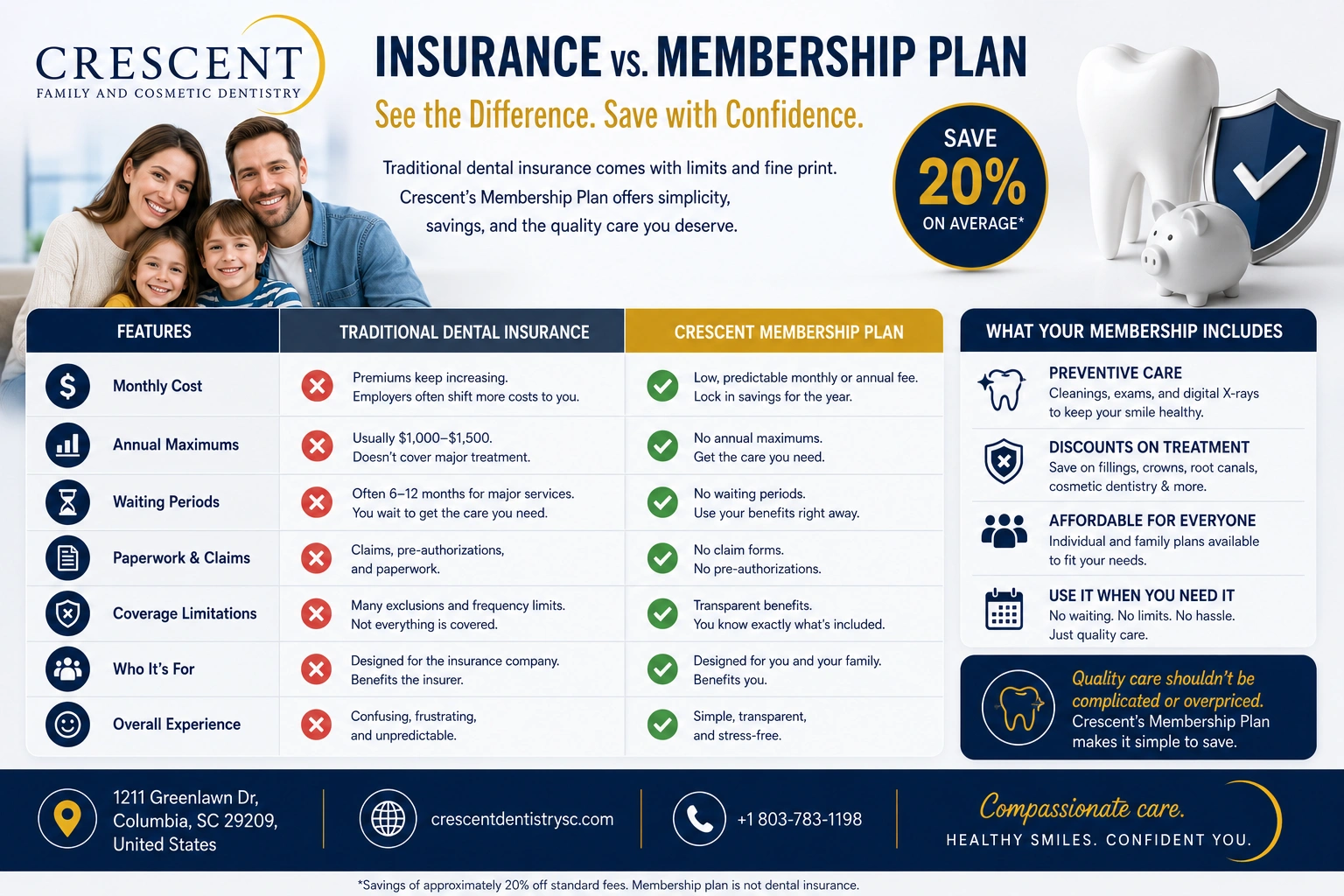
Crescent Family & Cosmetic Dentistry offers an in-house dental membership plan for patients without traditional insurance or for patients who want a simpler, more transparent way to manage dental costs.
Unlike insurance, membership plans are typically straightforward.
There are:
- no deductibles
- no waiting periods
- no claim forms
- no annual maximums
- no pre-authorizations
Instead, patients pay a membership fee and receive included preventive services plus discounts on additional treatment.
For many patients, that results in meaningful savings — often around 20% compared to standard fees.
More importantly, it removes a lot of uncertainty.
Patients know what is included and what discounts apply.
That clarity matters.
Especially for families trying to budget dental care responsibly.
Who Benefits Most From a Dental Membership Plan?
Membership plans are not perfect for everyone.
But they can make excellent financial sense for certain patients.
Patients Without Dental Insurance
This is the most obvious fit.
If you do not have dental insurance through an employer, buying an individual dental policy is not always cost-effective.
Many individual plans come with:
- waiting periods
- low annual maximums
- limited networks
- high monthly premiums
In some cases, patients spend so much on premiums and deductibles that the actual value becomes questionable.
A membership plan can offer more immediate value and more predictable pricing.
Retirees
Many retirees lose employer-sponsored dental benefits.
Medicare generally does not include routine dental coverage.
That leaves many older adults trying to balance preventive care, crowns, dentures, implants, or periodontal treatment without meaningful insurance support.
A membership plan can help reduce ongoing maintenance costs while encouraging regular visits.
Small Business Owners and Self-Employed Patients
Self-employed patients often struggle to find affordable dental coverage that actually provides good benefits.
Many end up paying significant monthly premiums for plans with restrictive annual caps.
For these patients, direct membership plans may provide more value.
Families Who Want Simplicity
Some families are simply tired of dealing with insurance confusion.
They want:
- predictable costs
- transparent pricing
- straightforward discounts
- fewer administrative headaches
That is where membership plans can feel refreshingly simple.
When Traditional Dental Insurance May Still Make Sense
This is important.
Not everyone should cancel their dental insurance.
Some employer-sponsored plans are genuinely valuable, especially when employers cover most of the premium.
Traditional insurance may still make sense if:
- your employer heavily subsidizes coverage
- you expect major treatment soon
- your plan has unusually strong benefits
- you already met waiting periods
- your preferred dentist is in-network
The key is comparing real numbers.
Not assumptions.
A lot of patients continue paying for plans without fully understanding:
- annual maximums
- exclusions
- waiting periods
- actual reimbursement percentages
- network restrictions
Sometimes the math works in your favor.
Sometimes it does not.
A good dental office should help you understand both.
One Thing Most Patients Do Not Realize About Insurance Networks
Cheaper insurance plans often come with narrower provider networks.
That can create pressure to choose a dentist based on insurance contracts instead of comfort, trust, experience, or convenience.
Many patients in Columbia and Sumter care more about:
- seeing a dentist they trust
- scheduling flexibility
- clear communication
- modern technology
- continuity of care
Membership plans allow patients to focus more on the relationship and care experience instead of network restrictions.
That is becoming increasingly important as insurance networks continue tightening.
Preventive Care Is Still the Cheapest Dentistry
This part has not changed.
The most affordable dental treatment is usually the treatment you avoid needing later.
Skipping cleanings and exams to save money often becomes far more expensive long term.
For example:
- A small cavity may require a simple filling.
- Waiting too long could lead to a root canal and crown.
- Untreated gum disease can eventually contribute to tooth loss.
This is one reason membership plans are designed around preventive care.
They encourage patients to maintain regular visits instead of postponing treatment because of insurance confusion or financial uncertainty.
And honestly, that is usually better for patients.
Most major dental problems do not appear overnight.
They develop gradually.
Routine preventive care catches issues earlier, when treatment is simpler and less expensive.
What Patients Should Ask Before Renewing Dental Insurance in 2026
Before automatically renewing your dental plan this year, ask:
What Is My Actual Annual Maximum?
Many people do not know this number.
And it matters more than the monthly premium.
Are There Waiting Periods?
Especially for crowns, implants, dentures, or major treatment.
Is My Dentist In-Network?
Out-of-network costs can surprise patients.
How Much Am I Paying in Premiums Annually?
Compare that against:
- preventive coverage
- expected treatment needs
- annual maximums
- out-of-pocket expenses
Would a Membership Plan Be Simpler or More Affordable?
For some patients, yes.
Especially if they primarily want preventive care, transparent pricing, and reduced treatment costs without insurance restrictions.
Dentistry Should Not Feel Financially Confusing
One reason patients delay treatment is uncertainty.
They are unsure:
- what insurance will cover
- how much treatment costs
- whether treatment is urgent
- whether they are being oversold
That uncertainty creates stress.
At Crescent Family & Cosmetic Dentistry, the goal is to make dental decisions clearer and less intimidating.
That means explaining:
- what treatment is necessary
- what can wait
- what alternatives exist
- how insurance applies
- what membership savings may look like
Good dentistry is not just about procedures.
It is about helping patients make informed decisions without pressure.
The Bottom Line on Rising 2026 Dental Insurance Costs
Dental insurance premiums are increasing in 2026 because healthcare costs, staffing costs, and claim expenses continue rising.
At the same time, many traditional plans still carry low annual maximums and restrictive limitations.
That is why more patients are reevaluating whether traditional insurance is delivering enough value.
For many individuals and families in Sumter and Columbia, Crescent’s membership plan offers a simpler alternative:
- preventive care included
- no waiting periods
- no annual maximums
- transparent discounts
- potential savings around 20%
Most importantly, it helps patients focus less on insurance rules and more on maintaining long-term oral health.
If you are unsure whether your current dental insurance still makes financial sense, Crescent Family & Cosmetic Dentistry can help you compare your options and understand what may work best for your situation.
FAQs About Dental Insurance and Membership Plans
Are dental membership plans insurance?
No.
Membership plans are not insurance policies. They are in-house savings programs offered directly through a dental practice.
Can I use insurance and a membership plan together?
Usually patients choose one or the other, but it depends on the practice structure and your specific coverage.
Do membership plans cover cosmetic dentistry?
Many plans include discounts on cosmetic procedures, but exact benefits vary.
It is important to ask for details before starting treatment.
Is a membership plan worth it if I only need cleanings?
Often yes, especially if the included preventive care and treatment discounts exceed the annual membership fee.
Why do dental insurance annual maximums stay so low?
Unlike medical insurance, many dental plans have not significantly increased annual maximums in decades.
That is one reason patients frequently face out-of-pocket costs for major treatment.
Can I still see specialists with a membership plan?
Membership plans generally apply only within the participating dental office.
Specialist referrals may involve separate costs.
How do I know whether insurance or a membership plan is better for me?
The best option depends on:
- your expected dental needs
- employer contributions
- annual premiums
- annual maximums
- preferred dentist
- long-term treatment goals
If cost is your biggest concern, ask for a clear breakdown of both options before making a decision.
Crescent Family & Cosmetic Dentistry serves patients in Sumter and Columbia, South Carolina with a focus on clear communication, preventive care, and practical treatment guidance.
Worried About Rising 2026 Dental Insurance Costs?
Save more on preventive and restorative care with Crescent’s Membership Plan and enjoy 20% savings.