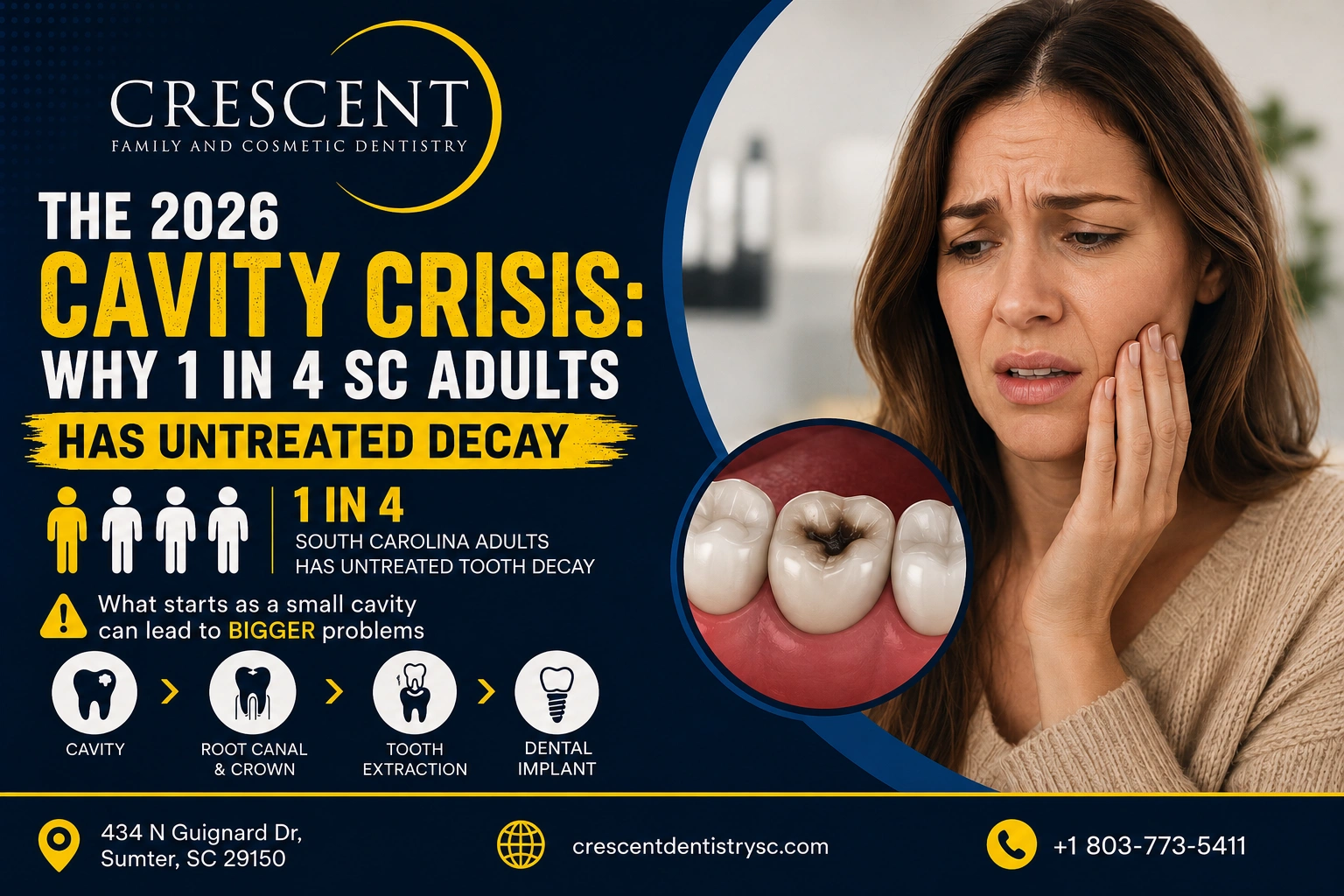
The 2026 Cavity Crisis: Why 1 in 4 SC Adults Has Untreated Decay
A lot of adults in South Carolina are walking around with untreated cavities.
Not “maybe I should whiten my teeth” dental concerns.
Actual decay.
The kind that can quietly grow from a small filling into a root canal, crown, extraction, or implant.
The short answer: untreated tooth decay is common because dental care is expensive, insurance is confusing, people wait until something hurts, and cavities often do not hurt until the problem is already advanced. National CDC surveillance found untreated tooth decay in about 21% of adults ages 20–64, and earlier national data placed it closer to 25%. South Carolina tracks oral health through its state Oral Health Program and surveillance system, including access and population oral health data.
For patients in Sumter and Columbia, this is not just a public health statistic.
It is the reason a $200–$300 filling can become a $2,000 root canal and crown.
It is the reason someone avoids smiling for years.
It is the reason a tooth that could have been saved eventually has to come out.
And most of the time, it did not have to get that far.
Worried About Hidden Cavities?
Untreated decay can worsen without warning. Schedule your dental exam today and protect your smile.
Why So Many Adults Have Untreated Cavities
Most people do not skip dental care because they do not care.
They skip it because something gets in the way.
Usually, one of these five things.
1. Cavities Often Do Not Hurt at First
This is the biggest trap.
A cavity can grow for months before you feel anything.
Early decay may cause no symptoms at all. By the time you feel lingering sensitivity, pain when chewing, swelling, or throbbing, the decay may already be close to the nerve.
That changes the treatment.
A small cavity may need a filling.
A deeper cavity may need a root canal and crown.
A severely damaged tooth may need extraction and replacement.
Pain is not a good early-warning system for tooth decay.
2. Dental Insurance Does Not Work Like Medical Insurance
Many patients assume, “I have dental insurance, so I’m covered.”
Not always.
Dental plans often include annual maximums, deductibles, waiting periods, frequency limits, and partial coverage for major treatment. That means a patient may delay care because they think they are protected, then discover the plan only covers part of the treatment.
This is especially frustrating when the yearly maximum is lower than the cost of one major dental procedure.
So people wait.
Then the problem becomes more expensive.
3. Cost Anxiety Is Real
A lot of patients avoid the dentist because they are afraid of what it will cost.
That fear is understandable.
But waiting rarely makes dental care cheaper.
Small decay is usually one of the least expensive restorative problems to fix. Advanced decay is one of the most expensive.
The cheapest option is not always “doing nothing.”
Sometimes doing nothing is just choosing the more expensive version later.
4. Adults Are Busy
Parents in Sumter and Columbia put their kids first.
Working adults postpone appointments because they cannot miss work.
Caregivers delay their own needs.
Retirees may lose employer-sponsored dental benefits.
Small dental problems become easy to push off when they are not painful.
But cavities do not care how busy your schedule is.
They keep moving.
5. People Are Embarrassed
This matters more than dentists sometimes admit.
Many adults avoid the dentist because they feel ashamed.
They worry they will be judged for:
not flossing
having broken teeth
missing appointments
needing a lot of work
not being able to afford treatment sooner
A good dental team should not shame you.
At Crescent Family & Cosmetic Dentistry, the goal is to help patients understand what is happening, what is urgent, what can wait, and what options make sense.
What Untreated Decay Can Turn Into
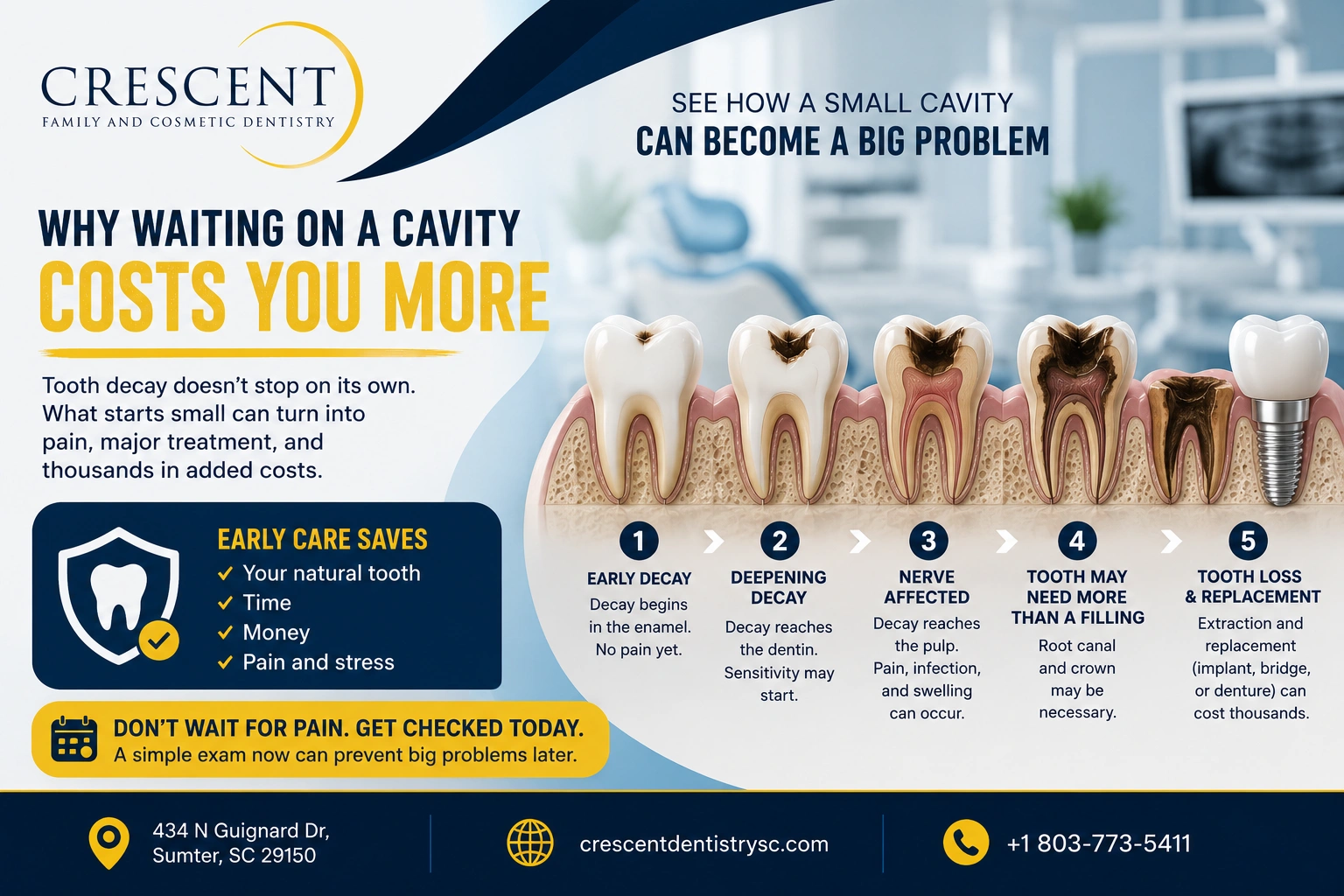
Untreated cavities usually progress in stages.
First, bacteria weaken the enamel.
Then decay reaches the dentin, the softer layer under enamel.
Then it can reach the pulp, where the nerve and blood supply live.
At that point, a filling may no longer be enough.
Possible next steps include:
root canal therapy
a crown
tooth extraction
bridge
partial denture
dental implant
This is why early detection matters. The CDC describes untreated decay as having one or more decayed teeth, and national surveillance continues to track it because it remains a major oral health burden.
The Financial Difference Is Huge
Here is the practical version.
A small filling might cost a few hundred dollars.
A root canal and crown can cost several thousand dollars combined.
A dental implant replacing a lost tooth can cost several thousand dollars, especially if extraction, bone grafting, implant placement, and the final crown are all needed.
That does not mean every cavity becomes an implant.
But it happens often enough that patients should take small cavities seriously.
Most dentists would rather fix a small cavity than explain why a tooth can no longer be saved.

Clear Aligners vs Traditional Braces: A Deep Dive into the Future of Orthodontics
Metal braces aren’t the only way to straighten teeth anymore. Clear aligners are quickly becoming the go-to for people who…

Who Is Most at Risk?
Untreated decay can happen to anyone.
But some patients are at higher risk:
people without dental insurance
people with dry mouth
smokers
patients with diabetes
adults with limited access to care
people who sip sweet drinks throughout the day
patients with older dental work
people who grind or clench
patients who have not had x-rays in years
Dry mouth is especially overlooked.
Saliva protects teeth. When medications, medical conditions, dehydration, or mouth breathing reduce saliva, cavities can develop faster.
Patients with older restorations should also pay attention to the signs of problems with old silver fillings, especially when they notice new sensitivity, cracks, or changes around an existing filling.
What You Can Do Before It Becomes Expensive
The best approach is boring but effective.
Brush twice a day with fluoride toothpaste.
Floss daily.
Limit frequent snacking and sugary drinks.
Do not sip sweet tea, soda, sports drinks, or flavored coffee all day.
Get routine exams and cleanings.
Ask about fluoride if you are cavity-prone.
Do not wait for pain.
That last one is the big one.
Families can also reduce cavity risk early by choosing kid-friendly snacks that are less likely to cause cavities, especially options that are lower in added sugar, less sticky, and paired with water.
When Should You Call a Dentist?
You should schedule an exam if you notice:
tooth sensitivity
pain when chewing
a chipped tooth
a broken filling
food getting stuck in one spot
dark spots on a tooth
bad taste
swelling
bleeding gums
pain that comes and goes
Not every symptom means something serious.
But guessing is risky.
An exam and x-ray can usually tell whether the issue is minor, moderate, or urgent.
The Bottom Line
South Carolina’s cavity problem is not about laziness.
It is about access, cost, confusion, fear, and delayed care.
But untreated decay is one of the clearest examples in dentistry where waiting can make the problem more expensive.
A small filling is usually simpler, cheaper, and easier than a root canal, crown, extraction, or implant.
If you are in Sumter or Columbia and you are worried about a cavity, broken filling, or tooth sensitivity, Crescent Family & Cosmetic Dentistry can help you understand what is going on before it becomes a bigger problem.
Don’t Let Tooth Decay Get Worse
Early treatment can save you from bigger dental problems. Call today to get your teeth checked.