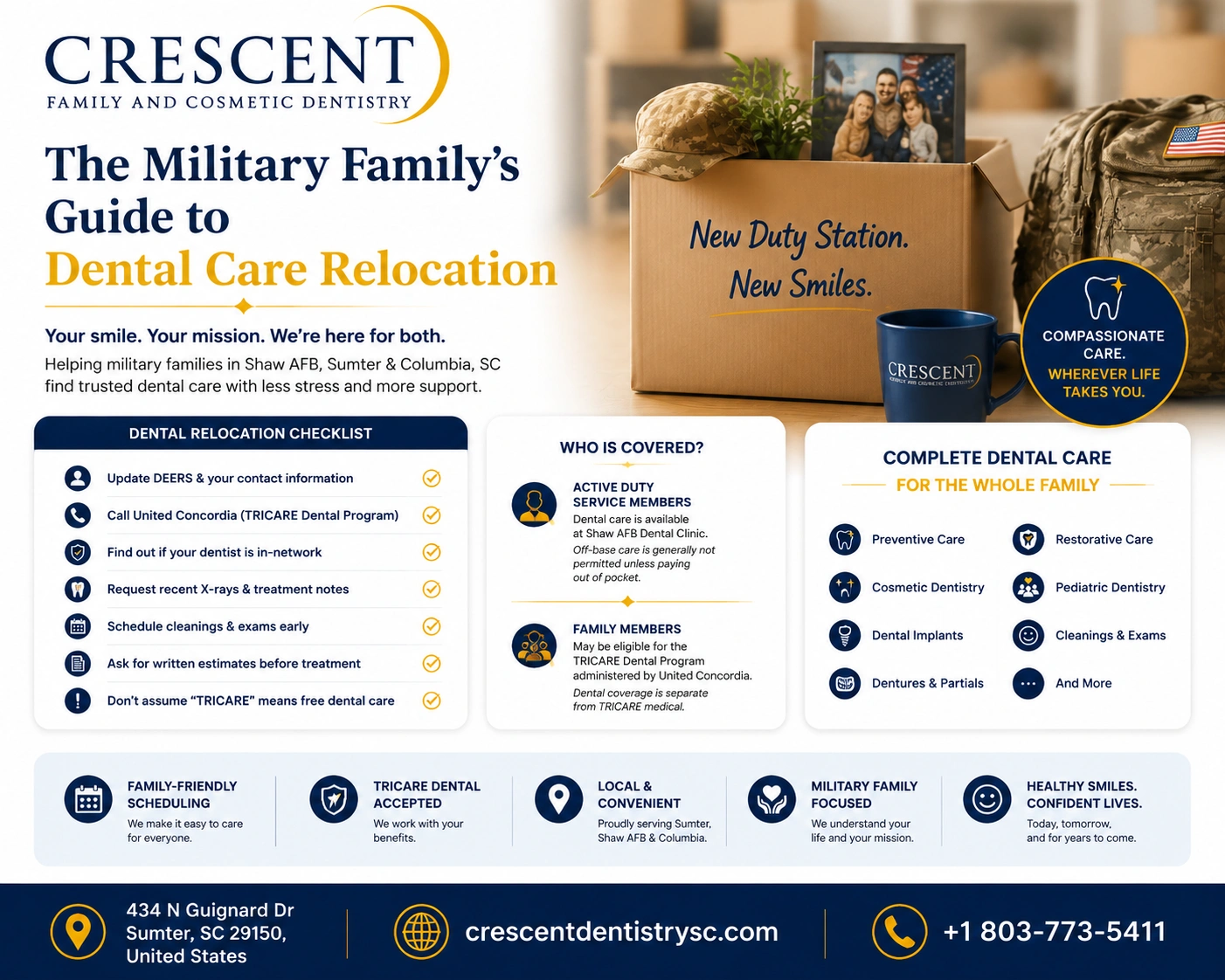
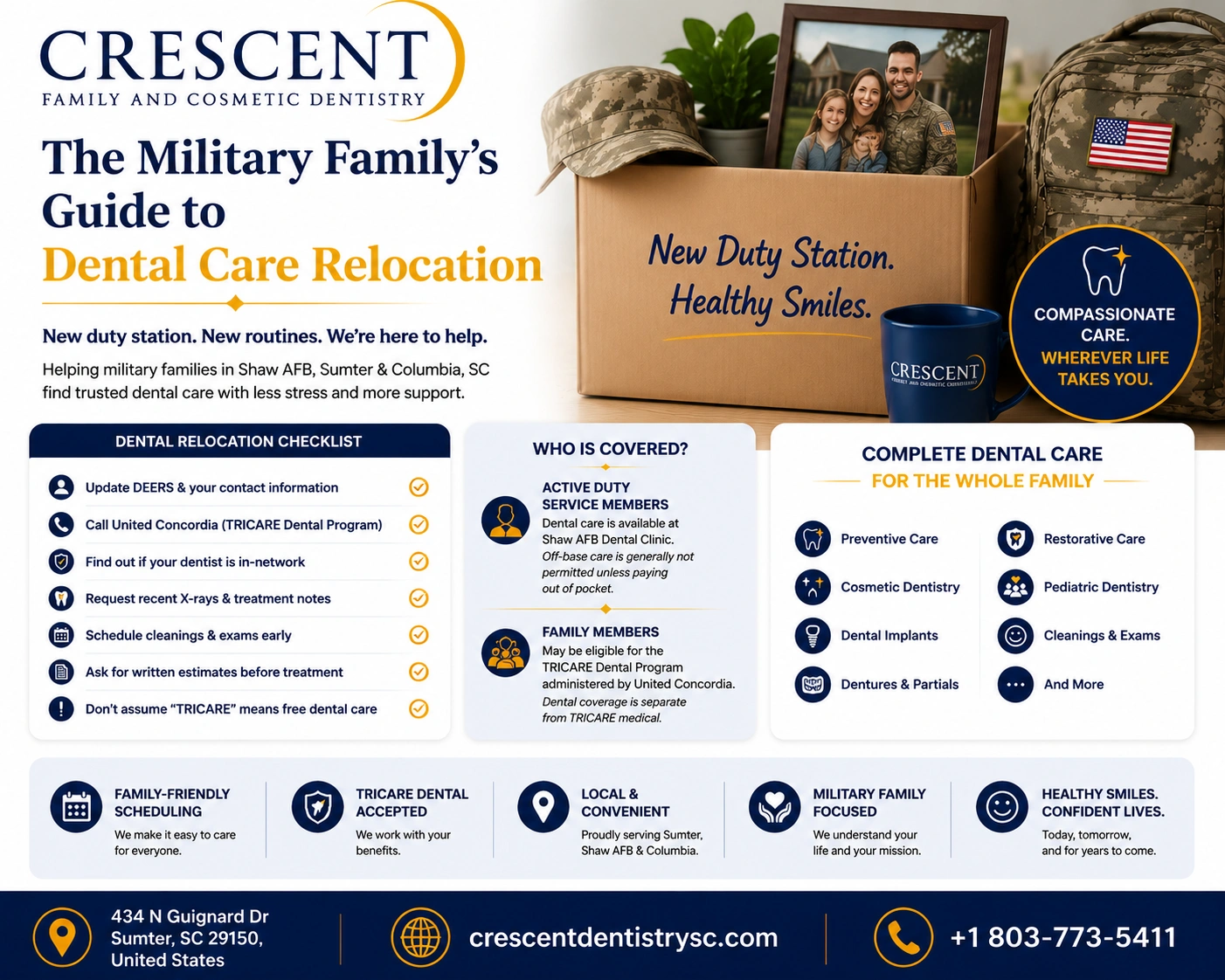
The Military Family’s Guide to Dental Care Relocation
Shaw AFB, Sumter, and Columbia, SC
A PCS move has a way of turning dental care into one more thing on an already impossible checklist.
You are changing addresses, schools, jobs, routines, pharmacies, doctors, child care, and maybe even time zones. Then someone loses a retainer. A child’s tooth starts hurting. A crown feels loose. Or you realize nobody in the family has had a cleaning since before orders dropped.
Here is the practical answer:
If your family is relocating to Shaw AFB or the Sumter area, do not wait for a dental emergency to find a local dentist. Update your TRICARE Dental information, confirm network status, transfer recent records, and schedule baseline visits once your family is settled enough to keep the appointment.
That does not mean rushing into treatment. It means getting enough information to avoid surprises.
Crescent Family & Cosmetic Dentistry serves families in Sumter and Columbia, South Carolina, including military families who need clear guidance, coordinated scheduling, and dental care that can follow the whole household—not just one patient. The content approach for Crescent is built around practical, consumer-first guidance that answers what patients ask before they call, approve treatment, or compare options.
Military Family Moving Soon? Protect Your Family’s Smile
Keep your family’s dental care on track during every PCS move. Get expert guidance on finding coverage, transferring records, and avoiding gaps in care.
The direct answer: what military families should do first
If you are moving to Shaw AFB, your dental relocation checklist should look like this:
- Update DEERS and your contact information.
- Call United Concordia if you are enrolled in the TRICARE Dental Program.
- Find out whether the dentist you choose is in-network.
- Request recent X-rays and treatment notes from your previous dentist.
- Schedule cleanings and exams before problems become urgent.
- Ask for written estimates before approving major treatment.
- Do not assume “TRICARE” means all dental care is free.
TRICARE’s moving guidance specifically says that families enrolled in the TRICARE Dental Program should call United Concordia to update records and find a new dentist after moving.
That one step prevents a lot of confusion.
First, know which dental system applies to your family
Military dental coverage can be confusing because active duty service members and family members are often handled differently.
Active duty service members
Shaw AFB’s dental clinic provides preventive and restorative dental services for active duty service members. The Shaw dental page also notes that active duty service members generally are not permitted to be treated at off-base dental clinics unless they are choosing to pay out of pocket.
So if you are the active duty member, your first stop is usually the military dental clinic or the appropriate military dental process.
Family members
Family members are different.
The TRICARE Dental Program is a voluntary dental plan administered by United Concordia. TRICARE states that eligible enrollees include family members of active duty service members, family members of National Guard and Reserve members, and certain National Guard or Reserve members who are not on active duty or covered by TAMP.
That means a spouse or child near Shaw AFB may need a civilian dental office that accepts or works with the TRICARE Dental Program.
This is where many families get surprised. Medical TRICARE and dental TRICARE are not the same thing. TRICARE itself states that dental coverage is separate from TRICARE medical coverage.
The Shaw AFB dental relocation problem no one talks about
Military families are used to starting over.
But dental care is not always easy to restart because dental problems do not reset when you move.
A cavity that was “being watched” at your last duty station is still being watched here.
A child who needed sealants still needs sealants.
A cracked filling is still cracked.
A wisdom tooth that was partially erupting does not care that you are waiting on furniture delivery.
The biggest mistake is assuming you can wait until life calms down.
Life after a move rarely calms down all at once.
A better approach is to schedule a new-patient or family exam early enough to learn what is urgent, what can wait, and what needs monitoring.
What records should you bring from your last dentist?
You do not need to bring a suitcase full of paperwork. But a few records can save time and money.
Ask your previous dental office for:
- Most recent bitewing X-rays
- Panoramic X-ray, if taken recently
- Periodontal charting, especially for adults with gum concerns
- Current treatment plan
- Notes about “watch areas”
- Orthodontic records or retainer instructions
- Information about crowns, implants, root canals, or dentures
- Child sealant history
- Insurance pre-authorizations, if any
Do not assume the new office can instantly get everything. Records requests can take time, and families often do not realize something is missing until treatment planning begins.
If you have a dental issue that was already diagnosed before the move, say that when scheduling.

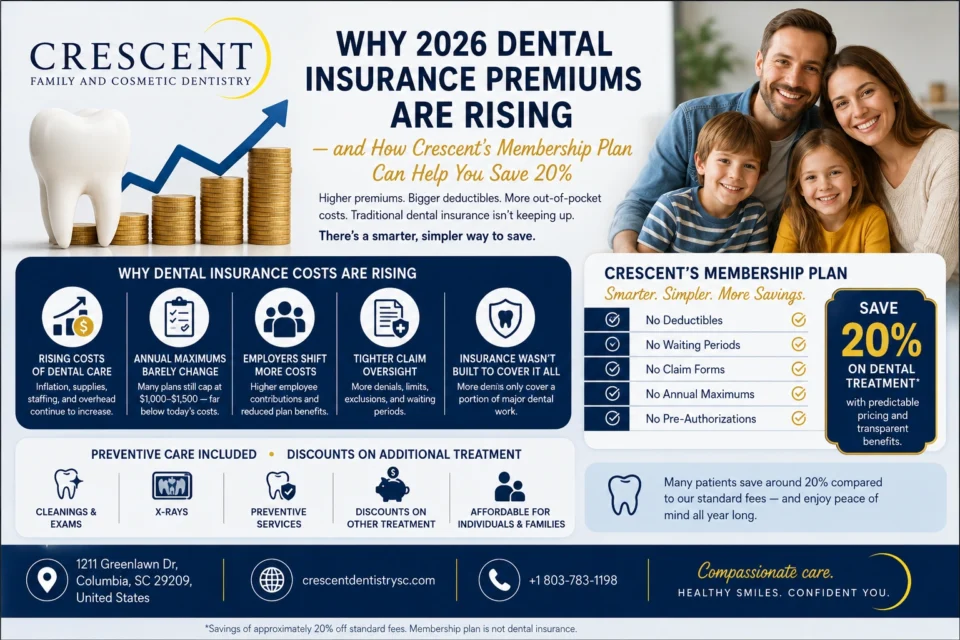
Why 2026 Dental Insurance Premiums Are Rising — and How Crescent’s Membership Plan Can Help You Save 20%
If your dental insurance premium increased for 2026, you are not imagining it. Across South Carolina and the rest of…
What should you schedule first after arriving in Sumter?
For most families, the best first appointment is not major treatment. It is a baseline exam.
A baseline exam helps answer:
- Does anyone have active decay?
- Are the kids due for sealants?
- Are wisdom teeth becoming a problem?
- Is gum disease present?
- Are old fillings or crowns failing?
- Does anyone need urgent treatment?
- Can routine care wait until school and work schedules settle?
- What will insurance likely cover?
Family dentistry is especially useful during relocation because one practice can coordinate care across children, teens, adults, and grandparents. Prior Crescent planning materials emphasize that consistency, whole-family scheduling, and unified records can make dental care less stressful for busy families.
That matters when your family calendar is already full.
The military family priority list: what can wait and what should not
Not every dental issue is an emergency. But some things should not be delayed until “after the move settles.”
Usually okay to schedule routinely
- Cleanings
- Dental exams
- Mild sensitivity that goes away quickly
- Small cosmetic chips with no pain
- Whitening consultations
- Nightguard replacement if there is no pain
- Routine sealant evaluation for children
Should be checked soon
- Toothache lasting more than a day
- Pain when biting
- Lost filling
- Loose crown
- Broken tooth
- Bleeding gums that do not improve
- Wisdom tooth soreness
- Child complaining of chewing pain
- A retainer that no longer fits
Should not wait
- Facial swelling
- Fever with dental pain
- Drainage or pus near a tooth
- Trouble swallowing or breathing
- Knocked-out permanent tooth
- Severe trauma to the mouth
- Rapidly worsening pain
- Swelling around a wisdom tooth with difficulty opening
If there is swelling, spreading infection, or trouble breathing or swallowing, seek urgent medical care. A hospital may not fix the tooth itself, but spreading infection is not something to “watch.”
How TRICARE Dental costs can surprise relocating families
The biggest misunderstanding is the word covered.
Covered does not always mean free.
With the TRICARE Dental Program, your out-of-pocket cost can depend on:
- Whether the dentist is in-network
- The procedure category
- Sponsor status and pay grade
- Deductibles or cost-shares
- Annual maximums
- Frequency limits
- Whether the service is excluded or limited
- Whether documentation is required
United Concordia’s TRICARE Dental site says families can use their account to find a network dentist, see claims history, manage account details, and access dental explanations of benefits.
Before approving major treatment, ask for an estimate that shows:
- The procedure code
- The expected insurance payment
- Your estimated patient portion
- Whether the dentist is in-network
- Whether the service is subject to a waiting period, limit, or annual maximum
- Whether there are alternatives
A good dental office should not make you feel difficult for asking.
You are not being cheap. You are trying to avoid surprise bills during a move.
What about children’s dental care after a PCS?
Kids often get lost in the shuffle during a move.
Not because parents do not care. Because there are too many moving parts.
For children, the first dental visit after relocation should focus on prevention and continuity:
- Are cleanings current?
- Are baby teeth falling out on schedule?
- Are adult teeth erupting properly?
- Are sealants needed on permanent molars?
- Is brushing effective?
- Are there diet or snacking changes after the move?
- Are there orthodontic concerns?
- Did the child lose or outgrow a retainer?
If your child is nervous, tell the dental office before the visit. A child who had a bad experience at the last duty station may need a slower introduction.
The goal is not to “get everything done” in one visit. The goal is to rebuild trust and routine.
Orthodontics, retainers, and aligners: do not let these slide
This is one of the easiest relocation problems to miss.
If your child or teen had braces, Invisalign, SureSmile, or retainers before the move, do not wait months to reconnect care.
Call a local dentist or orthodontic provider if:
- A retainer no longer fits
- Aligners were lost during the move
- A wire is poking
- A bracket is loose
- Teeth appear to be shifting
- You were told to schedule a follow-up soon after moving
Teeth can shift faster than families expect, especially if retainers are packed away or forgotten during the move.
Adults: watch for the “I’ll deal with it later” problems
Adults are usually the last people in the family to schedule themselves.
That is understandable. But it can become expensive.
Adults relocating to Shaw AFB or the Midlands should not ignore:
- Bleeding gums
- Loose teeth
- Old crowns
- Cracked fillings
- Tooth sensitivity
- Jaw clenching
- Headaches on waking
- Missing teeth
- Unfinished root canals
- Denture sore spots
- Implant maintenance
A routine exam is often cheaper and less stressful than emergency treatment. Earlier Crescent content notes that regular dental visits help catch decay, gum inflammation, and other issues before they become more complex.
That is especially true during relocation, when small problems can go unchecked for months.
If you had treatment planned before the move
Bring the treatment plan, but do not assume the new dentist will automatically agree with it.
That is not disrespectful to the previous dentist. It is responsible.
Dentists may differ in how they interpret risk, timing, materials, and treatment sequence. Also, your mouth may have changed since the plan was created.
Ask the new dentist:
- Do you agree with the previous diagnosis?
- Is this urgent?
- Are there less invasive options?
- What happens if I wait three to six months?
- Is this treatment still appropriate?
- Will insurance handle this differently now that we moved?
- Can treatment be phased?
If a treatment plan was made at another duty station, a second look in Sumter or Columbia can help you make a more confident decision.
How to choose a dentist after relocating to Shaw AFB
Do not choose only by distance.
Convenience matters, but it is not the whole decision.
For military families, a good dental office should be able to handle:
- Family scheduling
- Children and adults
- Emergency visits
- Preventive care
- Crowns, fillings, root canals, or referrals when needed
- Cosmetic questions without pushing veneers
- Insurance estimates
- Records transfers
- Clear explanations
- Treatment prioritization
Ask these questions before scheduling:
- Do you see both adults and children?
- Do you work with TRICARE Dental or United Concordia?
- Are you in-network or out-of-network?
- Can you help estimate my out-of-pocket cost?
- Can you schedule multiple family members together?
- How do you handle dental emergencies?
- Do you offer treatment plans in phases?
- Will you request records from our last dentist?
A military family does not need a dental office that makes everything feel more complicated. You need a steady local partner.
The first 30 days after arriving near Shaw AFB
Here is a realistic dental relocation checklist.
Week 1: Get your information straight
- Confirm your family’s DEERS information is current.
- Update your address with United Concordia if enrolled in TRICARE Dental.
- Locate your TRICARE Dental account information.
- Gather dental records from your previous office.
TRICARE’s moving checklist also reminds families to keep information updated when moving and specifically directs TRICARE Dental Program enrollees to contact United Concordia to update contact information.
Week 2: Choose your dental office
- Search for a network dentist if using TRICARE Dental.
- Call the office directly to confirm participation.
- Ask about family scheduling and emergency availability.
- Send records before the appointment if possible.
Week 3–4: Schedule baseline care
- Book exams and cleanings.
- Prioritize anyone with pain, broken teeth, gum bleeding, or unfinished treatment.
- Ask for a written plan if treatment is recommended.
- Avoid starting major non-urgent work until you understand costs and options.
The “PCS dental kit” every family should keep accessible
Do not pack these deep in a moving box:
- Toothbrushes and fluoride toothpaste
- Floss or floss picks
- Retainers, aligners, or nightguards
- Denture case or implant cleaning tools
- Dental insurance cards or login information
- Recent dental records
- Orthodontic wax
- Over-the-counter pain reliever, if safe for your family
- Temporary dental cement for a loose crown, used only as a short-term measure
- Contact information for your previous dentist
A little preparation can prevent a small issue from turning into a weekend emergency.
The honest bottom line
Relocating to Shaw AFB is already enough work. Dental care should not become a crisis because records were missing, TRICARE Dental information was outdated, or a minor problem waited too long.
For most military families, the smartest move is simple:
Update your dental benefits, find a local dentist early, transfer records, schedule baseline exams, and ask for clear estimates before treatment.
If you are settling into Shaw AFB, Sumter, Columbia, or the surrounding Midlands, Crescent Family & Cosmetic Dentistry can help your family understand what is urgent, what can wait, and how to keep dental care organized during the transition.
A good relocation dental visit should leave you with clarity, not pressure.
FAQs
Does Shaw AFB dental clinic see family members?
Shaw AFB’s dental clinic page describes services for active duty service members. Family members typically use civilian dental care through the TRICARE Dental Program if enrolled.
Who administers the TRICARE Dental Program?
The TRICARE Dental Program is administered by United Concordia.
What should I do with TRICARE Dental when I move?
TRICARE says enrolled families should call United Concordia to update records and find a new dentist after moving.
Do I need to transfer dental records?
Yes, especially if anyone has recent X-rays, gum disease history, orthodontic treatment, crowns, implants, root canals, wisdom tooth concerns, or unfinished treatment.
Should my family schedule dental visits before or after the move?
Ideally, handle known urgent issues before the move. After arriving, schedule baseline exams early so you know what can wait and what should not.
Is dental coverage included with regular TRICARE medical coverage?
No. TRICARE states that dental coverage is separate from TRICARE medical coverage.
Your Military Move Shouldn’t Disrupt Dental Care
From TRICARE dental tips to finding new providers fast, this guide helps military families relocate with confidence and peace of mind.