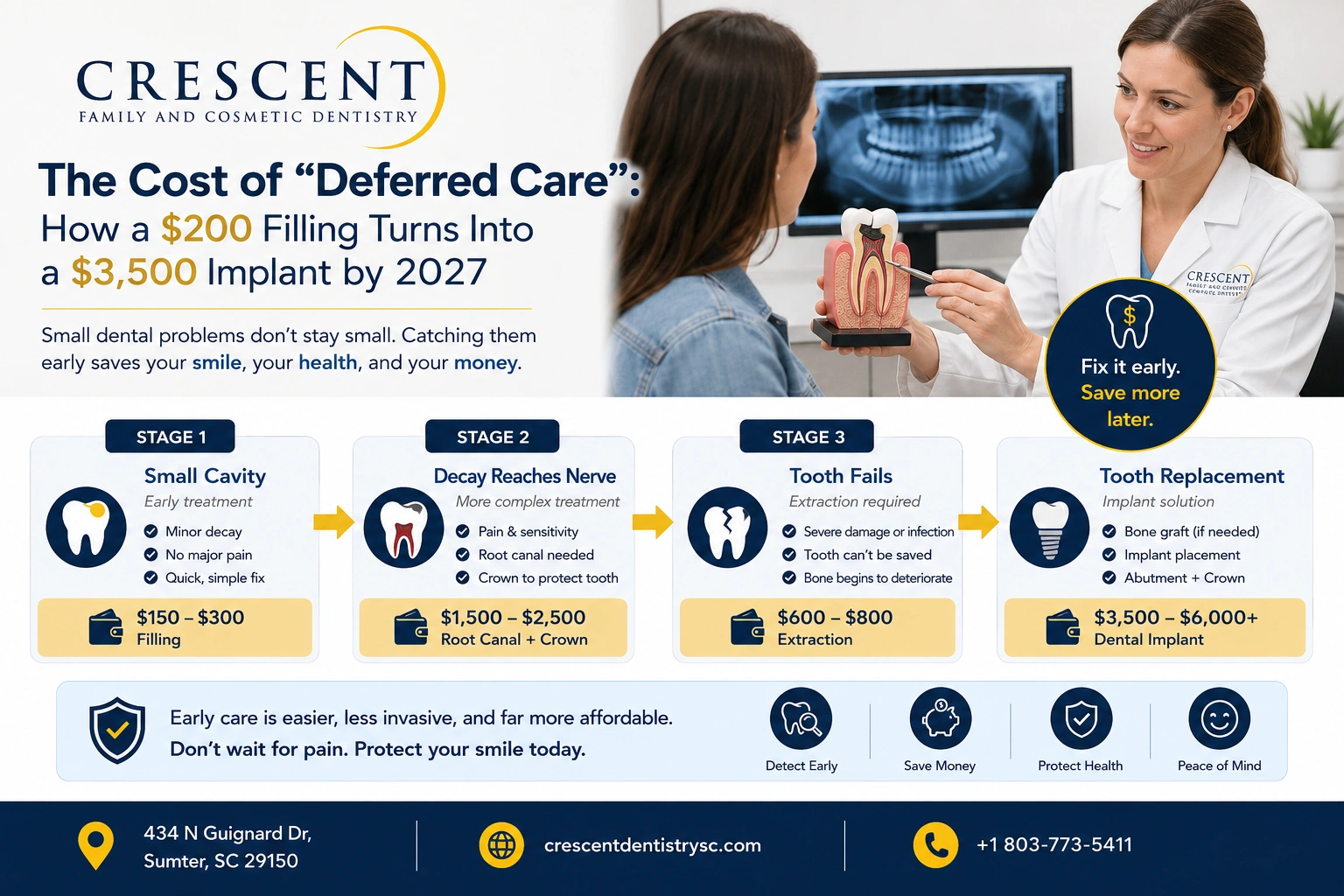
The Cost of “Deferred Care”: How a $200 Filling Turns Into a $3,500 Implant by 2027
A lot of expensive dental problems do not start as expensive dental problems.
They start as small things people postpone.
A little sensitivity while drinking cold water.
A cavity that “isn’t hurting yet.”
A cracked filling.
Bleeding gums during brushing.
A tooth that occasionally bothers you when chewing.
Then life gets busy. Work happens. Insurance resets. Kids need things. The pain goes away for a while.
And suddenly the problem that could have been handled with a simple filling now requires a root canal, crown, extraction, bone graft, and eventually a dental implant.
Don’t Let a Small Cavity Become a Big Expense
Treat decay early and protect your tooth before a simple filling turns into costly dental work. Call today to schedule your visit.
This happens every day.
Not because patients are irresponsible.
Usually because they are trying to save money.
Ironically, delaying treatment is often what makes dentistry dramatically more expensive.
At Crescent Family & Cosmetic Dentistry in Sumter and Columbia, we regularly help patients understand the true cost of deferred dental care — financially, physically, and emotionally.
And in many cases, the cheapest dentistry is the dentistry you handle early.
The Short Answer: Delaying Small Dental Problems Usually Makes Them Bigger and More Expensive
Here is the basic progression dentists see all the time:
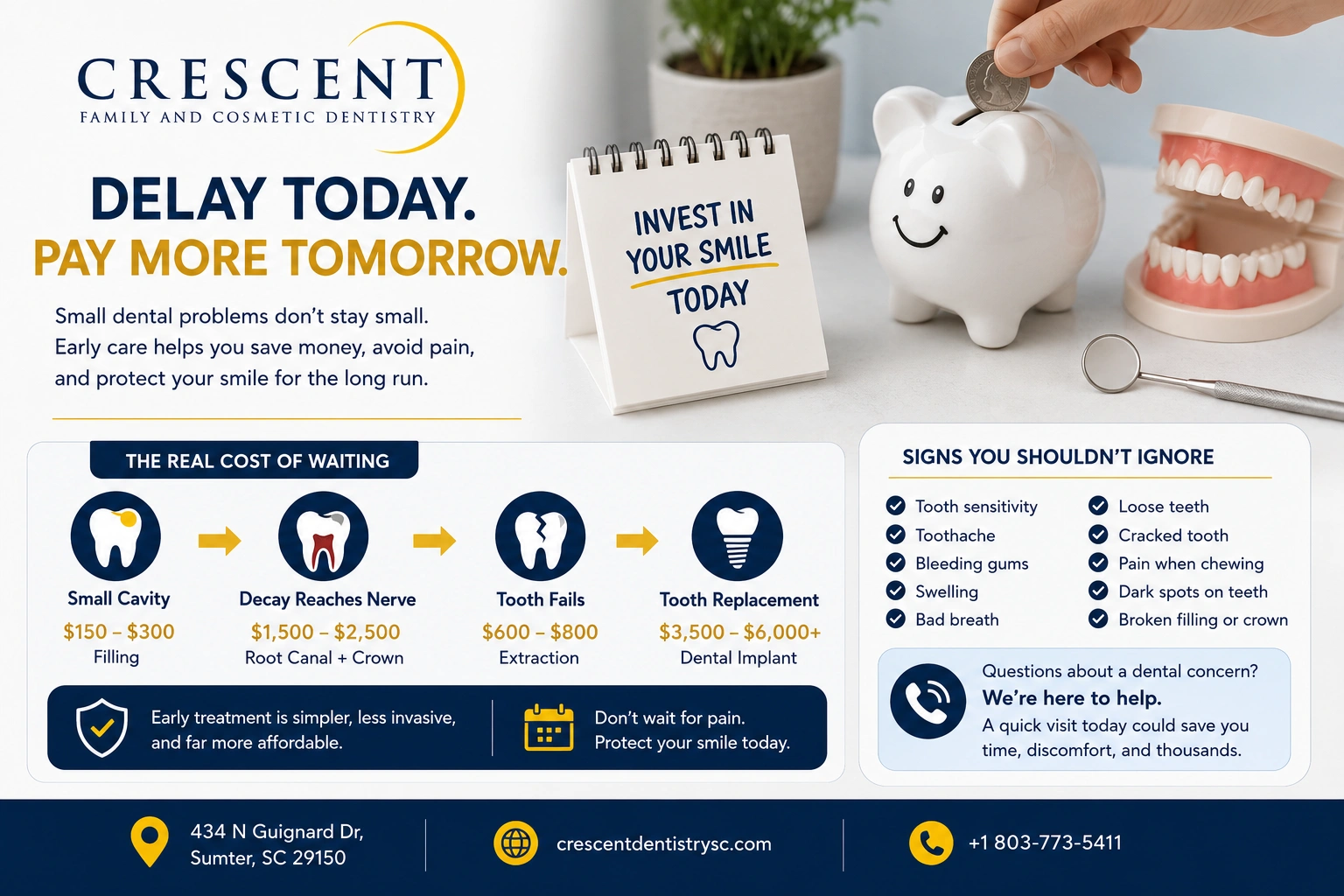
| Dental Problem | Early Cost | Delayed Cost |
| Small cavity | $150–$300 filling | $1,500–$2,500 root canal + crown |
| Cracked filling | Minor repair | Tooth fracture + extraction |
| Mild gum disease | Deep cleaning | Tooth loss + implants |
| Broken tooth | Bonding or crown | Implant or bridge |
| Missing tooth | Single replacement | Bone loss + multiple restorations |
A filling is usually one of the least expensive restorative procedures in dentistry.
An implant is often one of the most expensive.
The difference between those two outcomes is often time.
Most Cavities Do Not Hurt Right Away
This is one of the biggest misconceptions patients have.
People assume:
“If it doesn’t hurt, it probably isn’t serious.”
That is not how cavities work.
Tooth decay often progresses silently for months or years before becoming painful.
By the time pain appears, the cavity may already be close to the nerve.
That changes everything.
A small cavity confined to enamel may only require a filling.
Once bacteria reach the inner pulp of the tooth, treatment may require:
- root canal therapy
- a crown
- possible buildup procedures
- eventual extraction if the tooth cannot be saved
And the costs rise quickly.
How a $200 Filling Turns Into a Multi-Thousand-Dollar Problem
Let’s walk through a very common scenario.
Stage 1: Small Cavity ($200 Filling)
A patient notices mild sensitivity to sweets or cold drinks.
The decay is small.
At this stage, treatment is relatively simple:
- remove the decay
- place a tooth-colored filling
- preserve most of the natural tooth
This is usually quick, conservative, and affordable.
Most patients recover immediately.
No major interruption to life.
Stage 2: Larger Decay Reaches the Nerve ($2,000+ Root Canal and Crown)
The cavity is ignored for a year or two.
Now the decay reaches deeper layers of the tooth.
Pain becomes more noticeable.
Possible symptoms include:
- lingering sensitivity
- pain while chewing
- spontaneous toothaches
- swelling
- temperature sensitivity
At this point, a filling may no longer be enough.
The tooth may now require:
- root canal therapy
- buildup
- full dental crown
Costs rise substantially because the procedure becomes more complex.
And importantly, more natural tooth structure has now been permanently lost.
Stage 3: Tooth Fracture or Infection ($3,500+ Implant)
Eventually, some teeth become structurally unsalvageable.
This can happen because:
- decay weakens the tooth
- large fillings crack
- infection spreads
- the tooth fractures below the gumline
Now the tooth may need extraction.
And once a tooth is removed, replacement options become much more expensive.
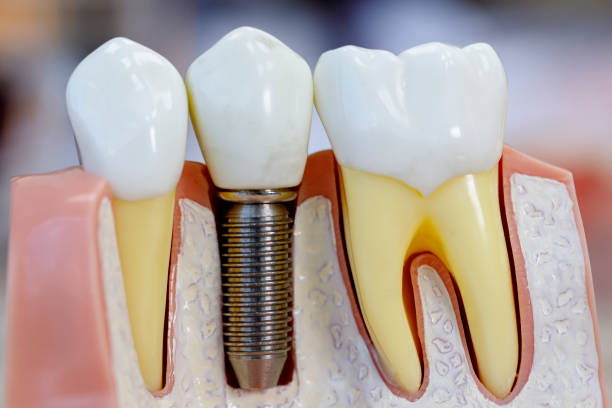
A single dental implant may involve:
- extraction
- bone grafting
- implant placement
- healing time
- implant crown
By 2027, in many markets, complete implant treatment can easily reach $3,500 to $6,000 or more depending on complexity.
And unlike a filling, implant treatment often takes several months.
Inflation Is Making Deferred Dental Care Even More Expensive
This part matters.
Dental costs are rising nationally due to:
- staffing shortages
- increased lab costs
- material costs
- technology expenses
- inflation
- insurance limitations
That means delaying treatment is becoming even riskier financially.
A crown that costs one amount today may cost more in two years.
An implant delayed until 2027 may cost significantly more than replacing the problem earlier.
This is especially important because many dental insurance annual maximums have barely changed in decades.
So patients often absorb most of the cost increases themselves.
Gum Disease Creates the Same Problem
Deferred care is not just about cavities.
Gum disease follows a similar pattern.
Early Gum Disease
Early gingivitis may cause:
- bleeding gums
- mild inflammation
- bad breath
- tenderness
At this stage, treatment is often manageable with:
- improved home care
- professional cleanings
- routine monitoring
Moderate Periodontal Disease
When gum disease progresses, the infection begins damaging bone and supporting tissues.
Now patients may need:
- scaling and root planing
- periodontal maintenance
- localized antibiotics
Costs increase.
But more importantly, bone loss begins.
Advanced Tooth Loss
Untreated periodontal disease remains one of the leading causes of adult tooth loss.
Once teeth become loose or infected beyond repair, replacement options may include:
- dentures
- bridges
- implants
- grafting procedures
Again, the cheapest treatment was usually the earlier treatment.
“I Was Trying to Save Money” Is Something Dentists Hear Constantly
Most patients who delay care are not neglectful.
They are trying to manage finances responsibly.
That is understandable.
Dental anxiety, insurance confusion, busy schedules, and fear of large treatment plans all contribute to postponement.
But here is the difficult reality:
Small dental problems rarely stay small indefinitely.
Especially decay and gum disease.
Dentistry is often less expensive when it is preventive and conservative.
It becomes more expensive when it becomes reconstructive.
The Internet Sometimes Encourages Dangerous Delay
This is another growing problem.
People search online hoping to avoid treatment.
And unfortunately, there is a lot of bad dental advice online.
Examples include:
- “You can heal cavities naturally.”
- “Oil pulling reverses decay.”
- “If the pain stops, the tooth healed.”
- “You only need treatment if it hurts.”

Why Dental Implants are Becoming the New ‘Second Chance’ Teeth
There’s something undeniably powerful about a smile. It’s often the first thing people notice about you—a sign of warmth, confidence,…
Some of this advice is simply inaccurate.
For example:
A tooth nerve dying can temporarily reduce pain.
That does not mean the infection disappeared.
In some cases, the infection is actually worsening silently.
Most dentists would rather place a small filling than extract a tooth later.
Conservative dentistry is usually better for everyone.
One of the Most Expensive Words in Dentistry Is “Eventually”
Patients often say:
“I know I’ll probably need to do something eventually.”
The problem is that “eventually” tends to increase both cost and complexity.
For example:
- a cracked tooth may eventually split
- mild gum disease may eventually loosen teeth
- untreated cavities may eventually infect the nerve
- missing teeth may eventually lead to shifting or bite problems
The longer problems remain untreated, the fewer conservative options may remain available.
Dental Implants Are Excellent — But Saving Natural Teeth Is Usually Better
This is important.
Dental implants are a fantastic modern treatment.
For many patients, implants restore function and confidence very successfully.
But most dentists would still rather help patients keep healthy natural teeth whenever possible.
Why?
Because implants still involve:
- surgery
- healing time
- cost
- maintenance
- possible complications
Natural teeth are biologically complex and difficult to perfectly replicate.
A small filling preserving a healthy tooth is often preferable to replacing a lost tooth years later.
What Dental Problems Should Never Be Ignored?
Some issues deserve prompt evaluation even if the pain seems manageable.
These include:
- swelling
- tooth fractures
- lingering tooth sensitivity
- bleeding gums
- loose teeth
- pus or bad taste
- pain while chewing
- recurring toothaches
- darkening teeth
- broken fillings or crowns
Not every issue becomes an emergency overnight.
But waiting too long often reduces treatment options.
Preventive Dentistry Usually Costs Less Than Restorative Dentistry
This may sound obvious, but it matters.
Routine preventive care is typically far less expensive than rebuilding damaged teeth later.
That includes:
- regular exams
- cleanings
- x-rays
- early fillings
- gum disease monitoring
Preventive dentistry is not about selling treatment.
It is about catching problems before they become financially and physically overwhelming.
And honestly, most patients prefer small appointments over major reconstruction.
Insurance Does Not Always Protect Patients From Deferred Care Costs
This surprises many people.
Dental insurance often helps with preventive services.
But major restorative procedures may still involve significant out-of-pocket costs.
Especially when patients exceed annual maximums.
For example:
A plan may partially cover:
- fillings
- exams
- cleanings
But only partially cover:
- crowns
- root canals
- implants
Or not cover implants at all.
That means delaying treatment can sometimes create costs insurance still does not meaningfully offset.
The Emotional Cost of Deferred Dental Care Is Real Too
This part gets overlooked.
Patients dealing with advanced dental problems often experience:
- embarrassment
- anxiety
- sleep disruption
- eating difficulty
- self-consciousness
- chronic discomfort
Many also feel regret.
Not because they intentionally ignored problems.
But because they wish they had addressed issues earlier when treatment was simpler.
Good dental offices understand this.
The goal is not to shame patients.
The goal is to help them move forward practically.
What If You Already Delayed Treatment?
Then the next best time to deal with it is now.
Seriously.
Patients sometimes avoid the dentist because they are worried about hearing bad news.
But delaying longer rarely improves the situation.
A good dental office should help you understand:
- what is urgent
- what can wait
- what options exist
- what treatment costs
- what financing or phased treatment may be possible
Not every problem requires immediate full-mouth reconstruction.
Sometimes dentistry can be prioritized strategically.
The important thing is understanding the situation clearly.
The Bottom Line: Small Problems Are Usually the Cheapest Problems
A $200 filling does not always become a $3,500 implant.
But it happens more often than most people realize.
Dental problems usually become more expensive as they become more advanced.
That is why preventive care and early treatment matter financially just as much as medically.
At Crescent Family & Cosmetic Dentistry, the focus is not just fixing teeth.
It is helping patients in Sumter and Columbia understand their options early enough to preserve healthier, simpler, and more affordable outcomes whenever possible.
If you are unsure whether a dental issue can wait, getting an evaluation early is usually far less risky — and far less expensive — than hoping the problem disappears on its own.
FAQs About Delaying Dental Treatment
Can a cavity really turn into an implant situation?
Yes.
Untreated cavities can progress into infections, fractures, or severe structural damage that eventually require extraction and replacement.
Is it always cheaper to fix teeth early?
Usually, yes.
Early treatment is generally simpler, less invasive, and less expensive than advanced restorative treatment.
What if I cannot afford all recommended treatment at once?
Many dental offices can help prioritize urgent treatment first and phase care over time.
Are dental implants worth the cost?
For many patients, yes.
Implants can restore function and appearance very effectively.
But preserving natural teeth when possible is usually preferable.
Can a tooth infection go away on its own?
No.
Symptoms may temporarily improve, but the underlying infection usually remains and can worsen over time.
What is the most important preventive dental habit?
Regular exams and cleanings combined with good home care remain the best way to catch problems early before they become expensive.
Waiting Could Cost More Than You Think
A minor dental problem today can become a major treatment later. Schedule your appointment now and protect your smile.