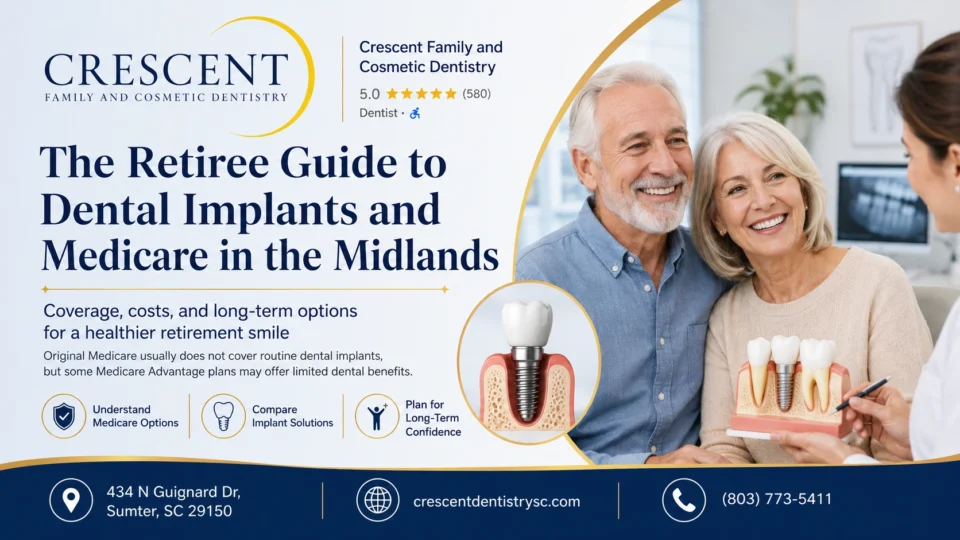
Dental Implants vs. Bridges: Which Is the “Forever” Fix for Sumter Veterans?
A lot of veterans ask this question after losing a tooth:
“Should I get a dental implant or a bridge if I want this fixed for good?”
Here is the honest answer.
A dental implant is usually the closest thing to a long-term, independent tooth replacement. But it is not always the best choice for every veteran. A dental bridge can be faster, less surgical, and sometimes more practical—especially if the teeth next to the missing tooth already need crowns.
The mistake is thinking one option is automatically “forever.”
Neither one is maintenance-free. Both can fail. Both need good home care. Both depend on your bone, gums, bite, health history, and budget.
For veterans in Sumter, Shaw AFB-area communities, and Columbia, the right answer usually comes down to four questions:
- Are the teeth beside the space healthy?
- Do you have enough bone for an implant?
- Do you want surgery or do you need a faster solution?
- What will VA benefits, VADIP, private insurance, or out-of-pocket cost actually cover?
Crescent Family & Cosmetic Dentistry helps patients in Sumter and Columbia, SC compare options without assuming the most expensive treatment is automatically the best one.
Tired of Temporary Fixes for Missing Teeth?
Get trusted guidance from veteran-friendly dental experts. Find out which option lasts longer, feels more natural, and protects your long-term oral health.
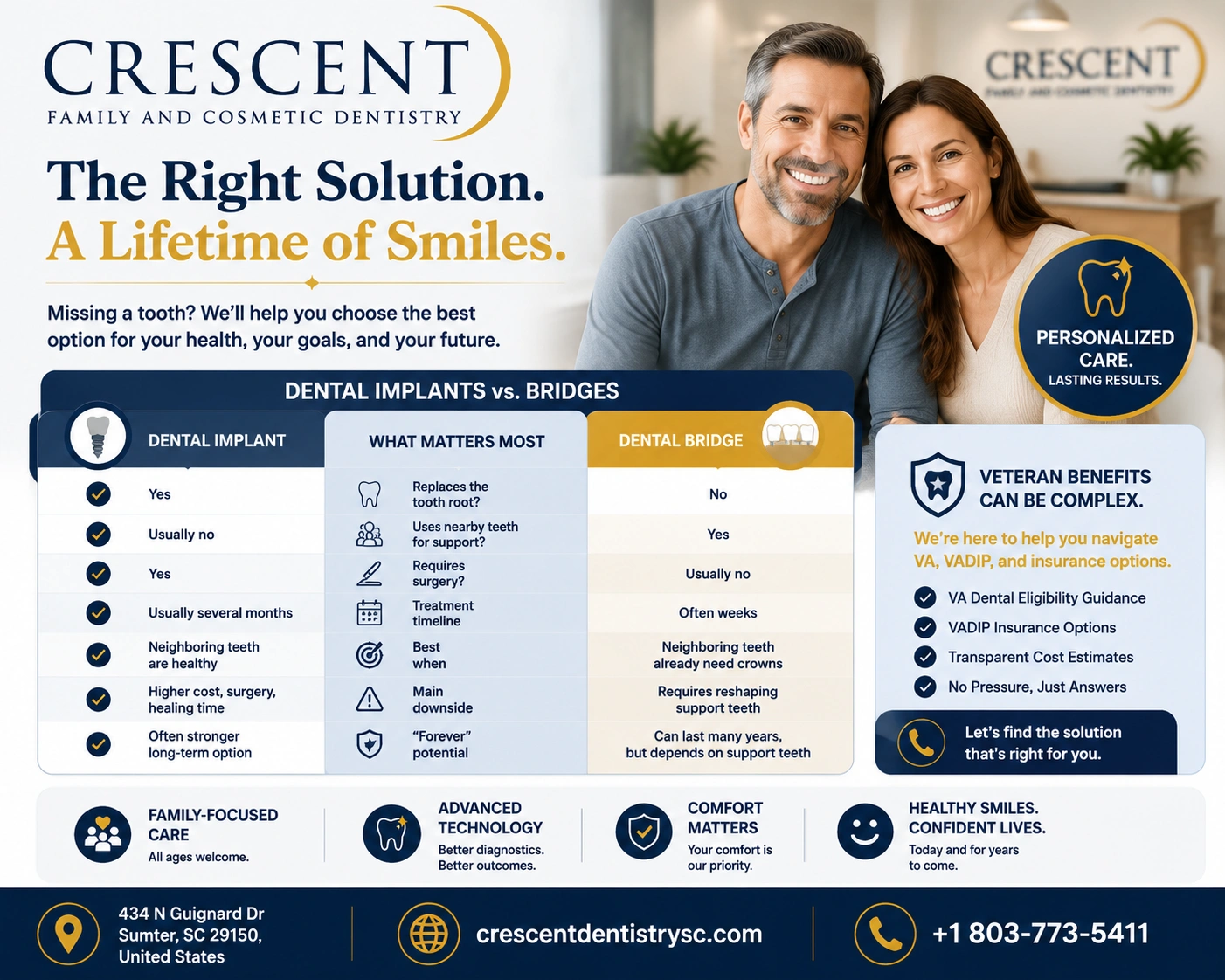
The direct comparison
| Question | Dental implant | Dental bridge |
| Replaces the tooth root? | Yes | No |
| Uses nearby teeth for support? | Usually no | Yes |
| Requires surgery? | Yes | Usually no |
| Treatment timeline | Usually several months | Often weeks |
| Best when | Neighboring teeth are healthy | Neighboring teeth already need crowns |
| Main downside | Higher cost, surgery, healing time | Requires reshaping support teeth |
| “Forever” potential | Often stronger long-term option | Can last many years, but depends on support teeth |
The American Dental Association describes implants as a long-term option for replacing missing teeth, especially for patients who do not want healthy tooth structure removed to make a bridge.
That last part matters.
A bridge may be a good fix, but it usually means the teeth on both sides of the missing tooth must be prepared for crowns. If those teeth are healthy, that is a real tradeoff.
What is a dental implant?
A dental implant is a small post placed in the jawbone to act like an artificial tooth root. After healing, a connector called an abutment and a crown are attached to complete the replacement tooth.
For one missing tooth, the implant usually stands on its own. It does not need to be connected to the teeth beside it.
That is the big advantage.
A dental implant may make sense if:
- The neighboring teeth are healthy
- You have enough bone to support the implant
- You want a fixed tooth replacement
- You are comfortable with surgery and healing time
- You want to avoid cutting down nearby teeth
- Your gums are healthy enough for implant treatment
Implants can be excellent, but they are not automatic. Veterans with uncontrolled gum disease, heavy smoking history, certain medical conditions, poor bone support, or severe grinding may need additional planning before an implant is recommended.
What is a dental bridge?
A traditional dental bridge fills a missing tooth space by attaching an artificial tooth to crowns on the neighboring teeth.
The ADA explains that fixed bridges are attached to surrounding teeth for support and can only be removed by a dentist. The success of a bridge depends heavily on the strength and health of the supporting teeth.
A bridge may make sense if:
- The teeth beside the missing tooth already need crowns
- You want to avoid implant surgery
- You need a faster replacement
- Bone grafting would make an implant too complex or expensive
- You are not a good implant candidate
- Your bite allows a bridge to function well
A bridge is not a “lesser” treatment when it is chosen for the right reason. In some mouths, it is the more practical option.

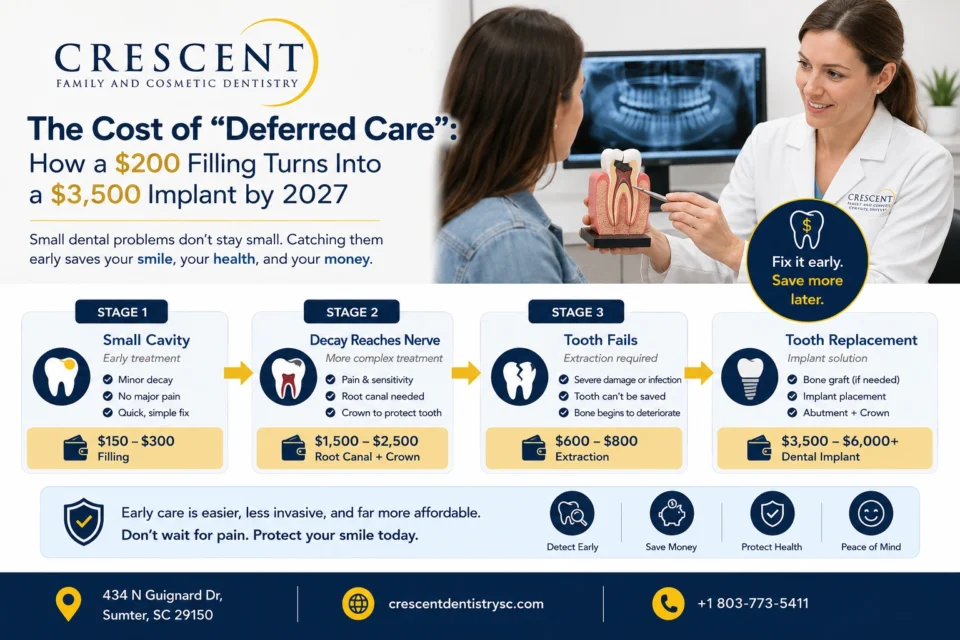
How Much Does a Dental Implant Cost in the Midlands in 2026?
A Local Price Guide for Sumter and Columbia, SC Most people asking about dental implant cost are not just price…
Which lasts longer: implant or bridge?
In many cases, a well-planned implant has the stronger long-term potential because it does not rely on nearby teeth for support.
But the key phrase is well-planned.
An implant can still develop problems around the gum and bone. The crown can chip. The screw can loosen. Heavy grinding can damage the restoration. Gum disease can threaten the implant.
A bridge can also last many years, but its weak point is often one of the support teeth. If decay forms under a bridge crown, or if one support tooth cracks, the whole bridge may fail.
So the “forever” answer is more realistic like this:
Implants are often the better long-term structure. Bridges are often the better short-term-to-medium-term solution when speed, cost, or neighboring tooth condition matters more.
The veteran-specific issue: dental benefits are not simple
This is where many Sumter veterans get surprised.
VA dental benefits are not the same as general VA medical benefits. The VA says eligibility depends on factors such as service history, current health, living situation, and assigned dental benefits class. Some veterans may qualify for some or all dental care through VA, while others may not.
The VA also states that veterans who do not qualify for VA dental care may be able to buy dental insurance through the VA Dental Insurance Program, known as VADIP.
That means a veteran may have VA health care but still not have broad VA dental coverage.
Before choosing between an implant and a bridge, ask:
- Do I qualify for VA dental care?
- What dental eligibility class applies to me?
- Is this tooth condition service-connected?
- Would VA authorize treatment through VA or community care?
- If I use VADIP, what is covered?
- What is my annual maximum?
- Are implants covered differently than bridges?
- What is my actual out-of-pocket estimate?
Do not assume “veteran” automatically means “the VA will pay for my implant.”
Cost: implants usually cost more upfront
For a single missing tooth, implants usually cost more upfront than a traditional bridge.
A single implant often involves:
- 3D imaging
- Possible extraction
- Possible bone graft
- Implant placement
- Healing time
- Abutment
- Implant crown
A bridge usually involves:
- Preparing the neighboring teeth
- Impressions or digital scans
- Temporary bridge
- Final bridge
The bridge may be faster and may have a lower initial cost. But if the neighboring teeth are healthy, you are paying with tooth structure, not just dollars.
That is why the cheapest option is not always the least expensive long term. Reviewing dental implant costs in the Midlands for 2026 can also help veterans understand the likely price range before comparing implants with bridges or other replacement options.
When an implant is usually the better choice
An implant is often the better choice when the missing tooth is between two healthy teeth.
Here is why: a traditional bridge would require reshaping those healthy teeth into crown supports. If those teeth do not already need crowns, that can feel like solving one problem by creating work on two other teeth.
An implant may also be better when:
- You want to protect neighboring teeth
- You are missing one tooth
- You have good bone and gum health
- You can tolerate a longer timeline
- You want a fixed replacement that functions independently
- You are willing to maintain it carefully
For many veterans, especially those replacing a single molar or premolar, this is the cleanest long-term plan.
When a bridge is usually the better choice
A bridge may be the better option when the teeth beside the space already need crowns.
In that case, the bridge can solve two problems at once: restoring damaged neighboring teeth and filling the missing tooth space.
A bridge may also be better when:
- You are not a candidate for implant surgery
- You do not have enough bone and do not want grafting
- You need the tooth replaced faster
- Your medical history makes implant healing less predictable
- Cost is the main barrier
- The missing tooth space is part of a larger bite problem
Most people do not need the most advanced option. They need the option that fits their mouth.
What if you are missing several teeth?
The comparison changes if you are missing more than one tooth.
For multiple missing teeth, options may include:
- Traditional bridge
- Implant-supported bridge
- Partial denture
- Implant-supported partial
- Full denture
- Implant-supported denture
- Fixed full-arch implant teeth
A traditional bridge is not always practical for a long span of missing teeth. The longer the bridge, the more stress goes on the support teeth.
Implants can sometimes reduce that stress by supporting a bridge without relying on natural teeth. But that also raises cost and planning complexity.
This is where a full-mouth treatment plan matters. Piecing together one tooth at a time may seem cheaper, but it can create a weaker long-term result.
The “forever fix” checklist
Before choosing an implant or bridge, ask your dentist these questions:
Questions about the missing tooth space
- How much bone do I have?
- Is bone grafting needed?
- Has the opposing tooth shifted?
- Are nearby teeth tipping into the space?
- Is there enough room for a proper replacement tooth?
Questions about the neighboring teeth
- Are the teeth beside the space healthy?
- Do they already need crowns?
- Do they have large fillings?
- Is there gum disease around them?
- Are they strong enough to support a bridge?
Questions about your bite
- Do I grind or clench?
- Will I need a nightguard?
- Is this a heavy chewing area?
- Will the implant or bridge be overloaded?
Questions about cost and benefits
- What does each option cost?
- What is included?
- What is not included?
- Will VA, VADIP, private insurance, or another plan help?
- What is my estimated out-of-pocket cost?
- What happens if I do nothing for six months?
A good treatment plan should answer these questions clearly.
What happens if you do nothing?
Sometimes the missing tooth does not hurt, so it feels optional.
But missing teeth can create slow problems.
The ADA notes that when teeth are missing, chewing and speech can become harder, teeth may shift or tilt into the open space, and the area around the mouth may lose support.
Not every missing tooth needs to be replaced immediately. But every missing tooth should be evaluated.
Waiting can lead to:
- Shifting teeth
- Bite changes
- Food trapping
- Bone loss
- More stress on remaining teeth
- Higher future treatment costs
- Fewer replacement options
If cost is the reason you are waiting, say that directly. A dentist should be able to discuss staged treatment, temporary options, or alternatives. Changes in bone support can also affect appearance over time, which is why understanding dental implants and facial structure can be useful when deciding whether to replace a missing tooth sooner rather than later.
The honest bottom line for Sumter veterans
If you want the option most likely to act like a stand-alone tooth replacement, a dental implant is usually the stronger “forever fix.”
But if the teeth next to the missing tooth already need crowns, if you want to avoid surgery, if you need a faster solution, or if your benefits make implant treatment unrealistic right now, a bridge can still be a smart, durable choice.
The best choice is not the one with the best marketing. It is the one that fits your mouth, your health, your timeline, and your actual out-of-pocket cost.
If you are a veteran in Sumter, Shaw AFB-area communities, Columbia, or the surrounding Midlands, Crescent Family & Cosmetic Dentistry can help you compare implants, bridges, partial dentures, and other tooth replacement options clearly before you commit to treatment.
FAQs
Are dental implants really permanent?
The implant post can last a long time, but the crown on top may need repair or replacement over the years. Implants also need healthy gums and regular maintenance.
Is a bridge cheaper than an implant?
Usually, yes upfront. But a bridge may involve reshaping nearby teeth, and future decay or fracture of a support tooth can make replacement more expensive later.
Will the VA pay for my dental implant?
Sometimes, but not for every veteran. VA dental eligibility depends on your benefit class, service connection, health situation, and other factors. VA dental benefits are separate from general VA medical benefits.
Can I get a bridge now and an implant later?
Sometimes. But a bridge can change the teeth and space around the missing tooth. Ask your dentist whether choosing a bridge now would make implant treatment harder later.
Which looks more natural?
Both can look natural when well-designed. Front-tooth cases need careful planning either way because gum shape, tooth color, and symmetry matter.
Which is better for a back molar?
Often an implant is preferred for a single missing molar if bone and health allow. A bridge may still be better if the neighboring teeth already need crowns or implant surgery is not a good fit.
Looking for a Permanent Tooth Replacement Solution?
Compare dental implants and bridges with experts who understand durability, function, and affordability — so you can make the right long-term choice.