Why Your Jaw Clicks on Your I-77 Commute: Stress and TMJ in the Midlands
You are halfway down I-77, traffic slows again, and suddenly you notice it:
Click.
Your jaw pops when you yawn. It clicks when you take a sip of coffee. Maybe your cheeks feel tired by the time you reach Columbia.
It is easy to blame stress.
And stress may be part of the problem—but a clicking jaw does not automatically mean something is wrong with your TMJ.
In fact, jaw clicking without pain or difficulty moving the jaw is common and usually does not require treatment. The National Institute of Dental and Craniofacial Research specifically notes that painless clicking and popping can be normal.
What matters is what comes with the click.
If you also have jaw soreness, headaches, limited movement, painful chewing, or a jaw that occasionally locks, it is worth having it evaluated.
Here is what Midlands drivers should know.
Stop the Clicking Before It Gets Worse
Jaw clicking on your commute may be a sign of TMJ stress. Call today to get evaluated and find the right treatment.
First: TMJ and TMD are not exactly the same thing
People often say, “I have TMJ.”
Technically, everyone has TMJs.
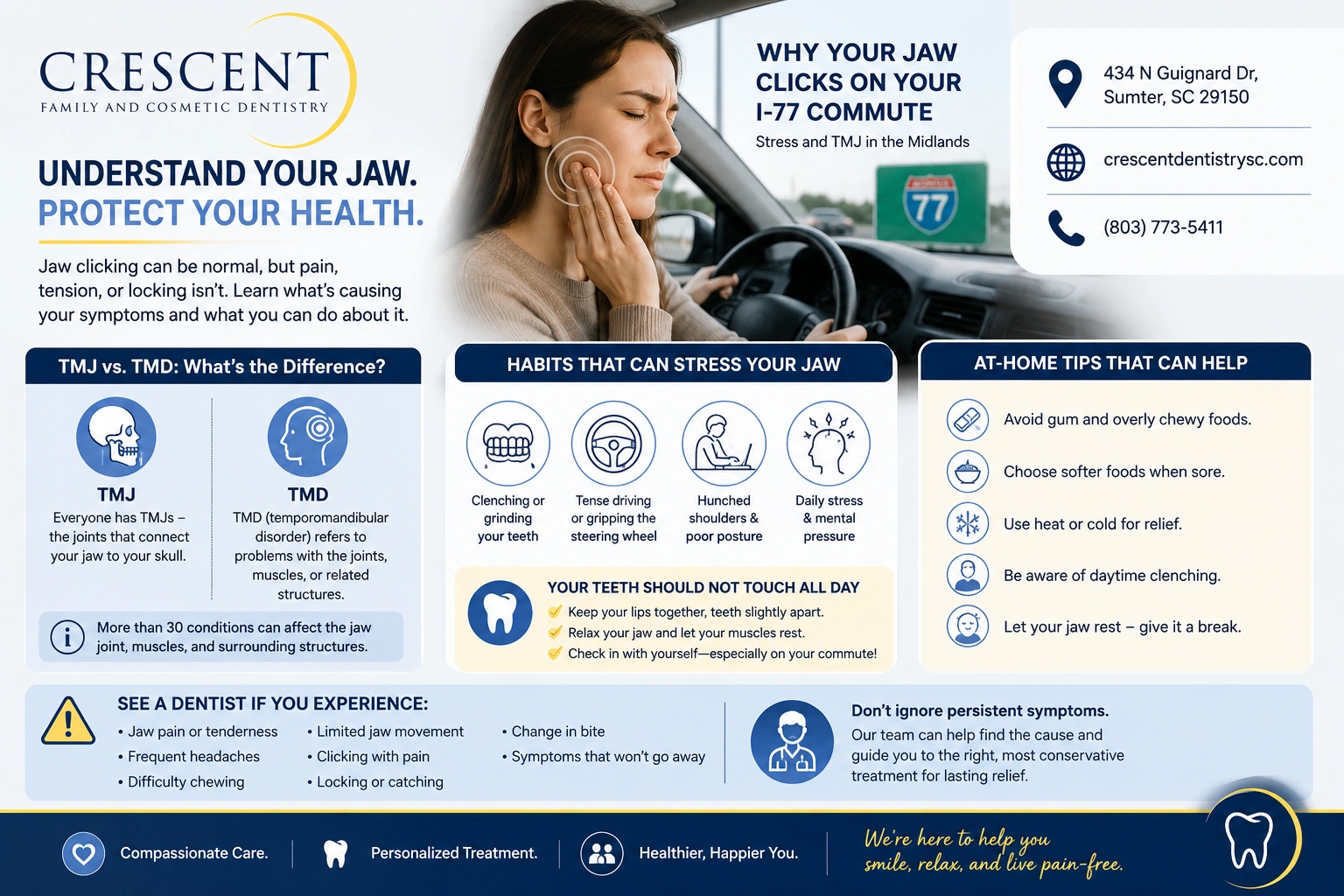
Your temporomandibular joints, or TMJs, are the two joints just in front of your ears that connect your lower jaw to your skull.
The better term for a problem involving those joints or the surrounding muscles is TMD, short for temporomandibular disorder.
TMD is not one single condition. The National Institute of Dental and Craniofacial Research describes more than 30 conditions involving the jaw joint, chewing muscles, or related structures.
That distinction matters because two people can both have a clicking jaw for completely different reasons.
Why does your jaw click?
Inside each jaw joint is a small cartilage disc that helps the joint move smoothly.
In some people, the movement of the joint and disc can produce a clicking or popping sound as the mouth opens and closes.
That sound alone is not necessarily a problem.
If your jaw clicks but does not hurt, lock, or limit how far you can open your mouth, you may not need treatment at all. Both NIDCR and Mayo Clinic advise that painless clicking without restricted movement generally does not require treatment.
The conversation changes when clicking is accompanied by symptoms such as:
- Pain around the jaw joint
- Tender or tired chewing muscles
- Pain while eating
- Headaches
- Facial or neck pain
- Difficulty opening your mouth
- A jaw that catches or locks
- A change in how your teeth seem to fit together
Those symptoms may justify a dental evaluation.
So what does your I-77 commute have to do with it?
Probably less than you think—and more than you realize.
Driving on I-77 does not cause TMD simply because the traffic is frustrating.
But think about what your face does when you are stressed.
You grip the steering wheel.
Your shoulders rise.
You concentrate on the car changing lanes in front of you.
And without realizing it, you may press your teeth together.
Do that repeatedly during the commute, through a stressful workday, and again while answering emails at night, and the muscles around the jaw can spend far more time working than they should.
Stress, jaw clenching, and teeth grinding are recognized factors that can contribute to or aggravate TMD symptoms. At the same time, researchers caution that the causes of TMD are complex and often cannot be traced to one single factor.
So the better explanation is:
Stress may not have created your clicking jaw, but clenching during stressful periods can make an already irritated jaw much more noticeable.
Your teeth are not supposed to touch all day
This surprises a lot of people.
When your jaw is relaxed, your upper and lower teeth generally should not be clenched together.
Your lips can be together while your teeth remain slightly apart.
Mayo Clinic recommends relaxed jaw posture as one conservative way to reduce TMD symptoms, along with becoming more aware of habits such as clenching and grinding.
Try checking yourself at the next red light.
Are your teeth touching?
Are you pressing your tongue hard against your teeth?
Are your shoulders tense?
Are you clenching the steering wheel and your jaw at the same time?
Simply noticing the habit can be useful.
A good reminder is:
Lips together. Teeth apart. Jaw relaxed.
You do not need to drive around dramatically holding your mouth open.
You are simply giving the jaw muscles a chance to rest.
Morning jaw pain may tell a different story
If your jaw hurts most when you first wake up, the commute may not be your biggest source of clenching.
You may be grinding or clenching your teeth while sleeping.
This is called sleep bruxism.
Signs that can sometimes accompany nighttime grinding include:
- Morning jaw soreness
- Tired facial muscles
- Headaches after waking
- Tooth wear
- Chipped teeth
- Sensitive teeth
- A partner hearing grinding sounds at night
Not everyone who grinds their teeth has all of these symptoms, and worn teeth alone do not prove that you are actively grinding today.
A dentist can look at the entire pattern rather than making the diagnosis from one clue.
Can stress really make TMJ symptoms worse?
It can.
But we would be cautious about telling someone that their TMD is “just stress.”
Research suggests that TMD can involve a combination of biological, psychological, behavioral, and life-stress factors. In many cases, the exact cause remains unclear.
That means telling a patient to simply “relax” is not much of a treatment plan.
Stress management may help if you clench more when you are under pressure.
But persistent jaw pain deserves a proper evaluation because other issues can also produce pain in the jaw, face, teeth, and surrounding muscles.
What can you try at home first?
If your symptoms are mild and you can open and close your mouth normally, conservative care is usually the right place to begin.
That is important because most people with mild jaw symptoms do not need aggressive TMJ treatment.
NIDCR recommends starting with simple, reversible approaches and cautions patients against treatments that permanently change the teeth, bite, or jaw unless there is a compelling reason.
You can start by reducing how much work you are asking your jaw to do.
For a week or two, consider:
Stop chewing gum.
If your jaw already feels tired, giving it an extra hour of chewing is not helping.
Notice daytime clenching.
Your commute, computer work, workouts, and stressful conversations are common moments to check your jaw position.
Choose easier foods temporarily.
You do not necessarily need to live on soup, but steak, bagels, chewy candy, and very hard foods can make a sore jaw work harder.
Avoid huge bites and excessive opening.
If your jaw hurts, this is probably not the week to test how large a sandwich you can bite into.
Try heat or cold.
Both NIDCR and Mayo Clinic include heat or cold among conservative options for jaw discomfort.
Give the joint a break.
Do not repeatedly open and close your mouth just to see whether it still clicks.
It probably will.
And repeatedly testing an irritated joint does not make it calmer.

The “Grey Tooth” Mystery: What to Do When an Old Injury Suddenly Changes Color
You look in the mirror one morning and notice something strange. One tooth looks darker than the others. Maybe it…
Should you buy a nightguard online?
Maybe—but this is where we would be careful.
A mouthguard may help certain patients with jaw pain or nighttime clenching, and dental splints are one of several conservative therapies used for some TMD cases.
But a nightguard is not a universal cure for clicking.
And the cheapest guard on the internet is not automatically the right appliance for your problem.
A poorly fitting appliance can be uncomfortable, interfere with sleep, or change how your teeth contact while you are wearing it.
Before spending hundreds of dollars on a custom appliance—or cycling through several over-the-counter versions—it makes sense to determine what problem you are actually trying to solve.
What about Botox for jaw clenching?
Botox gets a lot of attention online for “TMJ.”
That description is overly broad.
Botulinum toxin is sometimes injected into chewing muscles for certain patients with significant muscle-related symptoms or bruxism. Mayo Clinic notes that Botox may occasionally be used for pain related to TMJ disorders, but it is not the first or only treatment for every clicking jaw.
If your only symptom is a painless click, jumping immediately to injections would be difficult to justify.
Treatment should match the problem.
That principle matters more than whichever TMJ treatment happens to be trending on social media.
When should a clicking jaw actually concern you?
A click by itself is usually less concerning than a click plus dysfunction.
Schedule an evaluation if you develop:
- Persistent jaw pain
- Painful clicking or popping
- Difficulty chewing normally
- Frequent headaches associated with jaw soreness
- Increasing difficulty opening your mouth
- A jaw that locks open or closed
- Significant facial or joint tenderness
- A sudden change in your bite
- Symptoms that continue despite basic home care
Mayo Clinic recommends seeking care for persistent jaw pain or tenderness, or when you cannot fully open or close your jaw.
If your jaw becomes stuck open or closed, particularly if you cannot move it normally, do not spend the next several weeks waiting to see whether it fixes itself.
Call a dentist or appropriate healthcare professional.
Not every headache is a TMJ headache
This is another place where internet advice gets too confident.
TMD can be associated with headaches and pain involving the face, jaw, and neck.
But that does not mean every headache is being caused by your jaw.
The same is true of ear discomfort.
Because the TMJ sits close to the ear, jaw problems can sometimes feel like ear symptoms. But ear pain can also come from an ear problem.
A responsible evaluation looks at the pattern rather than blaming every symptom above your shoulders on “TMJ.”
Be cautious with anyone promising to permanently “fix your bite”
This deserves more attention than it gets.
If someone tells you that a clicking jaw means you immediately need extensive orthodontics, crowns, full-mouth reconstruction, irreversible bite adjustment, or jaw surgery, asking for another opinion is reasonable.
NIDCR specifically recommends avoiding treatments that cause permanent changes to the teeth, bite, or jaw as an initial approach because many TMD symptoms improve with conservative care and evidence for many irreversible treatments is limited.
That does not mean those treatments are never appropriate.
It means a clicking jaw alone is not enough reason to rebuild someone’s mouth.
The bottom line for Columbia and Midlands commuters
Your I-77 commute probably is not destroying your jaw.
But if traffic turns you into a steering-wheel-gripping, teeth-clenching version of yourself every morning and afternoon, that habit may be contributing to muscle tension and making jaw symptoms easier to notice.
Start with the simplest question:
Does it click, or does it hurt?
If it clicks occasionally without pain, locking, or restricted movement, you may simply need to keep an eye on it.
If you have pain, morning soreness, headaches, difficulty chewing, limited opening, or locking, it deserves a closer look.
At Crescent Family & Cosmetic Dentistry, Dr. Thad Vincent, Dr. Katherine Leblanc, Dr. Tina Vu-Heaton, Dr. James Goodson, and Dr. Adam Leblanc serve patients in Sumter, Columbia, and surrounding Midlands communities.
If your jaw has started making the commute uncomfortable, our team can evaluate your teeth, bite, jaw muscles, and joints and help determine whether you need treatment at all—and, if you do, what the most conservative reasonable next step looks like.
Because sometimes a clicking jaw needs treatment.
And sometimes it just needs you to stop clenching at Exit 9.
Frequently Asked Questions
Is it normal for my jaw to click?
It can be. Painless clicking or popping without limited jaw movement is common and generally does not require treatment.
Can stress cause TMJ problems?
Stress can contribute to behaviors such as jaw clenching or grinding and may be one factor associated with TMD symptoms. TMD is complex, however, and stress should not automatically be assumed to be the sole cause.
Why does my jaw hurt after driving?
Some people unconsciously clench their teeth when concentrating or feeling stressed. If you notice your teeth pressed together while driving, relaxing the jaw may help reduce muscle strain. Persistent pain should be evaluated rather than assumed to come from driving.
Should I wear a nightguard for TMJ?
Some people benefit from a dental splint or nightguard, particularly when clenching or grinding is part of the problem. But clicking alone does not automatically mean you need one. An evaluation can help determine whether an appliance makes sense for your symptoms.
Can TMJ cause headaches?
TMD can be associated with headaches, facial pain, and neck pain. But headaches have many possible causes, so recurring headaches should not automatically be diagnosed as a TMJ problem.
When should I see a dentist about jaw clicking?
Make an appointment if the clicking becomes painful, your jaw movement becomes limited, chewing hurts, the joint locks, or symptoms persist despite conservative measures.
Don’t Let Jaw Pain Ruin Your Drive
Clicking, tension, or soreness shouldn’t be part of your daily commute. Schedule your TMJ evaluation today.