
Medicaid Dental 2026: New SCDHHS Updates for Special Needs Patients
South Carolina Medicaid made important dental policy changes for 2026 that may affect patients with special healthcare needs, particularly those who require sedation to receive dental treatment safely and comfortably. Effective January 1, 2026, the South Carolina Department of Health and Human Services (SCDHHS) updated coverage for several general anesthesia and sedation services available through Healthy Connections Medicaid.
For patients, parents, and caregivers, understanding these changes can make it easier to discuss treatment options, coverage, and accommodations before an appointment. At Crescent Family and Cosmetic Dentistry, we believe patients and families should have clear information about the dental care options available to them.
What Changed With South Carolina Medicaid Dental Coverage in 2026?
SCDHHS announced its 2026 dental policy update in Medicaid Bulletin 25-042, published December 30, 2025. The changes became effective for dates of service beginning January 1, 2026.
The update was made partly to align South Carolina Medicaid policy with the American Dental Association’s 2026 Current Dental Terminology, commonly called CDT, code changes.
Most importantly for patients with special healthcare needs, SCDHHS updated procedure codes and added coverage for certain forms of general anesthesia, minimal sedation, and moderate sedation provided in a dental office. These services must be medically necessary and must be administered by a dental provider who holds the appropriate sedation permit.
The newly updated codes cover services including:
- General anesthesia involving an advanced airway
- Additional increments of general anesthesia
- In-office minimal sedation using a single enteral medication
- Moderate enteral sedation
- Moderate non-intravenous parenteral sedation
- Additional increments of qualifying moderate sedation
SCDHHS established specific limits for these procedures, including how many units can be provided on the same day and which sedation services can or cannot be billed together.
For families, the exact billing codes are usually less important than the broader change: South Carolina Medicaid now has updated pathways for covering several sedation techniques when a patient’s circumstances meet its requirements.
Why Are the 2026 Updates Important for Patients With Special Needs?
Dental treatment can present additional challenges for some people with intellectual, developmental, physical, behavioral, sensory, or other healthcare needs.
A patient may have difficulty tolerating the sounds, sensations, positioning, or duration of treatment. Others may experience significant anxiety or have trouble remaining still enough for a procedure to be completed safely.
Sedation is not necessary for every patient with a disability or special healthcare need. When it is medically appropriate, however, sedation may allow certain patients to receive dental treatment that would otherwise be very difficult to complete.
That makes the specific language in the 2026 SCDHHS update particularly relevant.
For Healthy Connections Medicaid members aged 21 or older who are not enrolled in the Intellectual Disability and Related Disabilities, or ID/RD, waiver, SCDHHS states that medically necessary in-office dental sedation administered by a properly permitted dental provider is allowed when the member has a special-needs diagnosis.
This does not mean that every sedation procedure will automatically be covered. Eligibility, medical necessity, the patient’s diagnosis, the type of dental treatment, provider qualifications, benefit limitations, and other Medicaid requirements can all affect coverage.
Who Qualifies Under the Updated SCDHHS Rules?
The rules differ depending on the patient’s age and Medicaid status.
Healthy Connections Medicaid Members Under Age 21
For full-benefit Healthy Connections Medicaid members through age 20, the sedation and anesthesia services identified in the 2026 update can be covered when they are provided by a dental professional with the appropriate sedation permit and Medicaid’s other requirements are met.
Children and young adults also receive dental benefits through Medicaid’s Early and Periodic Screening, Diagnostic and Treatment framework.
South Carolina’s dental periodicity schedule is based on recommendations from the American Academy of Pediatric Dentistry, and SCDHHS notes that medically necessary screenings may also be provided outside the standard periodic schedule when there is an indication of medical need.
Adults Enrolled in the ID/RD Waiver
Adults who are enrolled in South Carolina’s ID/RD waiver have a different dental benefit structure from adults receiving only standard Medicaid dental benefits.
SCDHHS states that the ID/RD waiver serves people with intellectual disabilities or related disabilities who meet the required institutional level-of-care criteria.
Under the January 2026 dental update, covered general anesthesia and sedation services can be reimbursed for ID/RD waiver members when administered by a dental provider who has the appropriate permit.
The broader dental manual also distinguishes ID/RD waiver members as a separate covered population.
Adults With a Special-Needs Diagnosis Who Are Not in the ID/RD Waiver
This is an especially important category to understand.
Not everyone with special healthcare needs is enrolled in the ID/RD waiver. In fact, SCDHHS specifically notes that the ID/RD waiver has limited capacity and does not include every Medicaid beneficiary who has special healthcare needs.
For adults aged 21 and older who are not enrolled in that waiver, the 2026 dental policy provides an additional route for medically necessary in-office sedation when the patient has a special-needs diagnosis and the service is administered by a dental provider with the appropriate sedation permit.
For adults without that qualification, SCDHHS states that medically necessary in-office dental sedation for Medicaid members aged 21 and older is otherwise allowed only for treatment by an oral surgeon under the conditions outlined in the policy.
These distinctions are one reason patients and caregivers should verify benefits before treatment rather than assuming that another Medicaid patient’s coverage will be identical to their own.
Does Having a Disability Automatically Mean Sedation Is Covered?
No. A disability or diagnosis alone does not mean that Medicaid will automatically cover dental sedation.
The SCDHHS policy specifically refers to medically necessary sedation. That means the patient’s individual circumstances and treatment needs matter.
A dental provider needs to determine what type of care can be provided safely and appropriately. Depending on the situation, alternatives may include routine treatment without sedation, behavioral accommodations, shorter appointments, minimal sedation, moderate sedation, referral to another dental provider, or treatment by an oral surgeon.
Coverage also depends on whether the patient has full Healthy Connections Medicaid benefits and whether the proposed service meets the applicable Medicaid criteria.
The SCDHHS dental manual states that only beneficiaries who are eligible for full Medicaid benefits and fall within covered beneficiary groups may receive medically necessary dental services. Providers are instructed to verify eligibility using the state’s dental administrator systems.
That is why confirming benefits before treatment remains important even after the 2026 coverage changes.
What Sedation Services Were Updated for 2026?
The SCDHHS bulletin lists six updated CDT procedure codes.
They include D9224 and D9225 for general anesthesia with an advanced airway, D9244 for in-office minimal enteral sedation, D9245 for moderate enteral sedation, and D9246 and D9247 for non-intravenous parenteral moderate sedation.
Each service has its own restrictions.
For example, SCDHHS limits the number of units that can be provided during one day and prohibits certain sedation codes from being used together during the same treatment encounter.
These details matter primarily to the dental provider handling the patient’s treatment plan and Medicaid claim, but patients and caregivers should understand that “sedation coverage” is not one broad benefit that applies identically to every procedure.
The type and duration of sedation must match the patient’s needs, the procedure being performed, and Medicaid’s coverage requirements.
What Is the Difference Between Minimal Sedation, Moderate Sedation, and General Anesthesia?
These terms describe different levels of sedation rather than different names for the same treatment.
Minimal Sedation
With minimal sedation, a patient remains responsive and generally maintains normal breathing and cardiovascular function.
It may be appropriate in certain situations where anxiety or difficulty tolerating treatment makes additional support helpful.
Moderate Sedation
Moderate sedation produces a deeper reduction in awareness. Patients can generally still respond purposefully to verbal instructions or light physical stimulation, but they require closer clinical monitoring.
SCDHHS’s 2026 update includes specific codes for both enteral and certain non-intravenous forms of moderate sedation.
General Anesthesia
General anesthesia involves a much deeper state in which the patient is not normally responsive during the procedure. It requires advanced monitoring, training, equipment, and appropriate clinical credentials.
The 2026 SCDHHS policy includes updated codes for general anesthesia involving an advanced airway.
Which approach is appropriate cannot be determined from a diagnosis alone. A dentist must consider the patient’s health history, dental procedure, ability to tolerate treatment, medications, level of cooperation, and other clinical factors.
How Can Families Prepare for a Dental Appointment?
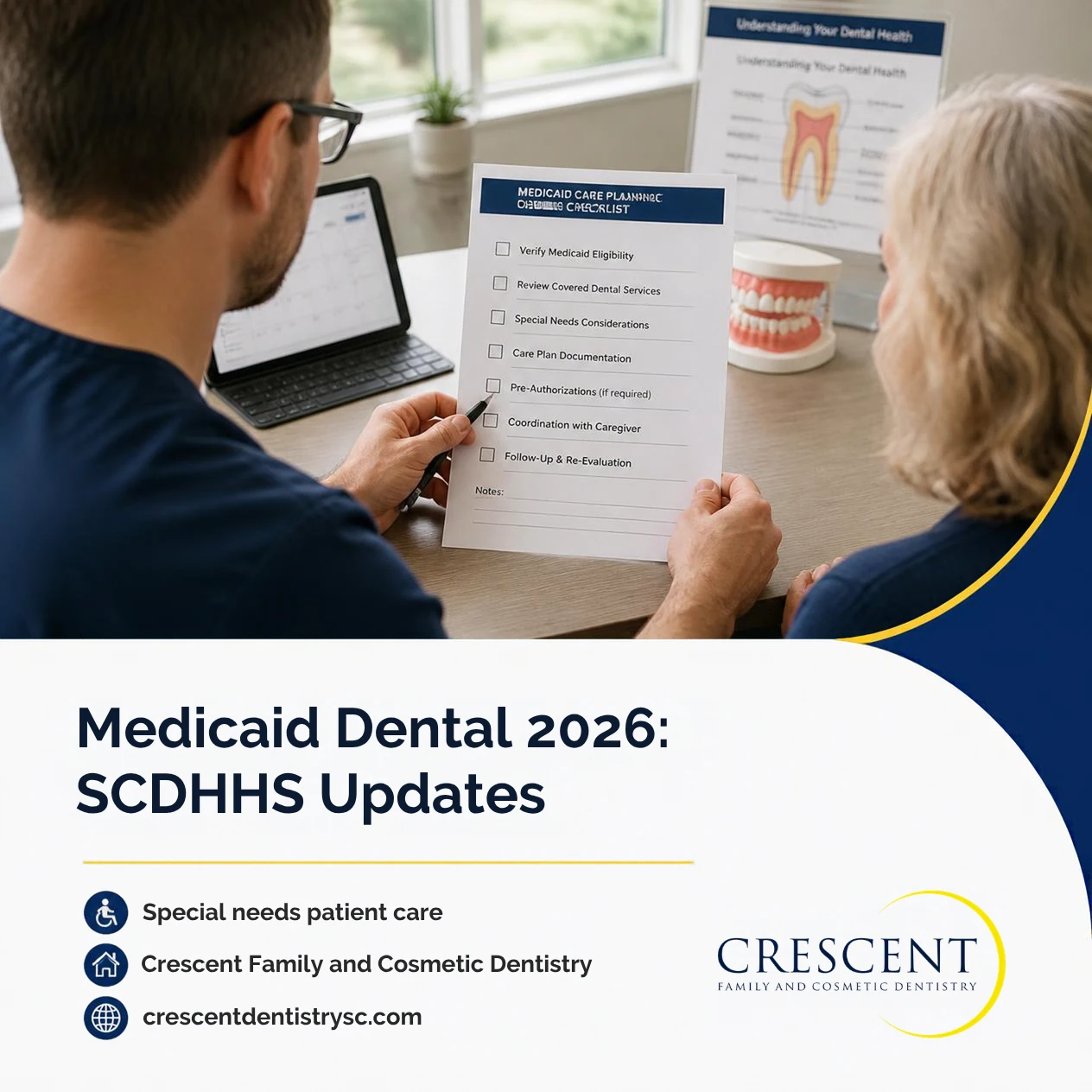
Good preparation can make a significant difference when arranging dental treatment for a child or adult with special healthcare needs.
Before the appointment, tell the dental office about relevant medical conditions and accommodations the patient may need.
Information worth discussing may include:
- Current medical diagnoses
- Prescription and over-the-counter medications
- Allergies
- Previous experiences with sedation or anesthesia
- Sensory sensitivities
- Communication needs
- Mobility requirements
- Difficulty remaining still
- Dental anxiety or fear
- Previous challenges completing dental procedures
- Medical specialists involved in the patient’s care
Caregivers can also explain what tends to make healthcare visits easier for the patient.
For example, some patients respond better when procedures are explained in advance. Others may benefit from reducing unnecessary sensory stimulation or allowing additional time to become familiar with the dental environment.
The objective is not simply to decide whether sedation is needed. It is to develop an approach that fits the individual patient.
Will Every Dentist Be Able to Provide Medicaid-Covered Sedation?
No.
SCDHHS specifically requires covered sedation and anesthesia services to be administered by dental professionals who hold the appropriate dental sedation permit from the relevant licensing authority.
Dental practices also vary in the level of sedation they provide.
At Crescent Family and Cosmetic Dentistry, available sedation options listed among our dental services include nitrous oxide, commonly known as laughing gas, and oral conscious sedation for appropriate patients who experience dental anxiety or require additional support during more complex treatment.
That does not mean every sedation technique listed in the SCDHHS Medicaid policy is necessarily provided at every Crescent location.
Patients should contact the office before scheduling to discuss their needs, the services available at that location, and whether a referral to another appropriately qualified provider may be necessary.
What Should Medicaid Patients Ask Before Scheduling Treatment?
Medicaid coverage can vary based on age, enrollment category, diagnosis, treatment, and authorization requirements.
Before a procedure, patients and caregivers may want to ask:
- Does this dental office participate with my specific Medicaid coverage?
- Is the proposed dental treatment covered?
- Is sedation medically appropriate for this patient?
- Is the recommended type of sedation covered?
- Does the dentist hold the permit required to provide that level of sedation?
- Does Medicaid require documentation or authorization before treatment?
- Are there frequency or procedure limitations?
- Will another provider or oral surgeon need to perform the treatment?
- Could any portion of the treatment be the patient’s financial responsibility?
Do not rely solely on another patient’s experience. Two people with Healthy Connections Medicaid may have different benefits depending on their age, enrollment category, waiver status, diagnosis, and requested treatment.
Are There Any Other South Carolina Medicaid Dental Changes for 2026?
Yes. The December 2025 SCDHHS bulletin also introduced coverage for two orthodontic services involving orthognathic surgery for full-benefit Medicaid members up to age 21.
The added codes are D8091 for comprehensive orthodontic treatment associated with orthognathic surgery and D8671 for certain periodic orthodontic treatment visits associated with orthognathic surgery.
Both require prior authorization and have specific frequency and treatment limitations.
These changes are separate from the special-needs sedation provisions, but they demonstrate why patients should check current Medicaid guidance rather than relying on information from previous years.
Why Regular Dental Care Remains Important for Patients With Special Healthcare Needs
The 2026 Medicaid changes primarily address specific sedation and anesthesia services, but sedation is only one part of good dental care.
Preventive visits can help identify tooth decay, gum disease, damaged teeth, infections, and other concerns before they become more complicated.
For people who find dental treatment especially challenging, preventing problems can be particularly valuable. Treating a small cavity may be considerably simpler than managing advanced decay, infection, or a dental emergency later.
Caregivers can support oral health between appointments through consistent brushing, appropriate flossing or interdental cleaning, monitoring changes in the mouth, and following recommendations made by the patient’s dentist.
The best approach should always be individualized. Physical ability, sensory needs, medications, diet, underlying health conditions, and the level of assistance available at home can all affect a person’s oral healthcare routine.
FAQs About the 2026 SCDHHS Medicaid Dental Updates
Did South Carolina Medicaid change dental sedation coverage in 2026?
Yes. SCDHHS updated several general anesthesia, minimal sedation, and moderate sedation codes effective January 1, 2026, including specific coverage provisions for patients with special healthcare needs.
Can an adult with special needs receive Medicaid-covered dental sedation?
Potentially. SCDHHS states that medically necessary in-office sedation may be provided to Healthy Connections members aged 21 or older with a special-needs diagnosis when administered by an appropriately permitted dental provider. Coverage requirements still apply.
Do you have to be enrolled in the ID/RD waiver?
Not necessarily. The 2026 policy separately addresses adults with a special-needs diagnosis who are not enrolled in the ID/RD waiver.
Does Medicaid automatically pay for sedation?
No. Coverage depends on eligibility, medical necessity, the service being performed, provider qualifications, Medicaid limitations, and any applicable authorization requirements.
Is every person with special needs enrolled in the ID/RD waiver?
No. SCDHHS states that the ID/RD waiver has limited capacity and does not include every beneficiary with special healthcare needs.
Should I verify Medicaid coverage before making an appointment?
Yes. Patients should confirm current eligibility, provider participation, covered procedures, and any authorization requirements before treatment.
Talk With Crescent Family and Cosmetic Dentistry About Your Dental Care Needs
Changes to South Carolina Medicaid dental policy may create additional options for some patients who need extra support to receive dental care. The 2026 SCDHHS update is particularly important for families and caregivers of patients who may require medically necessary sedation, but coverage still depends on each person’s eligibility, diagnosis, treatment needs, and Medicaid requirements.
At Crescent Family and Cosmetic Dentistry, we understand that every patient approaches dental treatment differently. Our team takes the time to learn about medical history, comfort needs, previous dental experiences, and any accommodations that may help make an appointment more manageable.
If you or a family member has special healthcare needs, contact Crescent Family and Cosmetic Dentistry to discuss the type of dental care you need and the options available at your preferred location. Patients with Healthy Connections Medicaid should also confirm current benefits and provider participation before scheduling treatment.
Our goal is to help every patient approach their dental care with clear information, thoughtful planning, and a treatment plan designed around their individual needs.