
Review: The Top-Rated Dental Insurance Plans for Shaw AFB Personnel
Military families around Shaw Air Force Base have plenty to manage without adding confusing dental insurance terminology to the list.
Between deployments, PCS moves, changing duty stations, family appointments, and everyday expenses, figuring out who pays for a cleaning or crown should not feel like another mission.
But there is an important point to understand before comparing dental plans:
The best dental coverage for someone connected to Shaw AFB depends heavily on military status.
An active-duty service member, an active-duty spouse, a Reservist, and a military retiree may have very different dental coverage options.
At Crescent Family and Cosmetic Dentistry, we want military-connected patients in the Midlands to understand their coverage before they need significant dental treatment.
Here is a practical look at the dental coverage options Shaw AFB personnel and families should know about.
#1: TRICARE Dental Program for Active-Duty Families
For many families of active-duty service members, the first program to understand is the TRICARE Dental Program, commonly called TDP.
TDP is a voluntary dental insurance program administered by United Concordia.
Eligible groups include active-duty family members as well as qualifying National Guard and Reserve members and family members.
Importantly, the active-duty sponsor is not enrolled in TDP as a family member. Active-duty service members receive dental care through the military dental system and the Active Duty Dental Program when applicable.
For spouses and children, however, TDP can provide valuable access to civilian dental care.
Why TDP Is Our Starting Point for Many Shaw Families
One major advantage is its preventive coverage.
Under current TRICARE cost-share information, diagnostic and preventive services in the continental United States have a 0% cost-share for covered TDP services.
That makes routine preventive dentistry particularly valuable.
Instead of waiting until something hurts, enrolled family members can take advantage of covered preventive services and regular evaluations.
That matters because early dental problems are generally easier to manage than advanced ones.
A small cavity discovered during an examination is very different from a tooth that develops a severe infection after months or years without care.
What Does TRICARE Dental Program Cost in 2026?
Premiums depend on the sponsor’s military status, pay grade, and enrollment category.
For coverage effective March 1, 2026 through February 28, 2027, active-duty family premiums are:
E-4 and below:
Single family-member enrollment: $8.79 per month
Family enrollment: $22.85 per month
E-5 and above:
Single family-member enrollment: $11.72 per month
Family enrollment: $30.47 per month
These figures apply to the relevant active-duty TDP enrollment categories and can change in future benefit years.
For many military households, that makes TDP worth investigating before considering other dental arrangements.
What About Fillings, Root Canals, and Other Treatment?
Dental insurance becomes more complicated once you move beyond preventive care.
TDP uses cost-sharing for many covered procedures.
For example, current CONUS cost shares generally list basic restorative treatment at 20%.
Other categories may have higher patient cost shares.
Depending on pay grade and procedure, services such as endodontics, periodontics, oral surgery, prosthodontics, implants, and certain other restorative treatments can require a larger patient contribution.
This is why patients should not assume that having dental insurance means every procedure will be free.
Before significant treatment, ask for an estimate of expected insurance benefits and your anticipated financial responsibility.
What About Active-Duty Service Members Themselves?
This is where we need to separate the sponsor from the family.
Active-duty service members generally receive dental care through military dental clinics.
The Active Duty Dental Program, or ADDP, complements care provided through military dental facilities when civilian dental services are authorized or otherwise appropriate under program rules.
Covered ADDP services do not carry the same type of out-of-pocket costs as the voluntary family TDP plan.
That means an active-duty Airman should not simply purchase or use family TDP coverage as though it were their primary dental insurance.
If you are active duty, follow the military dental system’s requirements regarding referrals, authorization, and civilian care.
#2: FEDVIP for Military Retirees
The situation changes after retirement.
Eligible retired members of the uniformed services and their families can obtain dental coverage through the Federal Employees Dental and Vision Insurance Program, or FEDVIP.
Unlike TDP, FEDVIP provides eligible individuals with a marketplace of participating dental plans.
That means there is not one universally “best” FEDVIP dental plan.
The right choice depends on factors such as:
- Where you live
- Which dentists participate
- Monthly or biweekly premiums
- Deductibles
- Annual maximum benefits
- Major-service coverage
- Orthodontic benefits
- Expected dental treatment
- Whether family coverage is needed
For Shaw-area retirees, network participation should be one of the first things you investigate.
Why Network Participation Matters
A dental plan can look excellent on paper and still be inconvenient if your preferred dentist is outside its network.
Before enrolling in any dental plan, ask:
Does my dentist participate?
Then confirm that information with the insurance carrier.
Network status can change, so do not rely exclusively on an old online directory or information from several years ago.
You should also understand how the plan handles out-of-network treatment.
Some plans may still provide benefits outside the network but leave the patient responsible for a larger portion of the bill.
Others may operate differently.
Read the current plan documentation before enrolling.
#3: Dental Coverage for National Guard and Reserve Families
TRICARE Dental Program eligibility also extends to qualifying National Guard and Reserve members and families.
The premiums differ from active-duty family premiums.
For the March 2026 through February 2027 benefit period, Selected Reserve and qualifying mobilization-category IRR enrollment can include sponsor-only, single, family, or sponsor-and-family options, depending on eligibility.
Because military status can change, Reservists should confirm current eligibility rather than assuming last year’s coverage automatically applies.
Changes involving activation or military status can affect benefits.
Keeping your DEERS information current is also important.
The “Best” Dental Plan Depends on What You Actually Need
We are cautious about websites that simply declare one dental insurance company the “#1 plan.”
Dental insurance does not work that way.
Consider two Shaw AFB families.
Family A has healthy teeth and primarily expects routine examinations and preventive care.
Family B knows that someone may need crowns, periodontal treatment, oral surgery, or another significant procedure.
Those households should evaluate insurance differently.
A lower premium may look attractive for Family A.
Family B may care much more about annual maximums, waiting periods, major-service cost sharing, exclusions, and network pricing.
Look Beyond the Monthly Premium
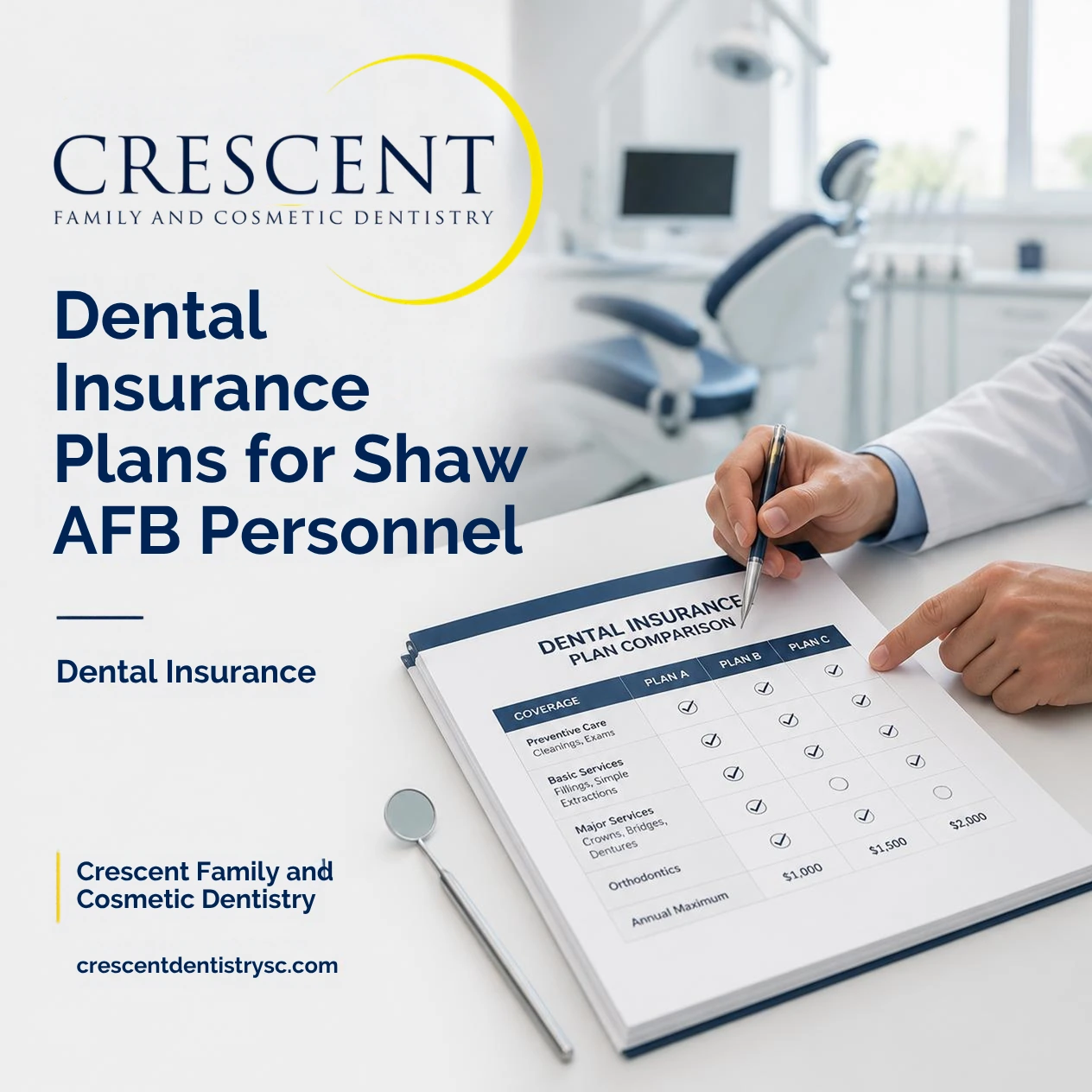
One of the easiest mistakes is choosing dental coverage based entirely on the monthly price.
A cheap premium does not automatically mean cheap dental care.
Before choosing coverage, investigate:
Deductible:
How much must you pay before certain benefits begin?
Cost-share or coinsurance:
What percentage of treatment remains your responsibility?
Annual maximum:
Is there a limit on what the plan will pay during the benefit year?
Waiting periods:
Are certain procedures unavailable immediately after enrollment?
Network:
Are dentists you want to use participating?
Major services:
How are crowns, bridges, dentures, implants, and other significant procedures handled?
Orthodontics:
Is orthodontic treatment covered, and who qualifies?
These details can matter more than a small difference in premiums.
What About Orthodontic Coverage Through TDP?
This is one area where patients should read the eligibility rules carefully.
TRICARE Dental Program does provide an orthodontic benefit for certain eligible enrollees, but age restrictions apply.
Current TRICARE guidance indicates orthodontic coverage is available for qualifying children and young adults based on age and student status, spouses up to age 23, and qualifying National Guard and Reserve sponsors up to age 23.
That means an adult spouse over the applicable age should not assume Invisalign or braces will be covered by TDP.
Before beginning orthodontic treatment, verify benefits directly.
Does Dental Insurance Cover Implants?
TDP lists implant services as a covered category subject to applicable program rules and cost sharing.
Current published cost-share information lists implant services at a 50% cost-share.
However, that does not mean every implant-related expense is automatically covered at exactly half with no limitations.
Coverage rules, maximums, clinical requirements, related procedures, and exclusions can affect the final benefit.
Always request a benefit estimate for expensive dental treatment before proceeding when possible.
PCS Orders? Don’t Forget About Your Dental Coverage
Military families move frequently.
That makes portability particularly important.
If your family receives PCS orders, dental coverage should be included on your relocation checklist.
Before moving:
- Confirm your current enrollment
- Update DEERS as required
- Locate participating dentists near the new duty station
- Transfer necessary dental records
- Finish time-sensitive treatment when practical
- Ask about ongoing orthodontic or periodontal treatment
A move can interrupt dental care if these details are left until the last minute.
If someone is halfway through a complex treatment plan, planning ahead becomes even more important.
Preventive Coverage Is Only Valuable If You Use It
One of the best ways to get value from dental insurance is also one of the simplest:
Use your preventive benefits.
Regular examinations can identify problems that are easy to overlook at home.
Professional dental care can help identify:
- Early tooth decay
- Gum inflammation
- Periodontal disease
- Cracked teeth
- Failing restorations
- Bite problems
- Areas of heavy tartar buildup
- Other oral health concerns
Waiting until a tooth hurts often turns a preventive situation into a restorative one.
Our Shaw AFB Dental Coverage Checklist
If you are comparing coverage, start with these questions:
1. What is my military status?
Active duty, family member, Guard/Reserve, and retiree status can lead to different coverage options.
2. Am I eligible for TDP, ADDP, or FEDVIP?
Determine which program actually applies before comparing benefits.
3. Is my preferred dentist in network?
Verify directly with the carrier.
4. What preventive care is covered?
Look at examinations, cleanings, X-rays, fluoride, and sealants as applicable.
5. What will major treatment cost me?
Review deductibles, cost shares, maximums, exclusions, and authorization requirements.
6. Does anyone in my family need orthodontics?
Check age restrictions and lifetime benefits before assuming braces or clear aligners are covered.
7. Are we expecting a PCS or status change?
Military transitions can affect coverage and continuity of care.
So, What’s the Top-Rated Plan for Shaw AFB Personnel?
There is not one dental plan that deserves that title for everyone.
For many active-duty family members, the TRICARE Dental Program is the logical place to begin because it is specifically designed for eligible military families.
For the active-duty service member, military dental care and the Active Duty Dental Program are the relevant systems.
For eligible military retirees and their families, FEDVIP provides dental plan choices that should be compared based on current premiums, provider networks, benefits, and expected treatment.
For National Guard and Reserve households, TDP may also provide coverage, but eligibility and premiums depend on military status.
The smartest strategy is not finding the plan with the most impressive advertisement.
It is finding the coverage that matches your actual eligibility and dental needs.
Military Family Near Shaw AFB? Know Your Benefits Before Treatment
At Crescent Family and Cosmetic Dentistry, we believe understanding your dental benefits can help you make better decisions about preventive and restorative care.
If you are connected to Shaw Air Force Base, do not wait until you need an expensive dental procedure to learn how your coverage works.
Review your current benefits, confirm eligibility, check network participation, and ask questions before treatment begins.
Most importantly, do not let insurance confusion keep your family from receiving appropriate preventive dental care.
If you are looking for dental care in the Midlands, contact Crescent Family and Cosmetic Dentistry to discuss your dental needs. Before scheduling treatment based on insurance coverage, confirm your current benefits and provider-network status directly with your dental carrier so you know what to expect.