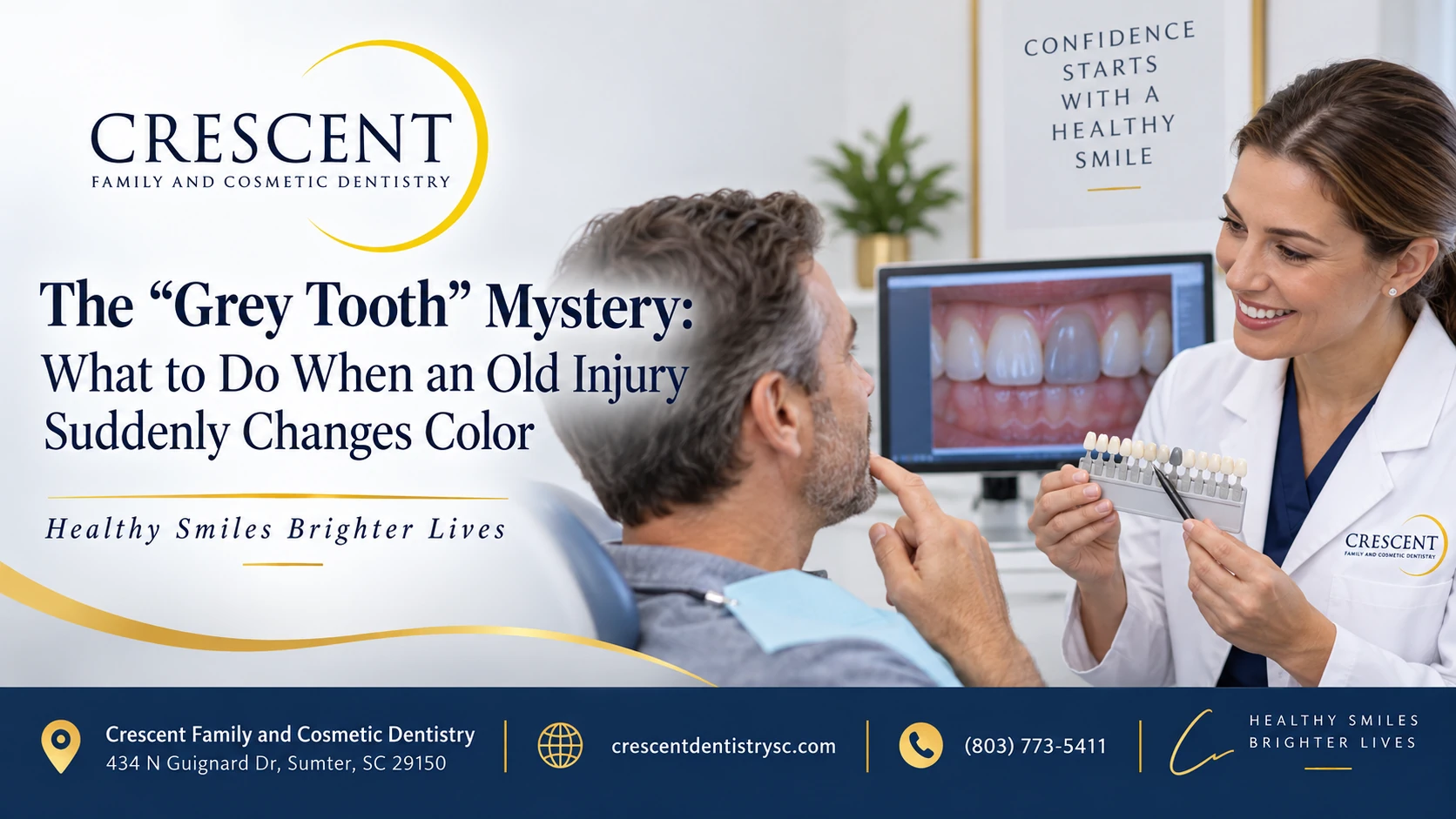
The “Grey Tooth” Mystery: What to Do When an Old Injury Suddenly Changes Color
You look in the mirror one morning and notice something strange. One tooth looks darker than the others. Maybe it has a grey, brown, or slightly bluish appearance that you are certain was not there before.
Then you remember something that happened years ago.
Maybe you fell off a bike as a teenager. Perhaps you took an elbow to the mouth while playing sports. Maybe you were involved in an accident and hit your front teeth. The tooth seemed fine afterward, so you stopped thinking about it.
Now, years later, it is changing color.
At Crescent Family and Cosmetic Dentistry, we want patients to know that a tooth suddenly turning grey deserves attention, particularly when there is a history of dental trauma. A color change can sometimes indicate changes occurring inside the tooth that are impossible to see from the surface.
The good news is that a grey tooth does not automatically mean the tooth has to be removed. Depending on what caused the discoloration and the condition of the tooth, several treatment options may be available.
Why Would a Tooth Turn Grey Years After an Injury?
Teeth may look solid from the outside, but they contain living tissue.
Underneath the enamel and dentin is the pulp, which contains nerves, connective tissue, and blood vessels. When a tooth experiences trauma, the pulp can be injured even when the outside of the tooth does not appear seriously damaged.
Think about hitting your arm and developing a bruise.
Something similar can happen inside a tooth, although the process and consequences are different. Trauma can damage blood vessels within the pulp. Changes inside the tooth may then affect the color visible through the enamel and dentin.
In some cases, the pulp recovers.
In others, the nerve and blood supply may gradually deteriorate. The tooth can eventually become darker as internal changes develop.
What makes this confusing is timing.
A tooth does not necessarily change color immediately after an injury. Problems related to dental trauma can sometimes become noticeable months or even years later.
Why Grey?
A healthy tooth reflects light through enamel and the underlying dentin, creating its natural white or slightly yellowish appearance.
When changes occur inside the tooth, that appearance can change.
Internal bleeding following trauma can cause pigments to enter the dentin. Changes involving the pulp can also make a tooth appear:
- Grey
- Brown
- Dark yellow
- Bluish
- Almost black in severe cases
The exact shade does not tell us everything about the health of the tooth.
That is why looking at the color alone is not enough to determine what happened.
A professional examination is needed to identify the underlying cause.
A Grey Tooth May Be a Sign of Pulp Necrosis
One concern with a previously injured tooth is pulp necrosis, which means the tissue inside the tooth has died.
This can happen after significant trauma disrupts the tooth’s blood supply.
The process may occur without dramatic symptoms.
Some patients expect a dying tooth to cause severe pain. While pain can certainly occur, it is also possible for a damaged tooth to become non-vital without producing significant discomfort.
That means a tooth could be changing internally even if:
- It does not hurt
- You can chew normally
- There is no visible crack
- The gums look normal
- The original injury happened years ago
This is one reason we recommend having unexplained tooth discoloration evaluated instead of waiting for pain to appear.
“But the Tooth Doesn’t Hurt. Do I Really Need a Dentist?”
Yes, we recommend having it examined.
Pain is an important warning sign, but it is not the only indication of a dental problem.
If the pulp has become severely damaged or died, nerve function may actually decrease. In some situations, the absence of pain does not necessarily mean the tooth is healthy.
A dental examination allows us to look beyond the color.
Depending on your situation, we may evaluate the tooth’s response to certain tests, examine the surrounding gum tissue, assess its stability, check your bite, and take dental X-rays when appropriate.
These findings help us determine whether the discoloration is cosmetic or associated with a deeper problem.
Other Warning Signs to Watch For
A color change may be the first symptom, but other signs can develop.
Contact a dentist if a grey or darkened tooth is accompanied by:
- Pain when biting
- Sensitivity to hot or cold
- Swelling around the tooth
- Gum tenderness
- A small bump or pimple on the gum
- Persistent bad taste
- Drainage
- Tooth mobility
- Facial swelling
- Increasing pressure or throbbing
A bump on the gum near a previously injured tooth can be particularly important. It may indicate that an infection has developed and found a pathway to drain through the gum tissue.
Even if the bump disappears and returns, the underlying issue may still require treatment.
Why Can an Old Injury Cause Problems So Much Later?
Dental trauma can be unpredictable.
When an accident occurs, the tooth may absorb significant force without breaking. The enamel can remain intact while the internal tissues sustain damage.
Sometimes the pulp survives initially but deteriorates over time.
This delayed response is why we encourage patients to mention previous dental injuries during examinations, even if those injuries happened many years ago.
That information can provide valuable context if we notice changes in a particular tooth.
For example, if one front tooth begins darkening while the surrounding teeth remain normal, knowing that the tooth was injured years earlier can help guide our evaluation.
Could the Grey Color Be Caused by Something Else?
Yes.
Not every dark tooth is caused by trauma.
Tooth discoloration can also be associated with:
- Tooth decay
- Certain medications
- Aging
- Large or older restorations
- Internal staining
- Previous root canal treatment
- Enamel changes
- External staining
A tooth that looks grey because of a large filling requires a different approach than a tooth that has darkened because the pulp is no longer healthy.
This is another reason self-diagnosis based on appearance alone can be misleading.
What Happens During the Dental Examination?
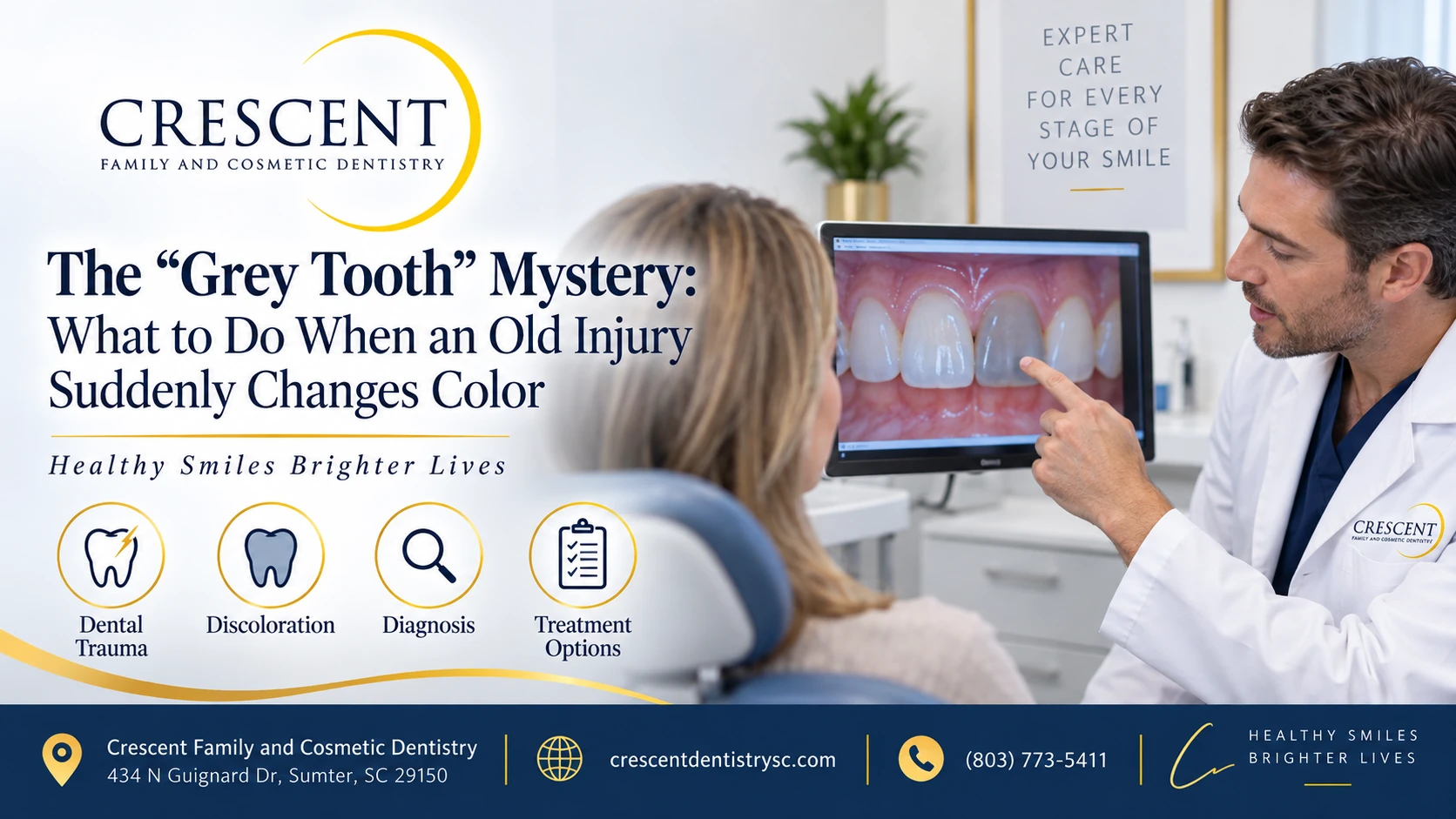
When you visit us because of a discolored tooth, our first priority is understanding why the tooth changed color.
We may begin by discussing its history.
We will want to know when you first noticed the discoloration, whether the tooth has ever been injured, whether you have experienced pain or sensitivity, and whether the color appears to be getting darker.
We can then examine the tooth and surrounding tissues.
Depending on the circumstances, additional diagnostic testing or dental imaging may be appropriate.
Our goal is not simply to make the tooth white again.
We first need to determine whether the tooth is healthy.
Does a Grey Tooth Need a Root Canal?
Not necessarily.
Color alone does not automatically mean root canal treatment is required.
However, if testing indicates that the pulp has died or an infection has developed inside the tooth, root canal therapy may be recommended.
During root canal treatment, the unhealthy or infected tissue inside the tooth is removed. The internal space is then cleaned, disinfected, shaped, and sealed.
The goal is to preserve the natural tooth while addressing the infection or damaged pulp.
Depending on the tooth’s condition, additional restorative or cosmetic treatment may be recommended afterward.
Can You Whiten a Grey Tooth?
This depends on the source of the discoloration.
Traditional teeth whitening products primarily address certain types of staining and may not produce the same results on a tooth that has darkened internally after trauma.
If only one tooth is affected, whitening all of your teeth may actually make the contrast more noticeable.
Instead, treatment needs to be individualized.
Once we have confirmed that the tooth is healthy or appropriately treated, cosmetic options may include professional whitening approaches, internal bleaching in certain previously root canal-treated teeth, bonding, veneers, or crowns.
The right option depends on factors such as:
- The cause of discoloration
- How dark the tooth has become
- Whether the tooth has undergone root canal treatment
- How much healthy tooth structure remains
- The condition of the enamel
- Your overall smile goals
We want the final result to address both health and appearance.
Don’t Try to Cover the Problem Before Diagnosing It
When a front tooth turns grey, the cosmetic change can understandably become the immediate concern.
You may be tempted to buy whitening strips or other products to fix the color.
But whitening should not be the first step when a single tooth suddenly becomes darker, particularly when there is a history of trauma.
The priority is finding out what is happening inside the tooth.
Covering the discoloration without addressing an underlying infection or damaged pulp does not solve the actual problem.
Diagnosis comes first.
Cosmetic improvement comes afterward.
Can a Grey Tooth Be Saved?
In many cases, yes.
A darkened tooth does not automatically need to be extracted.
Modern dentistry provides several ways to preserve and restore teeth affected by trauma. The appropriate treatment depends on the condition of the root, surrounding bone, remaining tooth structure, and internal tissues.
This is why earlier evaluation can be valuable.
If a problem is identified before extensive damage occurs, we may have more options for preserving the natural tooth.
Extraction is generally considered when a tooth cannot be predictably restored or maintained.
What If the Injury Happened During Childhood?
Childhood dental injuries are extremely common.
Falls, playground accidents, sports injuries, and collisions can all affect the front teeth.
Sometimes families remember the event clearly. Other times, an adult patient may only vaguely remember hitting a tooth decades ago.
If you have one tooth that is significantly darker than the matching tooth beside it, an old injury is worth mentioning during your dental appointment.
Even an event that seemed minor at the time could provide an important clue.
Should You Treat a Grey Tooth as a Dental Emergency?
A grey tooth without pain or swelling may not require the same immediate response as severe dental trauma or significant facial swelling.
However, it should not be ignored.
Schedule a dental evaluation so we can determine what is causing the discoloration.
Seek more urgent dental care if the tooth is accompanied by severe pain, rapidly increasing swelling, drainage, fever, facial swelling, or other signs of a potentially spreading infection.
The important point is not to wait indefinitely simply because the tooth does not hurt.
Your Old Dental Injury May Not Be Finished Telling Its Story
Dental injuries can be deceptive.
A tooth may survive an accident, look completely normal for years, and then suddenly begin showing signs that something has changed internally.
That grey color may be your first clue.
At Crescent Family and Cosmetic Dentistry, we encourage patients to pay attention when one tooth begins looking noticeably different from the rest of their smile.
The solution may be relatively straightforward, or the tooth may require treatment to protect its long-term health. Either way, the first step is determining the cause.
One Tooth Turning Grey? Let Us Take a Look
If an old injury has suddenly come back to haunt your smile, you do not have to guess what is happening.
Our team at Crescent Family and Cosmetic Dentistry can evaluate the discolored tooth, investigate the possible cause, and explain your treatment options.
Whether the solution involves monitoring the tooth, addressing an internal dental problem, or restoring its appearance, our priority is helping you preserve your natural smile whenever possible.
If you have noticed a grey, brown, or unusually dark tooth, especially one that was injured in the past, schedule an appointment with Crescent Family and Cosmetic Dentistry. Let us find out what is happening beneath the surface before a quiet problem has the opportunity to become a bigger one.