Fluoride vs. Hydroxyapatite: The 2026 Debate for Midlands Parents
If you’ve walked down the toothpaste aisle recently, you’ve probably noticed something interesting.
For decades, most toothpaste choices were relatively straightforward. Nearly every major brand relied on fluoride as the primary cavity-fighting ingredient.
Today, that’s changing.
A growing number of products now advertise hydroxyapatite toothpaste, often positioning it as a modern alternative to fluoride. Social media influencers promote it. Parenting groups debate it. Some brands market it as a “natural” solution for strengthening teeth.
As a result, many parents in Columbia, Sumter, and throughout the South Carolina Midlands are asking the same question:
“Should my child use fluoride toothpaste or hydroxyapatite toothpaste?”
The short answer is this:
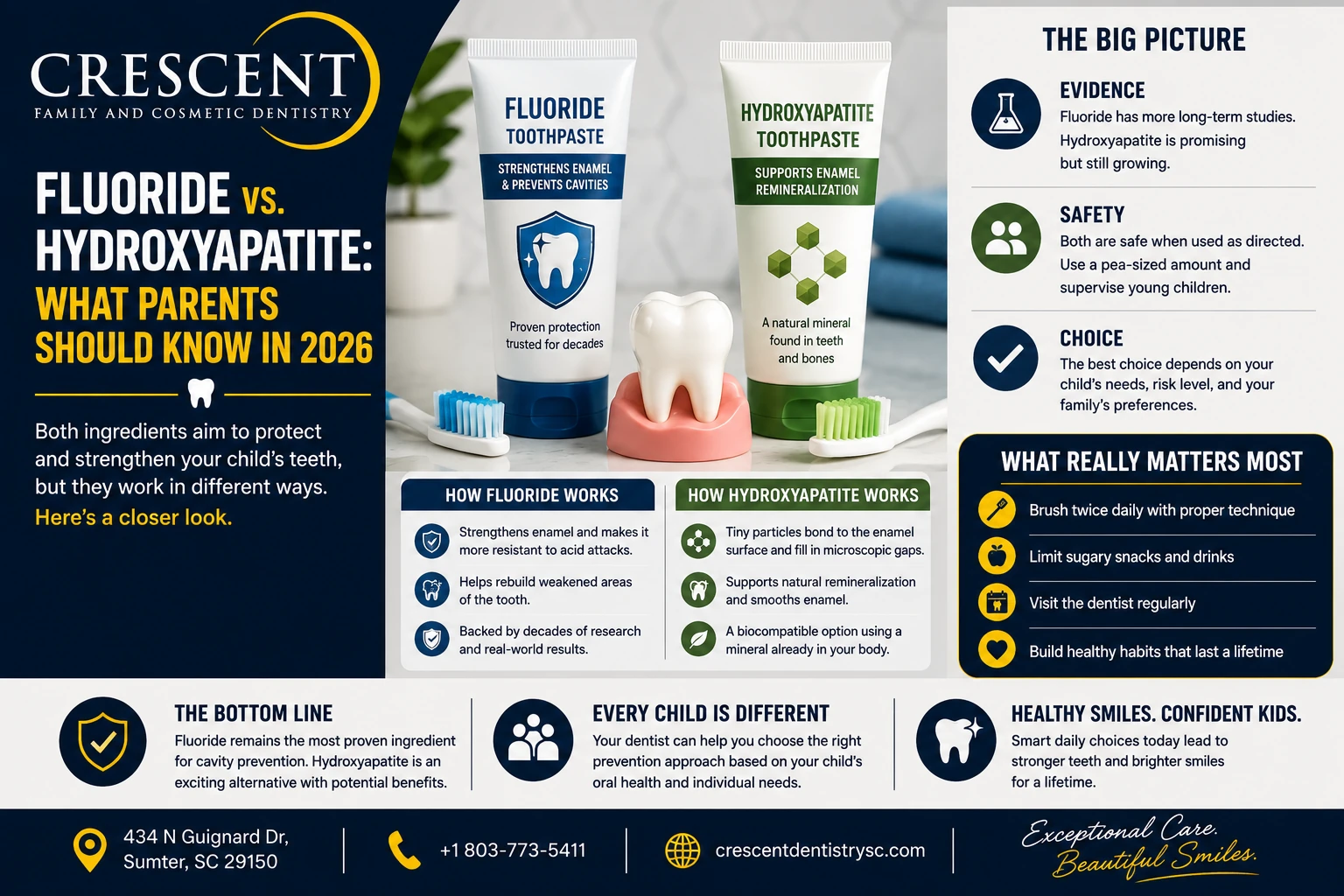
In 2026, fluoride remains the most thoroughly studied and proven cavity-prevention ingredient available. However, hydroxyapatite is emerging as a promising alternative in certain situations and continues to gain attention within preventive dentistry.
The important thing is understanding what we know, what we don’t know, and how to make the best decision for your child—not based on internet arguments, but on evidence.
At Crescent Family & Cosmetic Dentistry, parents regularly ask about fluoride, alternative toothpaste options, and what current research actually shows. Like many dental topics, the answer is more nuanced than the headlines suggest.
Choose the Right Protection for Your Child’s Teeth
Fluoride or hydroxyapatite? Talk with a dental professional and find the best option for your child.
Why This Debate Exists in the First Place
To understand the discussion, it helps to know what both ingredients are designed to do.
The goal of any cavity-prevention toothpaste is simple:
Help protect teeth from decay.
Every day, acids produced by bacteria attack tooth enamel.
When these acid attacks happen repeatedly, minerals are lost from the enamel surface.
This process is called demineralization.
If enough mineral loss occurs, a cavity develops.
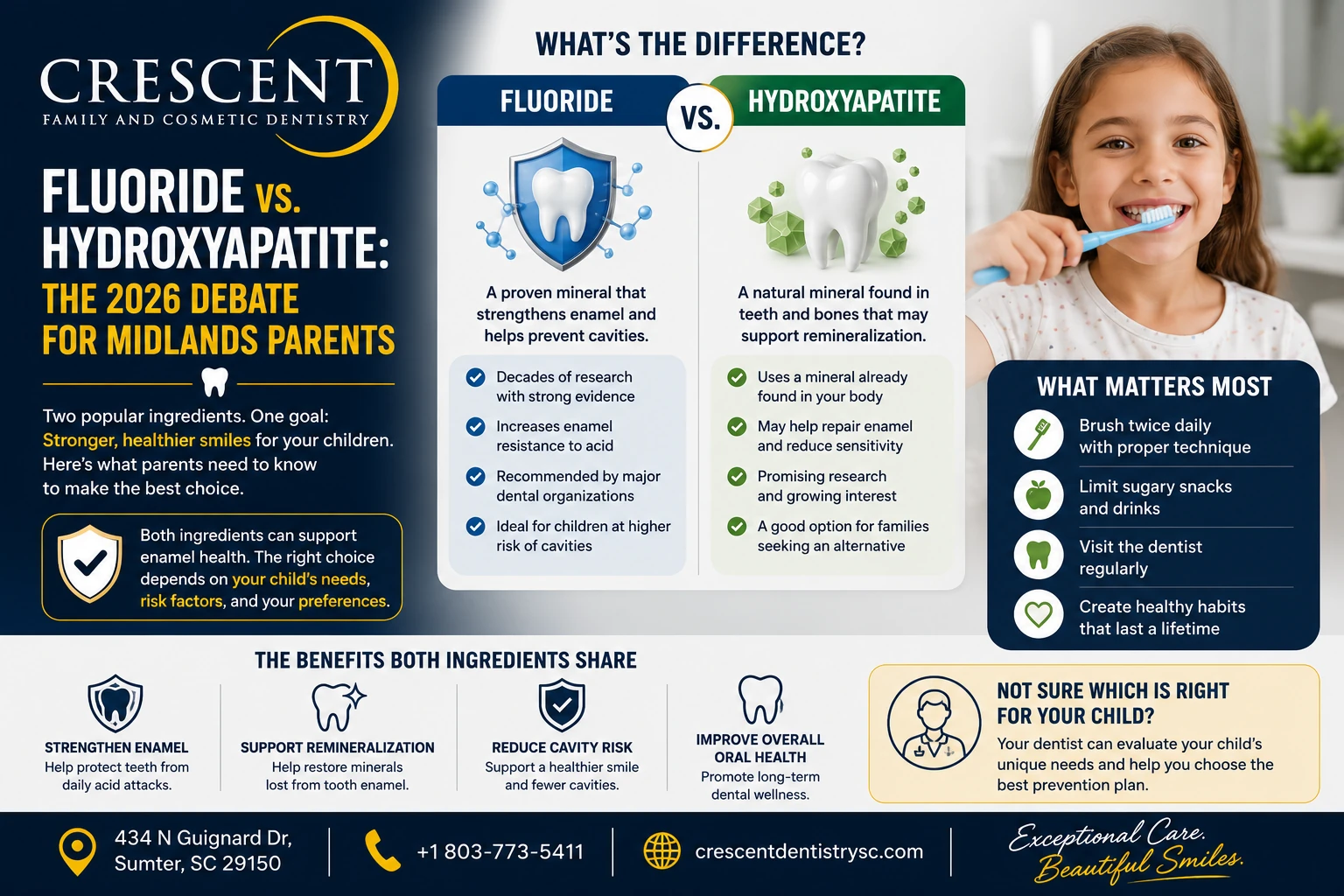
Both fluoride and hydroxyapatite aim to strengthen enamel and reduce the risk of cavities.
The difference is how they do it.
What Is Fluoride?
Fluoride is a naturally occurring mineral found in:
- Water
- Soil
- Certain foods
- Many dental products
Dentistry has used fluoride extensively for decades because of its ability to help prevent tooth decay.
When fluoride comes into contact with teeth, it helps:
- Strengthen enamel
- Increase resistance to acid attacks
- Support remineralization
- Slow cavity development
This is why fluoride is commonly found in:
- Toothpaste
- Mouth rinses
- Professional fluoride treatments
- Community water systems
The reason fluoride remains widely recommended is simple:
The amount of research supporting its effectiveness is enormous.
Few preventive dental ingredients have been studied as extensively.
What Is Hydroxyapatite?
Hydroxyapatite sounds complicated, but it’s actually familiar to your body.
Your teeth and bones are naturally composed largely of hydroxyapatite crystals.
In fact, enamel is primarily made of hydroxyapatite.
The concept behind hydroxyapatite toothpaste is straightforward:
Instead of strengthening enamel through fluoride chemistry, manufacturers provide tiny hydroxyapatite particles designed to integrate with the tooth surface.
Potential benefits may include:
- Enamel repair support
- Surface remineralization
- Reduced sensitivity
- Improved smoothness
- Cosmetic whitening effects
The idea is appealing because it uses a substance already naturally present in teeth.
This can be especially relevant for families also trying to understand tooth sensitivity to hot and cold, since sensitivity may be related to enamel wear, exposed dentin, or other dental changes that deserve a closer look.
Why Parents Are Suddenly Hearing So Much About Hydroxyapatite
Several factors have contributed to hydroxyapatite’s popularity.
Social Media Influence
Many influencers have promoted hydroxyapatite as a fluoride alternative.
Unfortunately, some discussions frame the issue as a battle between “good” and “bad” ingredients.
Reality is usually more complicated.
Interest in “Natural” Products
Many parents are actively seeking products with fewer synthetic ingredients.
Hydroxyapatite marketing often appeals to this preference.
Increased Product Availability
Hydroxyapatite toothpastes were once relatively difficult to find.
Today, they’re available through many major retailers and online stores.
Growing Research Interest
Researchers continue investigating hydroxyapatite’s role in preventive dentistry.
As new studies emerge, public awareness grows.
Does Hydroxyapatite Prevent Cavities?
This is the question that matters most.
The answer is:
Possibly yes—but the evidence is not yet as extensive as fluoride’s.
Research suggests hydroxyapatite may help:
- Reduce demineralization
- Support remineralization
- Improve enamel health
- Lower cavity risk
Some studies have shown promising results when compared with fluoride toothpaste.
However, there is an important distinction.
Promising Is Not the Same as Proven
Hydroxyapatite research is encouraging.
But fluoride has decades of large-scale evidence across diverse populations.
When pediatric dentists and public health organizations evaluate recommendations, the depth of evidence matters.
That’s one reason fluoride remains the standard recommendation in many preventive guidelines.
Why Some Parents Prefer Hydroxyapatite
Even parents who acknowledge fluoride’s effectiveness may still choose hydroxyapatite.
Common reasons include:
Concerns About Swallowing Toothpaste
Young children sometimes swallow toothpaste during brushing.
Some parents feel more comfortable using hydroxyapatite products because they do not contain fluoride.
Desire for Alternative Options
Families who prefer minimizing certain ingredients may view hydroxyapatite as an appealing choice.
Sensitivity Benefits
Some users report reduced tooth sensitivity when using hydroxyapatite toothpaste.
Personal Preference
Not every decision comes down solely to scientific comparisons.
Parents often weigh multiple factors when choosing products for their children.

Tooth Extraction and the Brain: What Patients Report Weeks Later
At first glance, a tooth extraction seems like a purely dental event. It's a localized procedure with local anesthesia, focused…

Why Many Dentists Still Recommend Fluoride
The reason is not tradition.
It’s evidence.
Fluoride has demonstrated effectiveness across generations of research.
Dentists routinely see its benefits in real-world settings.
Fluoride Has a Long Track Record
Millions of children and adults have benefited from fluoride exposure through:
- Toothpaste
- Professional treatments
- Community water fluoridation
It Works Particularly Well for High-Risk Patients
Children with increased cavity risk may benefit significantly from fluoride-based prevention strategies.
Risk factors may include:
- Frequent snacking
- Sugary beverages
- Poor oral hygiene
- Previous cavities
- Dry mouth conditions
For higher-risk children, dentists often prefer the ingredient with the strongest evidence base.
The Biggest Misconception About This Debate
Many online discussions assume you must choose one side.
That’s not necessarily true.
The reality is that dentistry continues evolving.
Hydroxyapatite and fluoride are not enemies.
Researchers are actively exploring how different preventive approaches can support enamel health.
The question isn’t:
“Which ingredient wins?”
The better question is:
“Which option makes the most sense for this child?”
Different patients may have different needs.
Is Fluoride Dangerous?
This is one of the most emotionally charged parts of the conversation.
The internet contains a tremendous amount of information—and misinformation—about fluoride.
Here’s the practical reality:
Fluoride Safety Depends on Dose
Like many substances, dosage matters.
Excessive fluoride exposure during tooth development can contribute to dental fluorosis.
Most fluorosis cases are mild and primarily cosmetic.
This is why parents are advised to:
- Use age-appropriate toothpaste amounts
- Supervise brushing
- Follow professional recommendations
Major Dental Organizations Continue Supporting Fluoride
Organizations including the American Dental Association and American Academy of Pediatric Dentistry continue recommending fluoride because they believe the benefits outweigh the risks when used appropriately.
That doesn’t mean every parent must agree.
But it helps explain why fluoride remains the standard recommendation.
What About Children Who Already Have Cavities?
For children with a history of tooth decay, many dentists are likely to recommend fluoride-based prevention.
The reason is simple:
When cavity risk is elevated, clinicians often prioritize the approach with the strongest evidence for decay prevention.
That may include:
- Fluoride toothpaste
- Professional fluoride applications
- Dietary counseling
- Improved brushing habits
In these situations, cavity prevention often becomes the primary goal.
What Really Matters More Than Toothpaste Choice
Parents sometimes spend hours debating ingredients while overlooking larger factors.
The truth is that many cavity risks are influenced by daily habits.
These include:
Brushing Consistently
Twice-daily brushing remains essential.
Limiting Sugary Drinks
Frequent sugar exposure dramatically increases cavity risk.
Regular Dental Visits
Professional evaluations help identify concerns early.
Good Oral Hygiene Habits
Technique matters as much as product selection.
Healthy Nutrition
Diet plays a major role in oral health.
Even the best toothpaste cannot completely compensate for poor oral hygiene or constant sugar exposure.
So What Should Midlands Parents Do in 2026?
For most families, the answer begins with understanding their child’s individual risk factors.
A child with excellent oral health and low cavity risk may have different preventive needs than a child who has experienced multiple cavities.
Parents should consider:
- Age
- Cavity history
- Oral hygiene habits
- Dietary patterns
- Professional recommendations
- Comfort level with available options
The goal isn’t winning an internet debate.
The goal is helping children maintain healthy teeth.
The Best Toothpaste Is the One That Fits Your Child’s Needs
The fluoride versus hydroxyapatite discussion will likely continue evolving as new research emerges.
Right now, fluoride remains the most extensively studied and widely recommended cavity-prevention ingredient available. Hydroxyapatite is an exciting area of research that may offer benefits for many patients, but it has not yet accumulated the same depth of evidence across decades of use.
For parents, the smartest approach is often avoiding extremes. Neither blind acceptance nor automatic rejection serves children particularly well. Understanding the science, evaluating risk factors, and seeking professional guidance usually leads to the best decisions.
At Crescent Family & Cosmetic Dentistry, our doctors help families navigate preventive care choices based on evidence, individual needs, and long-term oral health goals—not marketing trends or social media headlines.
Let’s Build a Prevention Plan That Makes Sense for Your Child
Choosing a toothpaste is important, but it is only one part of protecting your child’s smile.
Whether you have questions about fluoride, hydroxyapatite, cavity prevention, nutrition, or your child’s overall oral health, a personalized evaluation can provide clarity that online opinions often cannot.
At Crescent Family & Cosmetic Dentistry, families in Columbia, Sumter, and throughout the Midlands can receive practical, evidence-based guidance tailored to their child’s specific needs. The goal isn’t to push a particular product—it’s to help parents make informed decisions that support healthy smiles for years to come.
Frequently Asked Questions
Is hydroxyapatite better than fluoride?
Not necessarily. Hydroxyapatite shows promise, but fluoride currently has a much larger body of evidence supporting cavity prevention.
Can children use hydroxyapatite toothpaste?
Many hydroxyapatite products are marketed for children. Parents should always follow manufacturer guidelines and consult their dentist regarding individual recommendations.
Does hydroxyapatite rebuild enamel?
Research suggests hydroxyapatite may support remineralization and enamel repair processes, though ongoing studies continue to evaluate its effectiveness.
Why do dentists still recommend fluoride?
Fluoride has decades of research demonstrating its ability to reduce cavity risk and strengthen enamel when used appropriately.
Should I switch my child’s toothpaste?
That depends on your child’s age, cavity history, oral health status, and family preferences. A dental evaluation can help determine which preventive approach is most appropriate.
Confused About Fluoride vs. Hydroxyapatite?
Get personalized dental guidance for your child’s smile. Call today to make the right choice with confidence.