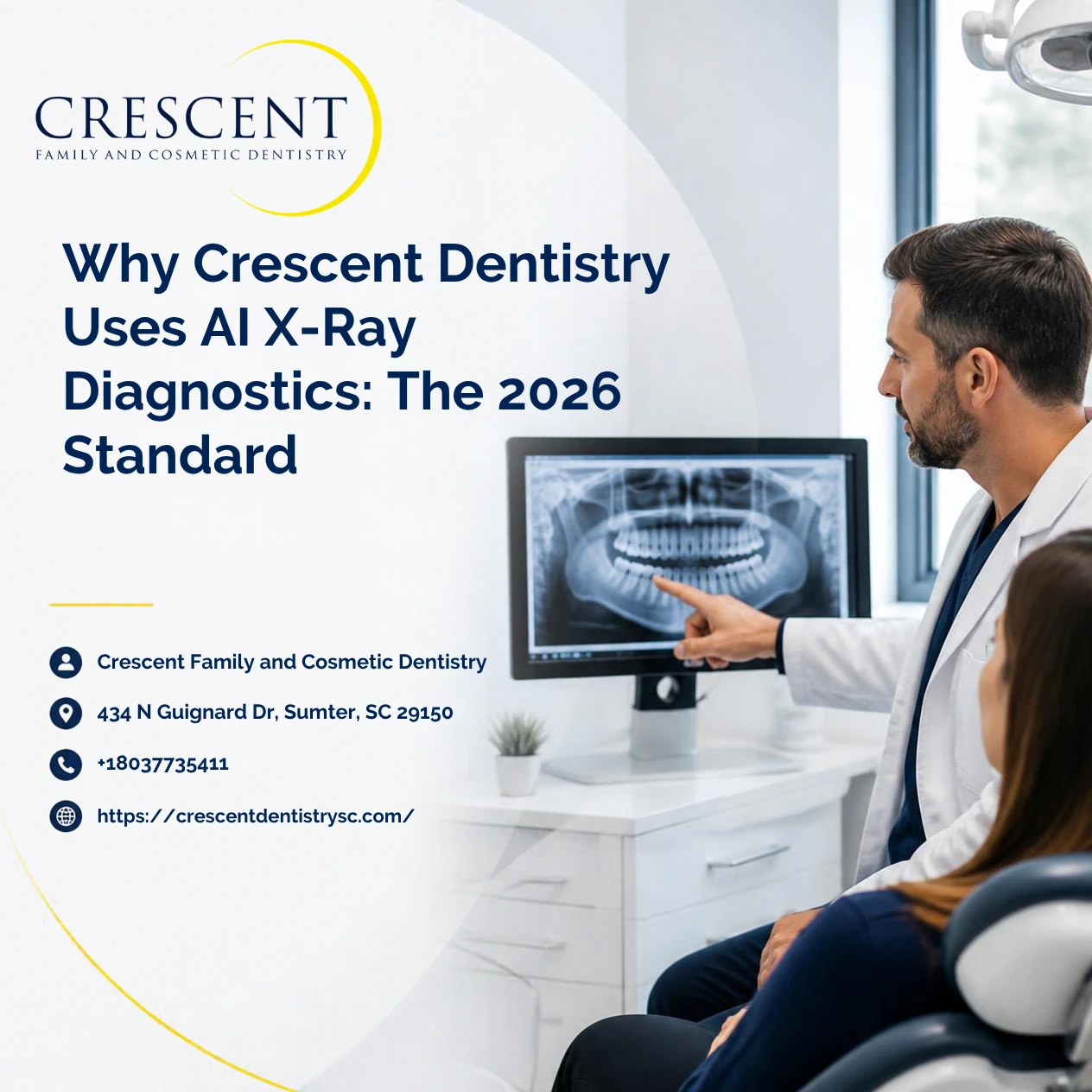
Why Crescent Dentistry Uses AI X-Ray Diagnostics: The 2026 Standard
For generations, dental X-rays have allowed dentists to see what the naked eye cannot.
A tooth may look perfectly healthy during a visual examination while decay is developing between teeth. Bone changes can occur below the gumline. An infection may be forming near a root without producing obvious symptoms.
In 2026, however, dental imaging is becoming even more sophisticated.
At Crescent Family and Cosmetic Dentistry, we believe technology should help us examine dental information more carefully while making it easier for patients to understand what we see. AI-assisted X-ray analysis represents one of the tools helping modern dentistry move in that direction.
Instead of replacing the dentist, artificial intelligence can act as an additional analytical tool when reviewing dental images.
Think of it as another set of digital eyes.
The technology can analyze radiographs and highlight areas that may deserve closer attention. Our dental team then considers those findings alongside the patient’s examination, symptoms, history, previous X-rays, and professional clinical judgment.
That distinction is important.
AI does not become your dentist. It gives your dentist another tool for evaluating your dental health.
What Does “AI X-Ray Diagnostics” Actually Mean?
The phrase sounds much more futuristic than the patient experience actually is.
You still have dental X-rays taken when they are clinically appropriate.
The difference is what can happen after the image is captured.
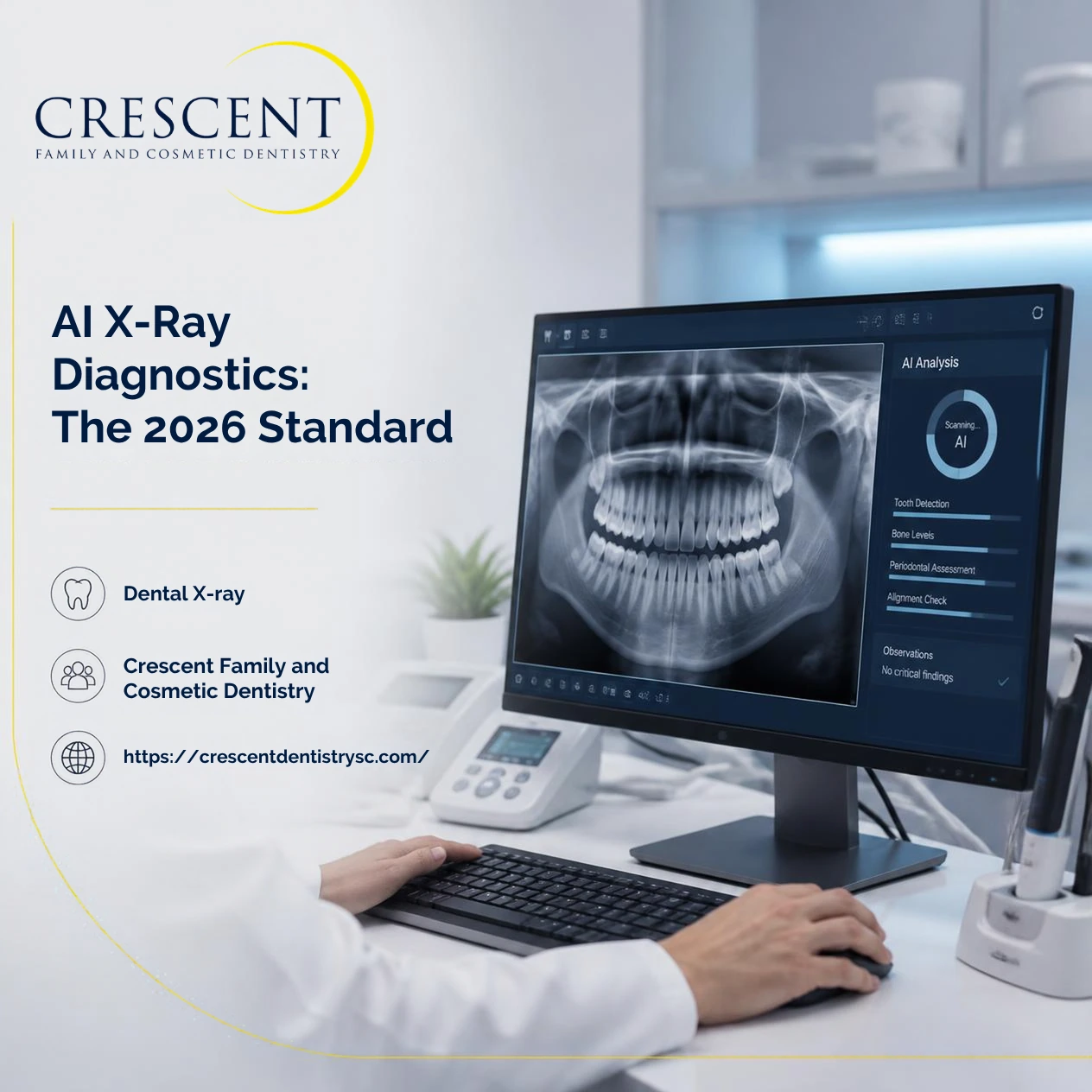
AI-based dental imaging software can analyze certain radiographic patterns and flag areas that may warrant additional evaluation.
Depending on the particular software and its regulatory clearance or intended use, AI systems may assist dental professionals with identifying or measuring findings involving areas such as:
- Tooth decay
- Bone levels
- Calculus
- Existing restorations
- Certain areas around tooth roots
- Other radiographic features
The dentist then reviews the original image and the AI-assisted information.
We do not simply accept everything a computer highlights.
We investigate it.
Why Use AI If Dentists Already Know How to Read X-Rays?
Because good technology does not have to replace professional skill to be useful.
Consider another familiar part of dentistry.
Dentists have used magnification and enhanced lighting for years. Neither tool replaces dental training. They simply help clinicians see more clearly.
AI-assisted imaging can serve a similar purpose.
A dental professional may review an X-ray normally and then use AI-generated information as an additional reference.
This can create another opportunity to examine subtle areas before making a clinical decision.
Modern dentistry is not about choosing between humans and technology.
It is about using technology responsibly to support humans.
Reason #1: An Additional Layer of Review
Dental X-rays contain a tremendous amount of visual information.
Dentists evaluate tooth structure, restorations, bone, roots, and other anatomical features while comparing findings with what they observe clinically.
AI can add another analytical layer.
The software may highlight an area for closer inspection that can then be evaluated by the dentist.
That does not automatically mean disease is present.
AI systems can produce false positives and false negatives. No diagnostic technology should be treated as infallible.
The value is in giving the dental professional another piece of information to consider.
At Crescent Family and Cosmetic Dentistry, technology should support clinical judgment, not override it.
Reason #2: Helping Patients Actually See What We See
This may be one of the most practical benefits of AI-assisted dental imaging.
Dentists spend years learning how to interpret radiographs.
Patients do not.
When we point at a conventional dental X-ray and say, “There is an area here we want to watch,” you may be looking at a collection of black, white, and grey shapes wondering what exactly we are talking about.
AI-assisted visualization can make certain findings easier to discuss.
When software highlights or measures an area on an image, patients may have a clearer reference point.
Instead of simply hearing:
“You may have a cavity here.”
You can look at the image with us while we explain what we are seeing and why it matters.
That can lead to better conversations about treatment.
Reason #3: More Transparent Dental Conversations
Nobody wants to feel pressured into dental treatment they do not understand.
If we recommend a filling, crown, periodontal treatment, root canal evaluation, or another procedure, you deserve to understand the reason behind that recommendation.
Technology can support transparency.
We can review your images together and discuss what the examination shows.
AI-generated visual aids may provide another way to explain the findings.
You can ask questions.
We can show you the area.
We can discuss whether something requires treatment now or should simply be monitored.
The final goal is not to impress patients with technology.
It is to help patients make informed decisions.
Reason #4: Tracking Changes Over Time
One X-ray provides information about one point in time.
Multiple X-rays taken appropriately over several years can tell a story.
Suppose we identify an area that does not yet require treatment.
Rather than immediately intervening, we may decide that monitoring is appropriate depending on the clinical circumstances.
At a future examination, comparison with earlier images can help determine whether the area appears stable or has changed.
AI-assisted measurement and analysis may provide additional information for these comparisons.
This can be particularly useful when evaluating changes involving bone levels or other measurable radiographic findings.
Reason #5: Supporting Earlier Recognition
One of the central goals of preventive dentistry is identifying disease before it becomes a major problem.
Consider tooth decay.
A smaller area of decay may require relatively conservative treatment.
If decay progresses deeply into a tooth, treatment can become more extensive.
The same general principle applies to periodontal problems.
Identifying changes earlier may give patients an opportunity to address problems before additional damage occurs.
AI-assisted radiograph analysis can support the dentist’s evaluation by highlighting areas that deserve closer attention.
It is important, however, not to promise that AI will detect every problem early.
No technology can guarantee that.
It is an additional tool, not a crystal ball.
Does AI Mean More Dental X-Rays?
No.
Using AI to analyze a dental X-ray does not mean we need to expose you to additional radiation simply because AI technology is available.
The AI analyzes images that have already been obtained for appropriate clinical reasons.
In fact, one of the major developments in dentistry in 2026 has been updated guidance about when dental imaging should be used.
Dental X-rays should be based on the individual patient’s needs rather than automatically taken according to a rigid schedule.
Factors can include:
- Dental history
- Current symptoms
- Cavity risk
- Gum health
- Age
- Existing restorations
- Previous imaging
- Clinical findings
- Planned treatment
Technology should make dental care smarter, not simply create more testing.
The 2026 Approach: X-Rays Should Be Individualized
Modern dentistry is moving away from the idea that every patient automatically needs exactly the same imaging at exactly the same interval.
Your dental situation is unique.
Someone with extensive restorations and a history of recurrent decay may have different imaging needs than someone with excellent oral health and very low cavity risk.
In 2026, updated professional recommendations emphasize performing a clinical examination and selecting radiographs according to the individual patient’s diagnostic needs.
That philosophy fits naturally with how we view AI.
The goal is not more technology.
The goal is better-informed care.
Does AI Diagnose Your Cavity?
Not by itself.
This distinction matters.
AI software may flag an area that appears consistent with a certain radiographic finding.
Your dentist still needs to interpret that information.
A clinical diagnosis can involve multiple sources of information, including:
- Your X-rays
- Visual examination
- Dental history
- Symptoms
- Clinical tests
- Previous restorations
- Comparison with earlier images
- Professional judgment
An AI highlight is not automatically a treatment plan.
The dentist remains responsible for clinical decisions.
What If the AI and Dentist Disagree?
That can happen.
Artificial intelligence is not perfect.
The software may highlight something that the dentist determines is not clinically significant.
It may also fail to highlight something the dentist notices.
This is exactly why we do not treat AI as an autonomous decision-maker.
If software flags an area, we evaluate it.
If our clinical findings do not support the AI result, we consider the entire clinical picture.
AI should prompt questions, not dictate answers.
AI Does Not Replace the Dental Examination
A radiograph provides valuable information, but it cannot tell us everything.
We still need to examine your mouth.
During a dental examination, we may evaluate:
- Teeth
- Gums
- Bite
- Existing fillings and crowns
- Areas of sensitivity
- Tooth mobility
- Gum recession
- Soft tissues
- Other oral structures
Some dental conditions are primarily diagnosed clinically.
Others require imaging.
Many require both.
Artificial intelligence does not change that fundamental principle.
What About Gum Disease?
AI-assisted radiographic tools can potentially help dental professionals evaluate certain features associated with periodontal health, such as bone levels.
But gum disease cannot be diagnosed from an AI image alone.
Periodontal evaluation can also involve measuring gum pockets, checking for bleeding, examining gum recession, assessing tooth mobility, and considering the patient’s history.
Again, AI provides another data point.
Our dental team puts those pieces together.
Can AI Help Prevent Unnecessary Treatment?
Responsible use potentially helps us have a more detailed conversation about whether an area needs treatment or monitoring.
If something is stable and clinically appropriate to watch, documentation and comparison can help support that decision.
If an area changes over time, we have additional information for discussing treatment.
But AI itself should never be used as an excuse to overtreat.
More highlighted areas do not automatically mean more dentistry.
The purpose of technology should be better decision support, not finding reasons to perform procedures.
Can AI Make Dentistry Less Intimidating?
For some patients, yes.
Dental anxiety sometimes comes from uncertainty.
You are lying in a chair while someone tells you that something is happening inside a tooth you cannot see.
Seeing the image can change that conversation.
Instead of asking you to simply trust a technical explanation, we can walk through what we are evaluating.
Visual information can make dental discussions feel more concrete.
You can see the tooth.
You can see the area we are discussing.
And you can ask questions about what happens next.
Is AI in Dentistry Actually Regulated?
Dental AI is not simply an unregulated collection of apps.
Certain AI-based radiological image-processing systems are regulated as medical devices in the United States, depending on their intended use.
The FDA has established classifications for automated radiological image-processing software, including software that uses artificial intelligence and machine-learning algorithms.
At the same time, professional organizations have been developing standards specifically addressing AI in dentistry.
That matters because responsible AI requires more than impressive software.
Systems need appropriate development, validation, security, transparency, and clinical oversight.
Dentistry Reached an Important AI Milestone Before 2026
In 2025, dentistry reached a significant point in the development of professional AI standards.
The first U.S. standard specifically addressing artificial intelligence in dentistry was approved through the American National Standards Institute and American Dental Association standards process.
The standard focuses on validation dataset guidance for AI image-analysis systems using two-dimensional dental radiographs.
In simple terms, dentistry is developing formal frameworks around how these systems should be built, validated, and evaluated.
That is a much more meaningful development than simply saying, “We use AI.”
Responsible adoption matters.
Is AI X-Ray Analysis the “2026 Standard”?
There is an important distinction.
AI-assisted X-ray analysis is not a universal requirement for every dental office in 2026.
Dentists can provide excellent care without using AI radiographic software.
However, AI is becoming increasingly relevant to contemporary dentistry.
By mid-2026, national ADA survey data showed that a meaningful share of dentists were already using AI for imaging and diagnostic applications, while additional practices were using or considering AI for other tasks.
So when we talk about a “2026 standard” at Crescent Family and Cosmetic Dentistry, we are talking about our approach to modern care:
Use appropriate technology when it adds meaningful information, keep the dentist responsible for clinical decisions, and make the diagnostic process easier for patients to understand.
Technology Should Never Replace Trust
The most advanced dental software in the world cannot replace a good relationship between a patient and dental team.
You should feel comfortable asking:
“Can you show me what you see?”
“Does this need treatment now?”
“Can we monitor it?”
“What happens if we wait?”
“What are my options?”
AI can make those conversations more visual.
But the conversation itself still matters most.
What AI Cannot Do
There is plenty of excitement around artificial intelligence, so it is equally important to understand its limitations.
AI cannot independently understand everything about you.
It does not know that a tooth started hurting yesterday unless that information becomes part of the clinical evaluation.
It cannot feel swelling.
It cannot ask follow-up questions about your symptoms.
It cannot understand your treatment priorities in the same way a conversation with your dentist can.
And it cannot replace professional accountability.
Those responsibilities remain with your dental team.
The Future of Dental X-Rays Is Human + Technology
We do not believe the future of dentistry is AI instead of dentists.
We believe it is skilled dental professionals using better tools.
Digital imaging gave dentists faster and more flexible ways to evaluate X-rays.
Three-dimensional imaging expanded what could be visualized in appropriate cases.
AI-assisted analysis adds another layer of information.
But at every stage, technology remains a tool.
The dentist still needs to determine what the information means for the person sitting in the chair.
See What We See at Crescent Family and Cosmetic Dentistry
At Crescent Family and Cosmetic Dentistry, our approach to technology is simple:
If a tool can help us evaluate information more carefully or help you understand your dental health more clearly, we believe it deserves consideration.
AI-assisted X-ray diagnostics can give our team an additional analytical resource while providing patients with more visual ways to understand dental findings.
But technology never gets the final word.
Our dental professionals do.
If you have been putting off an examination or want a clearer understanding of what is happening with your teeth and gums, schedule an appointment with Crescent Family and Cosmetic Dentistry.
Modern dental technology can help us look closer, but personalized care, professional judgment, and a conversation with you remain at the center of every diagnosis.