Best Toothpastes for Sensitive Teeth in 2026: A Dentist’s Comparison
Quick answer: For most people the best toothpaste for sensitive teeth is a fluoride toothpaste that also contains potassium nitrate or stannous fluoride, used twice a day for 2–4 weeks. Our first pick for everyday use is Sensodyne Pronamel Gentle Whitening; if your gums also bleed, Crest Pro-Health Gum & Sensitivity (stannous fluoride); on a budget, Colgate Sensitive Maximum Strength. If one tooth hurts more than the others, pain lingers, or biting hurts, it is not “sensitive teeth” – get it checked.
Reviewed by the dental team at Crescent Family and Cosmetic Dentistry, Sumter and Columbia, SC. Last reviewed September 2026. We do not sell toothpaste and have no relationship with any brand listed.
Need relief from sensitive teeth fast?
Get professional recommendations for toothpaste and dental care that support stronger, healthier teeth. Call now.
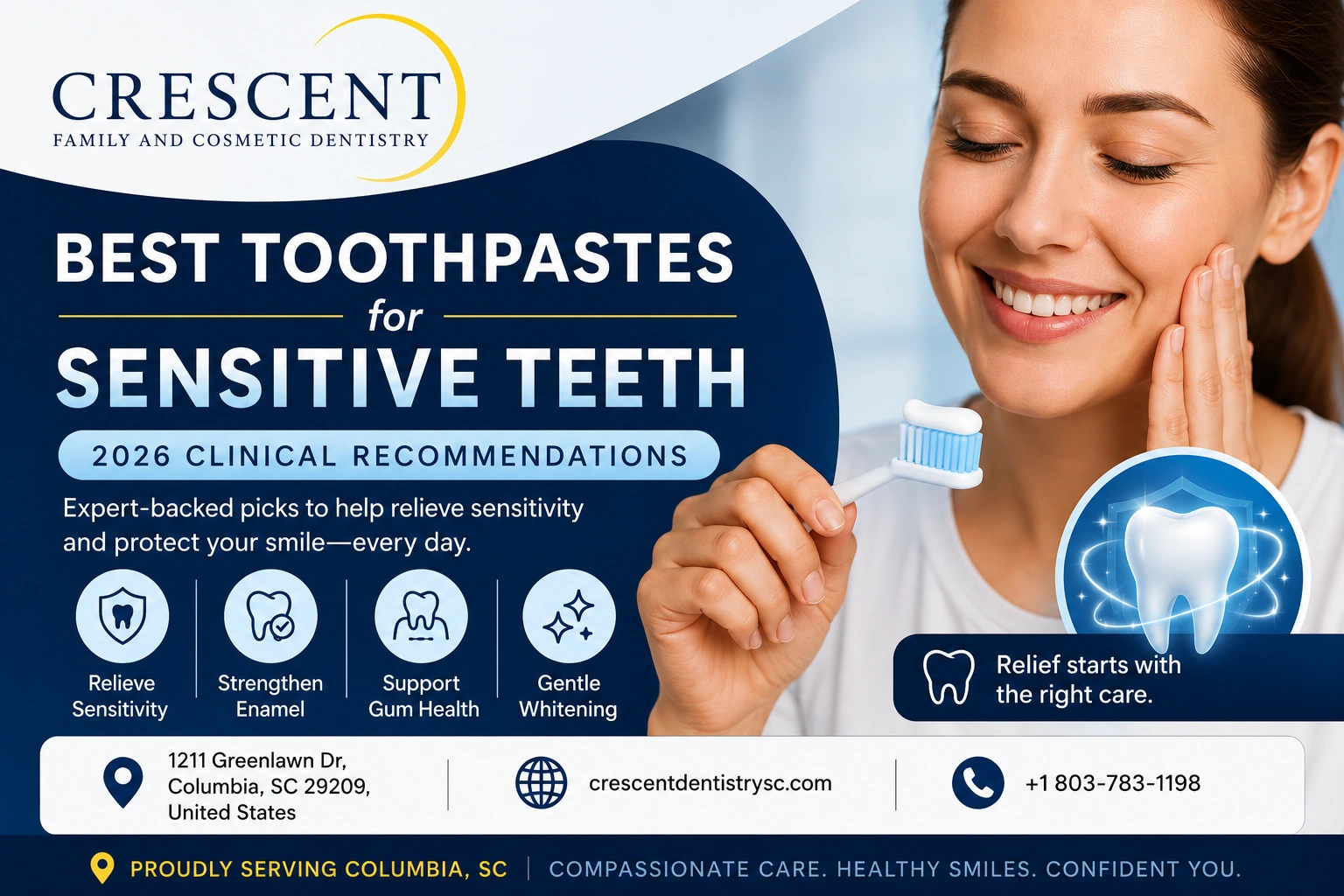
Comparison table: sensitive toothpastes at a glance
| Toothpaste | Desensitizing ingredient | Fluoride | Best for |
|---|---|---|---|
| Sensodyne Pronamel Gentle Whitening | Potassium nitrate | Yes | Everyday sensitivity with enamel wear or an acidic diet – our first pick |
| Crest Pro-Health Gum & Sensitivity | Stannous fluoride | Yes | Sensitivity plus bleeding gums or recession |
| Colgate Sensitive Maximum Strength | Potassium nitrate | Yes | Budget pick, widely available |
| Sensodyne Rapid Relief | Stannous fluoride | Yes | Faster relief for flare-ups |
| Sensodyne Repair and Protect | Stannous fluoride | Yes | Exposed dentin / repair focus |
| Colgate Sensitive Prevent & Repair | Potassium nitrate | Yes | Whitening-related sensitivity |
| Arm & Hammer Sensitive Teeth and Gums | Potassium nitrate | Yes | Baking-soda feel, gum support |
| Tom’s of Maine Rapid Relief Sensitive | Arginine + calcium carbonate | No | Fluoride-free preference (not for cavity-prone patients) |
Ingredients reflect current manufacturer labels at the time of review – always check the tube, as formulas change.
How we picked
Ingredient first, brand second. Three ingredient families have consistent clinical evidence for dentin hypersensitivity: potassium nitrate (calms the nerve), and stannous fluoride and arginine/calcium carbonate (block the exposed dentin tubules). Then fluoride, because most sensitive patients also have recession or enamel wear and need cavity protection. Then abrasiveness – low-abrasion pastes matter when roots are exposed. Then what our hygienists see patients actually stick with, because a toothpaste only works if you use it every day for a month.
Our picks, explained
1. Sensodyne Pronamel Gentle Whitening – best overall
Best for: daily sensitivity with enamel wear or acid exposure.
This is one of the easiest recommendations for patients who say, “Cold drinks bother me, but I also want something gentle enough to use every day.” It is designed for sensitive teeth, a good option for enamel-wear concerns, offers gentle rather than aggressive whitening, and is practical for daily use. This is a good first choice if your sensitivity feels general, not limited to one tooth.
2. Crest Pro-Health Gum & Sensitivity – best with gum problems
Best for: sensitivity with bleeding gums, gum irritation, or recession risk.
This type of toothpaste is useful when sensitivity is not the only issue. If your gums bleed or feel tender, or if your dentist has mentioned gingivitis or recession, a stannous fluoride toothpaste may be a better fit. Stannous fluoride can help with sensitivity and also has benefits for plaque and gingivitis control. The ADA notes that toothpastes may contain ingredients beyond fluoride to help with sensitivity, gingivitis, tartar buildup, enamel erosion, whitening, or breath concerns.
3. Colgate Sensitive Maximum Strength – best budget
Best for: reliable sensitivity relief without paying premium prices.
This is the kind of toothpaste many patients can find at grocery stores, pharmacies, big-box stores, and online. It is usually easy to find, often less expensive than specialty formulas, a good basic desensitizing option, and a reasonable first step for mild sensitivity. If cost matters, start here before assuming you need the most expensive tube on the shelf.
4. Sensodyne Rapid Relief – best for fast relief
Best for: short-term flare-ups or sensitivity that needs quicker calming.
Rapid-relief formulas are designed for people who want noticeable improvement sooner. They are not magic, and they still need consistent use, but they may be helpful if cold drinks, brushing, or air sensitivity are bothering you regularly. The key is consistency. Do not rotate between five toothpastes and expect a clear result.
5. Sensodyne Repair and Protect – best repair-focused
Best for: ongoing sensitivity from exposed dentin or enamel wear.
Repair-style formulas are aimed at helping block exposed dentin tubules – the tiny channels that can transmit cold, air, or touch sensations toward the nerve. A systematic review found evidence supporting several desensitizing toothpaste ingredients, including potassium-based formulas, stannous fluoride, calcium sodium phosphosilicate, and arginine-containing toothpastes for dentin hypersensitivity. That does not mean every product works equally for every person. It means the ingredient matters.
6. Colgate Sensitive Prevent & Repair – best whitening-sensitive
Best for: patients who want some whitening benefit without jumping to harsh whitening toothpaste.
Whitening toothpaste can be tricky if you already have sensitive teeth. Some formulas are too abrasive or irritating for certain patients. A sensitive whitening toothpaste may be a better compromise if your main goal is stain control, not dramatic whitening. But be realistic: toothpaste removes surface stain. It does not bleach teeth the way professional whitening does.
7. Arm & Hammer Sensitive Teeth and Gums – best baking-soda option
Best for: patients who like a baking soda feel and want sensitivity support.
Some people love baking soda toothpastes because they leave the mouth feeling very clean. Others find the texture or taste too strong. This can be a reasonable option if you want sensitivity relief and prefer Arm & Hammer’s formula style. Just avoid brushing harder because the paste feels “gritty.” Sensitivity often gets worse when people scrub.
8. Tom’s of Maine Rapid Relief Sensitive – fluoride-free, with a warning
Best for: patients who specifically want fluoride-free sensitivity toothpaste.
This may be reasonable for some adults who strongly prefer a fluoride-free option, but here is the clinical caveat: for most patients, we still prefer fluoride toothpaste. Fluoride helps prevent cavities. The ADA states that toothpastes with an ADA Seal cavity-prevention claim must contain fluoride. If you are cavity-prone, have dry mouth, exposed roots, orthodontic history, gum recession, or frequent dental work, do not drop fluoride casually. Ask your dentist first.

How Can I Overcome Fear of Going to the Dentist?
If the thought of sitting in a dental chair makes your stomach turn, you’re definitely not alone. Dental anxiety is…

Sensodyne vs Colgate Sensitive vs Crest: which is better?
None is better across the board. Sensodyne’s line is built around sensitivity and offers both potassium nitrate (Pronamel) and stannous fluoride (Rapid Relief, Repair and Protect) formulas. Colgate Sensitive uses potassium nitrate and is usually the least expensive way to get it. Crest Pro-Health Gum & Sensitivity is the pick when gums are the bigger problem, because stannous fluoride also reduces plaque and gingivitis. Choose by ingredient and by your other symptoms, not by brand.
Best natural or fluoride-free toothpaste for sensitive teeth
If you want fluoride-free, choose one with a real desensitizing ingredient – arginine/calcium carbonate (Tom’s Rapid Relief) or nano-hydroxyapatite – and accept that you give up cavity protection. We do not recommend fluoride-free for anyone with recession, dry mouth, a history of cavities or braces. Charcoal pastes are too abrasive for sensitive teeth.
What ingredient should you look for?
Potassium nitrate
Potassium nitrate helps calm the nerve response inside the tooth over time. It is one of the most common sensitivity ingredients and suits cold sensitivity, general sensitivity, sensitivity in several teeth, and patients who want a traditional desensitizing toothpaste. It usually takes consistent use. Do not expect one brushing to solve months of sensitivity.
Stannous fluoride
Stannous fluoride can help block sensitivity and also support gum health and plaque control. It suits sensitivity plus gum concerns, root exposure, bleeding gums, and patients who want an all-in-one toothpaste. Some stannous fluoride formulas can leave temporary staining in certain mouths, although many newer formulas are designed to minimize that.
Arginine and calcium carbonate
These ingredients are used in some rapid-relief formulas to help plug exposed dentin tubules. They suit patients who want tubule-blocking sensitivity relief, people who do not respond well to potassium nitrate, and certain fluoride-free or alternative formulas.
Hydroxyapatite
Hydroxyapatite is popular right now, especially in “enamel repair” and more natural-positioned products. Some research supports nano-hydroxyapatite and related formulas for dentin hypersensitivity, but evidence quality varies by ingredient and study design. A Cochrane network meta-analysis found that several interventions were better than placebo or standard fluoride toothpaste, while noting varying certainty of evidence. Hydroxyapatite may be reasonable for some patients, but we would not automatically choose it over fluoride for someone at higher cavity risk.
What Crescent recommends first, and how to use it
For most adults with mild to moderate sensitivity, we would usually start with a fluoride toothpaste containing potassium nitrate or stannous fluoride, used twice daily for at least two to four weeks. Do not rinse aggressively after brushing. Spit out the excess, but let a thin layer of toothpaste stay on the teeth. For a very sensitive spot, some patients can dab a small amount of sensitivity toothpaste on the area before bed. Ask your dentist first if you have crowns, veneers, gum recession, or unexplained pain. Brushing technique matters as much as the paste – see what our team actually uses.
When sensitivity toothpaste is not enough
Sensitive toothpaste is reasonable when several teeth are mildly sensitive, cold sensitivity goes away quickly, the problem is stable, there is no swelling or biting pain, you recently had whitening or a cleaning, and your dentist has ruled out decay or cracks.
Call a dentist if one tooth hurts more than the others, pain lingers after cold or heat, you have pain when biting, sensitivity wakes you up, you see a hole, crack, or dark spot, a filling or crown feels loose, your gums are swollen, or you have facial swelling or drainage. That pattern is what we see with cracked teeth, failing fillings and early nerve inflammation – the fix is a filling, crown, gum treatment or root canal, not a different tube. To understand the causes, read why teeth become sensitive to hot and cold.
How long should it take to work?
Most sensitivity toothpastes need two to four weeks of consistent use. Some rapid-relief products may help sooner, but ongoing relief still depends on daily use. If there is no improvement after a month, do not keep switching brands forever. Book a dental exam – the problem may not be the toothpaste.
Frequently asked questions
What is the best toothpaste for sensitive teeth?
A fluoride toothpaste with potassium nitrate or stannous fluoride. Our everyday pick is Sensodyne Pronamel Gentle Whitening; Colgate Sensitive Maximum Strength is the budget equivalent.
Is Sensodyne better than Colgate Sensitive?
Not necessarily – both use potassium nitrate in their standard sensitive formulas. Sensodyne offers more stannous fluoride options; Colgate is usually cheaper.
Is Sensodyne better than Crest?
For pure sensitivity they are comparable; Crest Pro-Health Gum & Sensitivity is the better choice if you also have bleeding gums.
Is stannous fluoride better than potassium nitrate?
Neither is always better. Potassium nitrate helps calm nerve response over time. Stannous fluoride can help block sensitivity and may also support gum health. Some patients respond better to one than the other.
How long does sensitive toothpaste take to work?
Two to four weeks of twice-daily use. If nothing changes after a month, the cause is probably not something toothpaste can fix.
Can sensitive toothpaste fix a cavity?
No. Sensitive toothpaste may temporarily reduce discomfort, but it will not repair decay. A cavity needs dental treatment.
Should I use whitening toothpaste if my teeth are sensitive?
Use caution. Choose a toothpaste made for sensitivity with gentle whitening rather than an aggressive whitening formula.
When should I see a dentist for sensitive teeth?
See a dentist if sensitivity lasts more than a few weeks, affects one tooth more than others, causes biting pain, lingers after cold or heat, or comes with swelling, a crack, or a visible dark spot.
Still sensitive after a month? Let’s find the cause
Crescent Family and Cosmetic Dentistry – 434 N Guignard Dr, Sumter – (803) 773-5411 · 656 Bultman Dr, Sumter – (803) 778-2337 · 1211 Greenlawn Dr, Columbia – (803) 784-1304.
Sharp pain when drinking hot or cold beverages?
Let our dental team help you choose the best toothpaste for sensitive teeth and improve daily comfort.