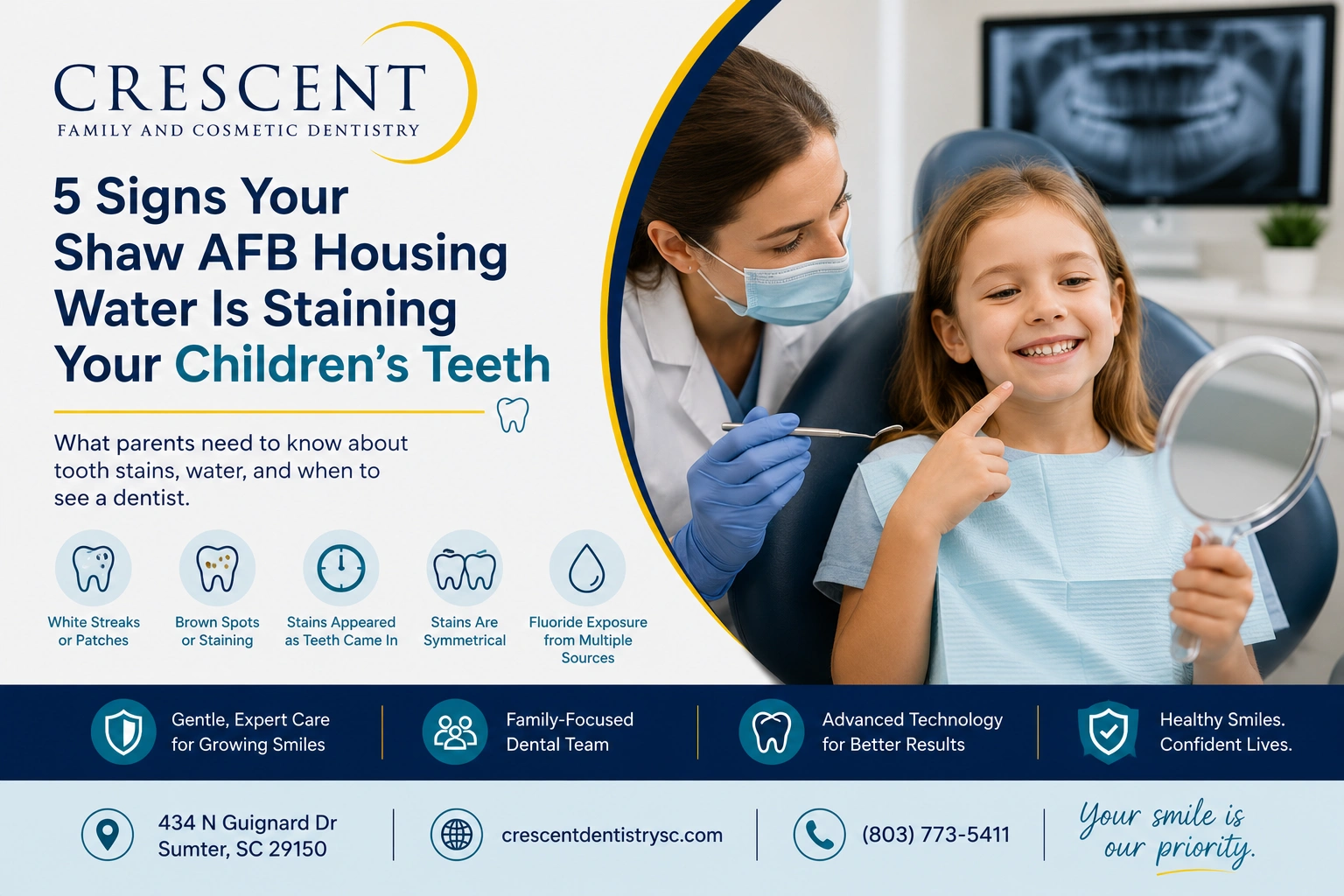
5 Signs Your Shaw AFB Housing Water Is Staining Your Children’s Teeth
Parents near Shaw AFB ask this question more often than you might think:
“Is the water in base housing staining my child’s teeth?”
The honest answer is: possibly, but water is only one of several causes of tooth staining in children. Before you blame Shaw housing water, it is worth knowing what water-related staining usually looks like, what it does not look like, and when a dentist should check it.
Some stains are harmless surface stains. Some are early cavities. Some are developmental enamel changes. And some may be related to fluoride exposure while the adult teeth were forming.
The important thing is not to panic. The important thing is to know the signs.
Crescent Family & Cosmetic Dentistry serves families in Sumter and Columbia, South Carolina, including many military families stationed near Shaw Air Force Base. If you are new to the area and noticing changes in your child’s teeth, a simple exam can usually separate surface staining from something that needs treatment.
Noticing White, Yellow, or Brown Spots on Your Child’s Teeth?
Call now for a gentle dental checkup and personalized treatment options.
The direct answer
Water-related tooth staining in children usually shows up as white streaks, chalky patches, brown spotting, or discoloration that appears in a pattern across several teeth.
The most common water-related dental concern is dental fluorosis, which can happen when children consume too much fluoride from any source while adult teeth are still developing under the gums. The CDC says fluorosis can only develop before about age 8, while enamel is forming; older children, teens, and adults cannot newly develop fluorosis after the teeth have already erupted.
That does not mean fluoride is bad. At the right level, fluoride helps prevent cavities. The issue is balance: not too little and not too much.
The City of Sumter’s 2025 Annual Water Quality Report says Sumter’s water source is groundwater from deep wells and reports that the water meets or exceeds federal and state requirements. It also notes that substances can naturally enter water as it travels over land or underground, and that the presence of constituents does not automatically mean there is a health risk.
So this article is not saying Shaw AFB housing water is unsafe. It is saying parents should know what to look for and when to have stains checked.
Sign 1: White streaks or cloudy patches on several adult teeth
This is the classic fluorosis pattern.
Dental fluorosis often appears as faint white lines, streaks, or cloudy areas on the enamel. The American Dental Association says fluorosis occurs when younger children consume too much fluoride over long periods while teeth are developing under the gums. Once teeth come through the gums, a child cannot newly develop fluorosis on those teeth.
What parents may notice:
- White marks that do not brush off
- Similar marks on both sides of the mouth
- Streaks across front teeth
- Chalky-looking enamel
- Spots that were present when the adult teeth first came in
This is different from plaque. Plaque feels soft or fuzzy and may improve with brushing. Fluorosis is part of the enamel itself.
Most fluorosis in the United States is mild and cosmetic, not painful and not harmful to tooth function, according to the CDC.
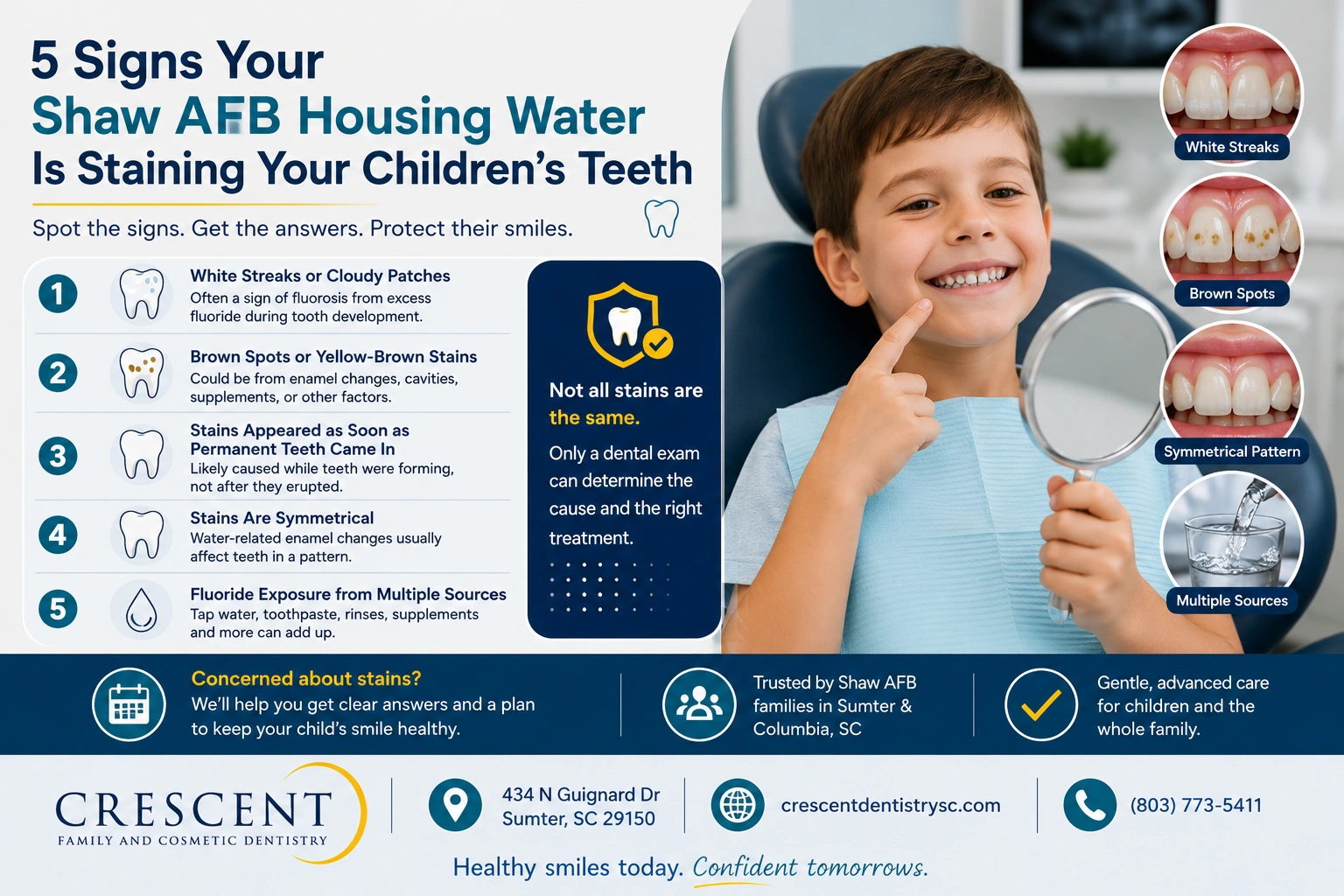
Sign 2: Brown specks or yellow-brown staining mixed with white spots
Mild white streaks are one thing. Brown spots are worth a closer look.
Brown staining may happen with more noticeable enamel changes, but it can also come from other causes, including:
- Cavities
- Poor brushing around braces
- Iron-containing vitamins or supplements
- Certain foods and drinks
- Enamel defects from childhood illness or trauma
- Chromogenic bacteria
- Old dental work
- Medication history
This is where parents get into trouble trying to diagnose stains at home.
Brown does not automatically mean “bad water.”
It also does not automatically mean “cavity.”
A dentist can tell whether the stain is sitting on the surface, inside the enamel, or caused by decay.
Sign 3: The stains appeared as soon as the permanent teeth came in
Timing matters.
If the marks were already there when the adult teeth erupted, the issue likely happened while the tooth was forming. That can point toward fluorosis or another enamel-development issue.
If the stains appeared months or years after the teeth came in, water is less likely to be the only explanation.
For example:
| When the stain appeared | More likely possibilities |
| Present as soon as adult tooth erupted | Fluorosis, enamel defect, developmental issue |
| Appeared after braces | Plaque scars, early enamel damage, hygiene difficulty |
| Appeared near the gumline | Plaque, tartar, early decay, brushing issues |
| Appeared on one tooth only | Trauma, cavity, old filling, enamel defect |
| Appeared after new vitamins or medicines | Supplement-related staining |
This is why the phrase “water staining” can be misleading. Water-related enamel changes usually have a developmental timeline. They do not usually show up overnight on fully formed teeth.
Sign 4: The stains are symmetrical
Water-related enamel changes often affect teeth in a pattern.
You may see similar white or brown marks on matching teeth, such as both upper front teeth or several teeth that developed around the same time.
A single dark spot on one molar is less likely to be a water issue and more likely to be a cavity, stain in a groove, old sealant, or enamel defect.
A useful parent rule:
Patterned stains across several teeth may be developmental. One isolated dark spot should be checked for decay.
Sign 5: Your child is under 8 and gets fluoride from several sources
For younger children, the question is not just “What is in the water?”
It is “How much total fluoride is my child getting?”
Children can get fluoride from:
- Tap water
- Toothpaste
- Fluoride mouth rinse
- Prescription fluoride supplements
- Bottled water
- Formula mixed with fluoridated water
- Professional fluoride treatments
The CDC recommends that children ages 3 to 6 use no more than a pea-sized amount of toothpaste, and children under 3 use only a smear about the size of a grain of rice. Parents should also teach children to spit, not swallow, toothpaste.
This matters because young children swallow toothpaste easily. For many families, swallowed toothpaste contributes more to fluoride exposure than parents realize.

How Often Should You Visit the Dentist for Optimal Oral Health?
Skipping dental visits might seem harmless—but it can cost you more than you think. Many people wait until something hurts…

What about Shaw AFB housing water specifically?
For families in or near Shaw AFB housing, the practical step is to identify your actual water provider and review the current water report.
Depending on exactly where you live, your water may be connected to a base system, City of Sumter, or another local provider. Sumter’s report says the City routinely monitors drinking water under state and EPA requirements, reports no violations for the listed system, and provides contact information for questions or concerns.
The CDC also advises parents of children under 8 to contact the organization they pay for water to ask about fluoride levels, and to test well water or bottled water through proper channels if needed.
So the best next step is not guessing. It is asking:
“What is the fluoride level in the water my child drinks every day?”
What else can stain children’s teeth?
A lot.
Before assuming the water is the cause, consider these common culprits.
Surface stains
These sit on top of the tooth and may come from tea, soda, sports drinks, berries, sauces, or poor brushing. Some children also develop dark staining from harmless pigment-producing bacteria.
Early cavities
Early enamel damage may look white and chalky before it turns brown or forms a hole. This is common near the gumline, between teeth, or around braces.
Enamel hypoplasia
This means the enamel did not form normally. It can appear as pits, grooves, yellow-brown areas, or thin enamel.
Trauma
A baby tooth injury can sometimes affect the developing adult tooth underneath. A single discolored adult tooth may also need evaluation.
Iron supplements
Some liquid iron supplements and vitamins can leave dark stains, especially if they sit on the teeth.
Braces or aligner hygiene issues
White squares or chalky marks after braces are usually not from water. They are often from plaque sitting around brackets for too long.
Should you filter the water?
Maybe. But do not buy a filter out of fear.
Some filters remove fluoride. Some do not. The CDC specifically recommends checking with the filter manufacturer to see whether a filter removes fluoride.
This is important because removing fluoride is not automatically better. Too little fluoride can increase cavity risk, especially in children who are cavity-prone.
Before switching your child exclusively to filtered, bottled, or reverse-osmosis water, ask a dentist or pediatrician whether your child still needs fluoride from another source.
The goal is not “no fluoride.”
The goal is the right amount of fluoride.
When should a parent call a dentist?
Call a dentist if you notice:
- White spots that do not brush off
- Brown or yellow stains on adult teeth
- A stain on only one tooth
- Rough, pitted, or chalky enamel
- Tooth sensitivity
- Bad breath with visible buildup
- Stains around braces
- A child who avoids chewing on one side
- Any spot that seems to be growing
A dental exam does not automatically mean your child needs treatment. Sometimes the answer is monitoring, better brushing, fluoride adjustment, sealants, or a professional cleaning. Other times, early treatment prevents a small cavity from becoming a bigger problem.
Treatment options if the staining is cosmetic
Treatment depends on the cause and your child’s age.
Possible options may include:
- Professional cleaning
- Fluoride adjustment
- Remineralizing products
- Resin infiltration for certain white spots
- Dental bonding
- Microabrasion
- Whitening later in the teen years
- Veneers only in select older cases
Most children do not need aggressive cosmetic dentistry.
If the stain is mild and the tooth is healthy, the best treatment may be patience, monitoring, and good prevention.
The honest bottom line
Your child’s tooth stains may be related to water, but they may also be caused by cavities, plaque, enamel defects, braces, supplements, or normal developmental changes.
For Shaw AFB and Sumter-area families, the smart move is simple:
- Find out your actual water provider.
- Ask about the fluoride level.
- Make sure your child uses the right amount of toothpaste.
- Have a dentist check any white, brown, or chalky spots that do not brush away.
If you are concerned about your child’s teeth after moving into Shaw AFB housing or the Sumter area, Crescent Family & Cosmetic Dentistry can help you determine whether the staining is cosmetic, developmental, or something that needs treatment. Our teams in Sumter and Columbia can also help you understand prevention options without over-treating a child’s smile.
FAQs
Can Shaw AFB housing water stain my child’s teeth?
It is possible for water chemistry to play a role in tooth appearance, especially fluoride exposure before age 8, but water is only one possible cause. A dentist can help determine whether stains are from fluorosis, plaque, cavities, enamel defects, or something else.
What does fluorosis look like?
Mild fluorosis often looks like faint white lines, streaks, or cloudy patches. More noticeable cases may include brown staining or pitted enamel, though moderate and severe fluorosis are uncommon in the United States.
Can my older child or teenager develop fluorosis now?
No. Fluorosis develops only while teeth are forming under the gums, generally before about age 8. Once the teeth erupt, they cannot newly develop fluorosis.
Should I stop giving my child tap water?
Not without checking the facts first. Fluoride at the right level helps prevent cavities. Contact your water provider for fluoride information and ask your dentist whether your child’s fluoride exposure is appropriate.
Are brown spots always cavities?
No. Brown spots can be stain, fluorosis, enamel defects, or cavities. But because cavities can look brown, a dentist should examine spots that do not brush off.
What is the biggest mistake parents make with tooth staining?
Waiting too long because the child is not in pain. Early cavities and enamel problems often do not hurt. A quick exam can prevent a small issue from becoming a bigger one.
Worried About Tooth Stains From Shaw AFB Water?
Schedule a kid-friendly dental evaluation today and get answers you can trust.