
The “Shaw AFB Discount” Myth: Understanding Your Actual TRICARE Dental Out-of-Pocket Costs
If you live near Shaw Air Force Base, it is easy to assume there is a special “Shaw AFB discount” for dental care.
Usually, there is not.
The real question is not, “Does this office give a military discount?” The better question is:
“Is this covered by TRICARE Dental, is the dentist in-network with United Concordia, and what is my actual cost-share?”
For many Shaw AFB families in Sumter, that difference matters a lot.
Think You're Getting a Shaw AFB Dental Discount? Verify Before You Pay
Many military families are surprised by their true dental costs. Get clear answers about TRICARE coverage, copays, and patient responsibility so you can make informed decisions with confidence.
The direct answer
For most eligible military families, dental savings come from the TRICARE Dental Program, not from a separate Shaw AFB discount.
The TRICARE Dental Program is a voluntary dental plan administered by United Concordia. It requires enrollment, monthly premiums, and cost-shares for covered dental services. TRICARE states that the plan is available to eligible active duty family members, National Guard and Reserve members, and eligible family members.
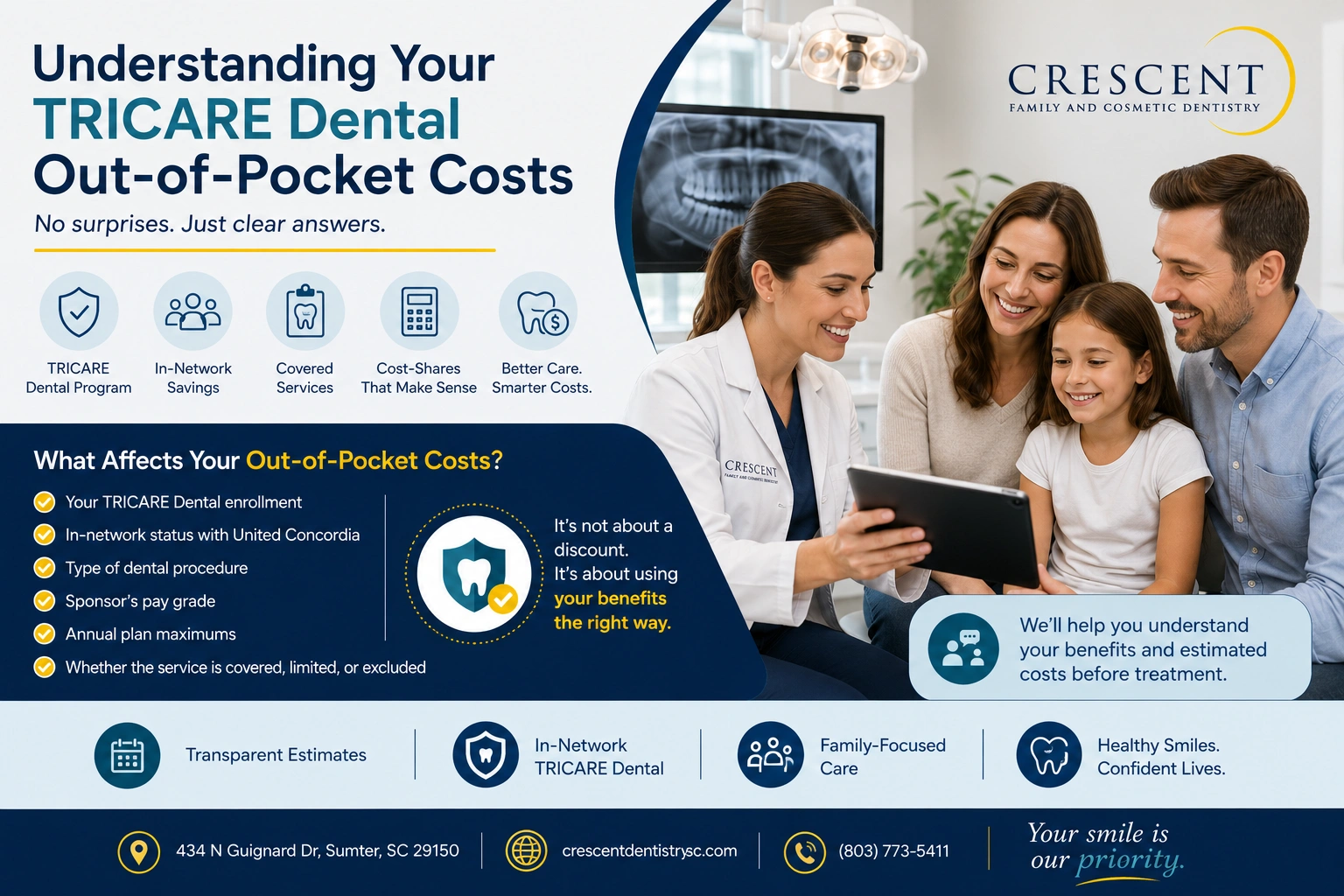
So if you are a Shaw AFB family member, your dental out-of-pocket cost usually depends on:
- Whether you are enrolled in TRICARE Dental
- Whether the dentist is in-network
- The type of dental procedure
- The sponsor’s pay grade
- Whether you have reached annual plan limits
- Whether the service is covered, limited, or excluded
A “military discount” may sound helpful, but it is often much less important than understanding your actual TRICARE benefit.
Why the “Shaw AFB discount” idea causes confusion
Many patients use “TRICARE,” “military insurance,” “base benefits,” and “discount” as if they all mean the same thing.
They do not.
Active duty service members are different from family members
Active duty service members generally use the Active Duty Dental Program, which complements care provided through military dental clinics and does not charge out-of-pocket costs for covered services.
Family members are different. They may be eligible for the TRICARE Dental Program, but that program is voluntary, requires enrollment, and includes monthly premiums and cost-shares.
That is where many surprise bills start.
A spouse may say, “We have TRICARE,” and expect the visit to be free. But for dental care, the plan may pay differently depending on the procedure.
What Shaw AFB families actually pay in 2026
For the TRICARE Dental Program, monthly premiums changed for the coverage year March 1, 2026 through February 28, 2027. TRICARE says the plan is a “pay ahead” program, meaning each payment covers the next month of coverage.
2026 TRICARE Dental monthly premiums
For active duty family members:
| Sponsor status | Enrollment type | Monthly premium |
| Active duty, E-4 and below | Single family member | $8.79 |
| Active duty, E-5 and above | Single family member | $11.72 |
| Active duty, E-4 and below | Family | $22.85 |
| Active duty, E-5 and above | Family | $30.47 |
For Selected Reserve and IRR categories, premiums are different and can be higher depending on sponsor status and enrollment type. TRICARE lists those 2026 rates separately.
The premium is only the first part. The bigger issue is what you pay when treatment is actually done.
TRICARE Dental cost-shares: the part patients often miss
A cost-share is the percentage of the covered service cost that you pay.
In the CONUS service area, which includes South Carolina, TRICARE Dental cost-shares are based on service category and sponsor pay grade.
Here is the practical version for Shaw AFB families.
| Dental service category | E-1 through E-4 cost-share | E-5 and above cost-share |
| Diagnostic care | 0% | 0% |
| Preventive care | 0% | 0% |
| Sealants | 0% | 0% |
| Office visit / consultation | 20% | 20% |
| Basic restorative care | 20% | 20% |
| Root canal treatment | 30% | 40% |
| Periodontal treatment | 30% | 40% |
| Oral surgery | 30% | 40% |
| General anesthesia | 40% | 40% |
| IV sedation | 50% | 50% |
| Nightguards / miscellaneous services | 50% | 50% |
| Crowns and other restorative care | 50% | 50% |
| Dental implants | 50% | 50% |
| Prosthodontics | 50% | 50% |
| Orthodontics, when eligible | 50% | 50% |
This is the part that surprises people.
A cleaning may be covered at 0%.
A filling may be covered very differently.
A crown may leave you responsible for about half of the allowed fee.
An implant may also fall into a 50% cost-share category.
That is not a Shaw AFB discount. That is your insurance structure.
A simple example: why “covered” does not mean “free”
Let’s say a military spouse needs a crown.
If the crown is covered under TRICARE Dental but falls under a 50% cost-share category, the patient may still owe about half of the allowed amount. That does not include possible deductibles, non-covered services, plan limits, upgrades, or services that require documentation.
A dentist might say, “TRICARE covers this.”
What patients often hear is, “TRICARE pays for this.”
Those are not the same thing.
A better question is:
“What is my estimated patient portion after TRICARE processes this claim?”
Why in-network status matters more than a discount
TRICARE specifically notes that using a TRICARE Dental Program network dentist can save you money, and patients can use United Concordia’s Find a Dentist tool or call United Concordia for help.
That matters because an in-network dentist has agreed to certain contracted fees for covered services.
A “10% military discount” at an out-of-network office may not beat the savings of using your actual TRICARE Dental network benefits.
Before assuming a discount is the best deal, ask:
- Are you in-network with United Concordia for TRICARE Dental?
- Is this procedure covered under my plan?
- What category does this procedure fall under?
- What is my cost-share?
- Does my annual maximum affect this?
- Are there any non-covered fees?
Those questions protect you better than simply asking, “Do you offer a Shaw discount?”

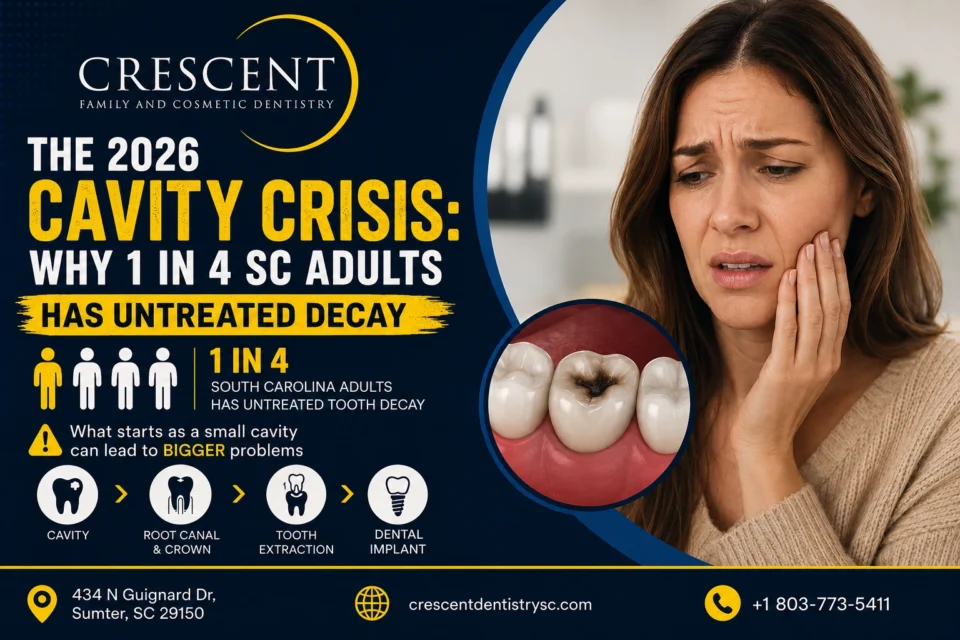
The 2026 Cavity Crisis: Why 1 in 4 SC Adults Has Untreated Decay
A lot of adults in South Carolina are walking around with untreated cavities. Not “maybe I should whiten my teeth”…
The annual maximum can change the real cost
TRICARE Dental has plan maximums. That means the plan does not pay unlimited benefits every year.
For non-orthodontic services, TRICARE lists an annual maximum of $1,500 per person, per contract year. Orthodontic treatment has a $1,750 lifetime maximum per person, and dental accident coverage has a $1,200 annual maximum per person, per contract year.
This is important for bigger treatment plans.
If you need several crowns, gum treatment, oral surgery, or implant treatment, your out-of-pocket cost may increase once plan limits are reached.
That is why a written estimate matters.
Common situations for Shaw AFB families
Routine cleaning and exam
For many enrolled TRICARE Dental patients, diagnostic and preventive services are often covered at a 0% cost-share.
That does not mean every possible service at a preventive visit is automatically free. X-rays, fluoride, sealants, frequency limits, and eligibility rules can still matter.
Fillings
Basic restorative care has a 20% cost-share in the CONUS service area.
So a patient may still owe part of the allowed fee.
Root canal treatment
Endodontic treatment has a 30% cost-share for E-1 through E-4 sponsors and a 40% cost-share for E-5 and above sponsors in the CONUS service area.
This is one of those areas where families can be surprised. The tooth may hurt, the treatment may be necessary, and the plan may cover it—but there may still be a meaningful patient portion.
Crowns
Crowns often fall into “other restorative” categories, which TRICARE lists at a 50% cost-share in the CONUS service area.
A crown is not usually priced like a cleaning or small filling. Ask for an estimate before starting treatment.
Dental implants
Implant services are listed at a 50% cost-share.
That does not mean implants are inexpensive. It means that, when covered and subject to plan rules, the patient may still be responsible for a significant portion.
Orthodontics
Orthodontic services are listed at a 50% cost-share when eligible, with age and eligibility restrictions. TRICARE notes orthodontic coverage is available for enrolled family members, including children up to age 21 or 23 depending on student status, spouses up to age 23, and certain National Guard and Reserve sponsors up to age 23.
The lifetime orthodontic maximum also matters.
What Crescent recommends before treatment
If you are stationed at or near Shaw AFB and using TRICARE Dental, do not rely on vague answers.
Ask for a clear estimate that shows:
- The procedure code
- The expected TRICARE allowed amount
- The estimated insurance payment
- Your estimated patient portion
- Whether the dentist is in-network
- Whether the service is subject to a waiting period, age limit, frequency limit, or annual maximum
- Whether any part of treatment may not be covered
A good dental office should be able to explain this without making you feel difficult for asking.
You are not being cheap. You are being responsible.
The honest bottom line
There usually is no special “Shaw AFB discount” that magically lowers dental treatment costs.
For most military families around Sumter, the real savings come from understanding and using your TRICARE Dental Program benefits correctly.
Preventive care may cost little or nothing out of pocket. More involved treatment—like root canals, gum therapy, crowns, sedation, implants, and orthodontics—can still leave you with a meaningful patient portion.
If you are unsure what TRICARE Dental will actually pay, Crescent Family & Cosmetic Dentistry’s team in Sumter and Columbia can help you review your estimated benefits, understand your options, and make a treatment decision without pressure.
FAQs
Does Shaw AFB have a special dental discount?
Usually, no. Most savings come from TRICARE Dental network benefits through United Concordia, not a base-specific discount.
Is TRICARE Dental free for family members?
No. The TRICARE Dental Program is voluntary and includes monthly premiums and cost-shares for covered services.
Are cleanings free with TRICARE Dental?
Diagnostic and preventive care are listed at a 0% cost-share in the CONUS service area, but frequency limits and specific plan rules may still apply.
Does TRICARE Dental cover crowns?
Crowns may be covered when medically necessary, but they often fall into categories with a 50% cost-share. Ask for an estimate before treatment.
Does TRICARE Dental cover dental implants?
Implant services are listed at a 50% cost-share, but coverage depends on plan rules, eligibility, documentation, and annual maximums.
What is the biggest TRICARE Dental mistake?
Assuming “covered” means “free.” It does not. Covered services may still have cost-shares, limits, exclusions, and annual maximums.
Know Your Real TRICARE Dental Expenses Before Treatment Begins
Don't rely on rumors or assumptions about military dental discounts. Get a personalized explanation of your coverage and estimated costs from professionals who understand TRICARE benefits.