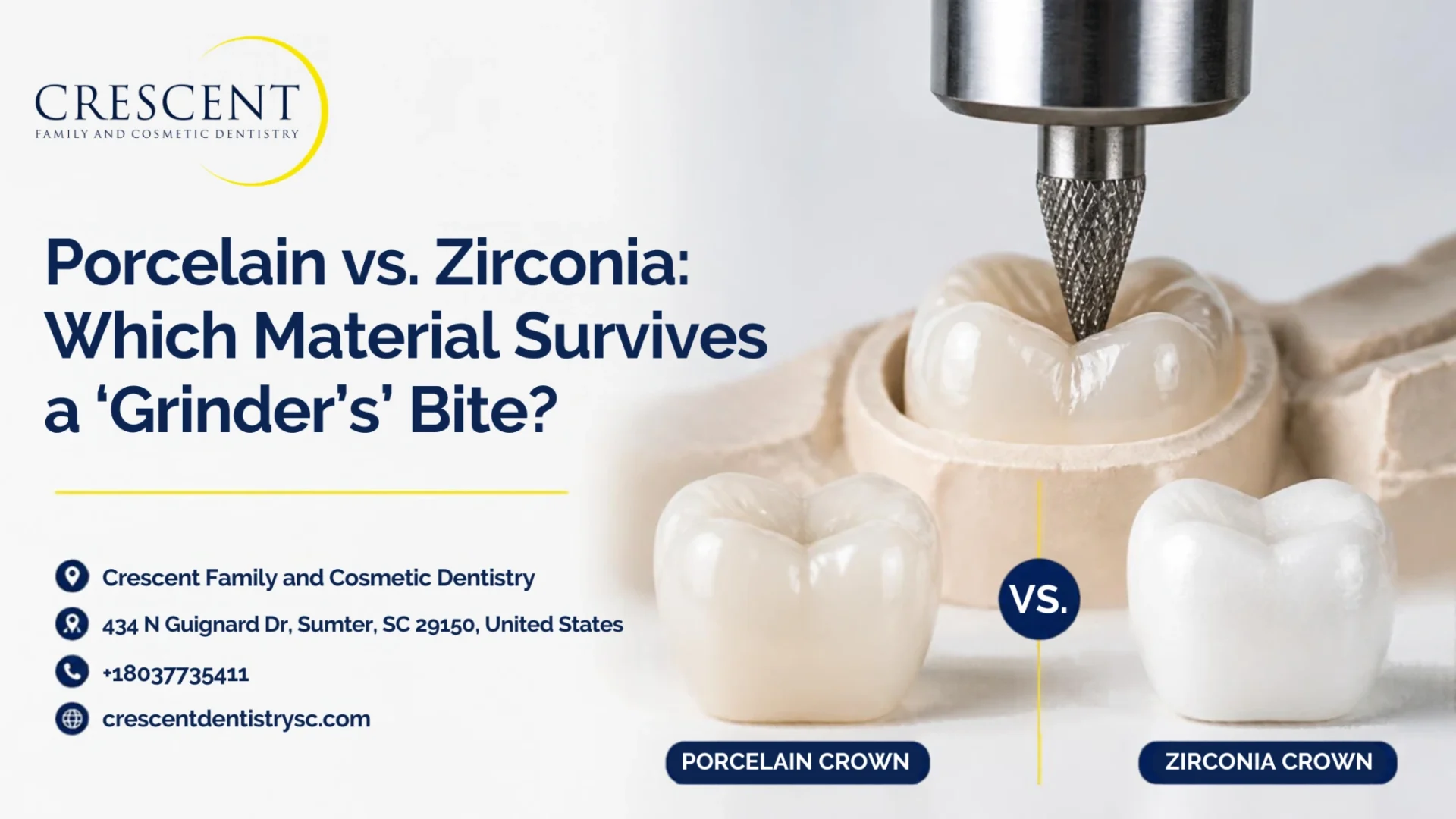
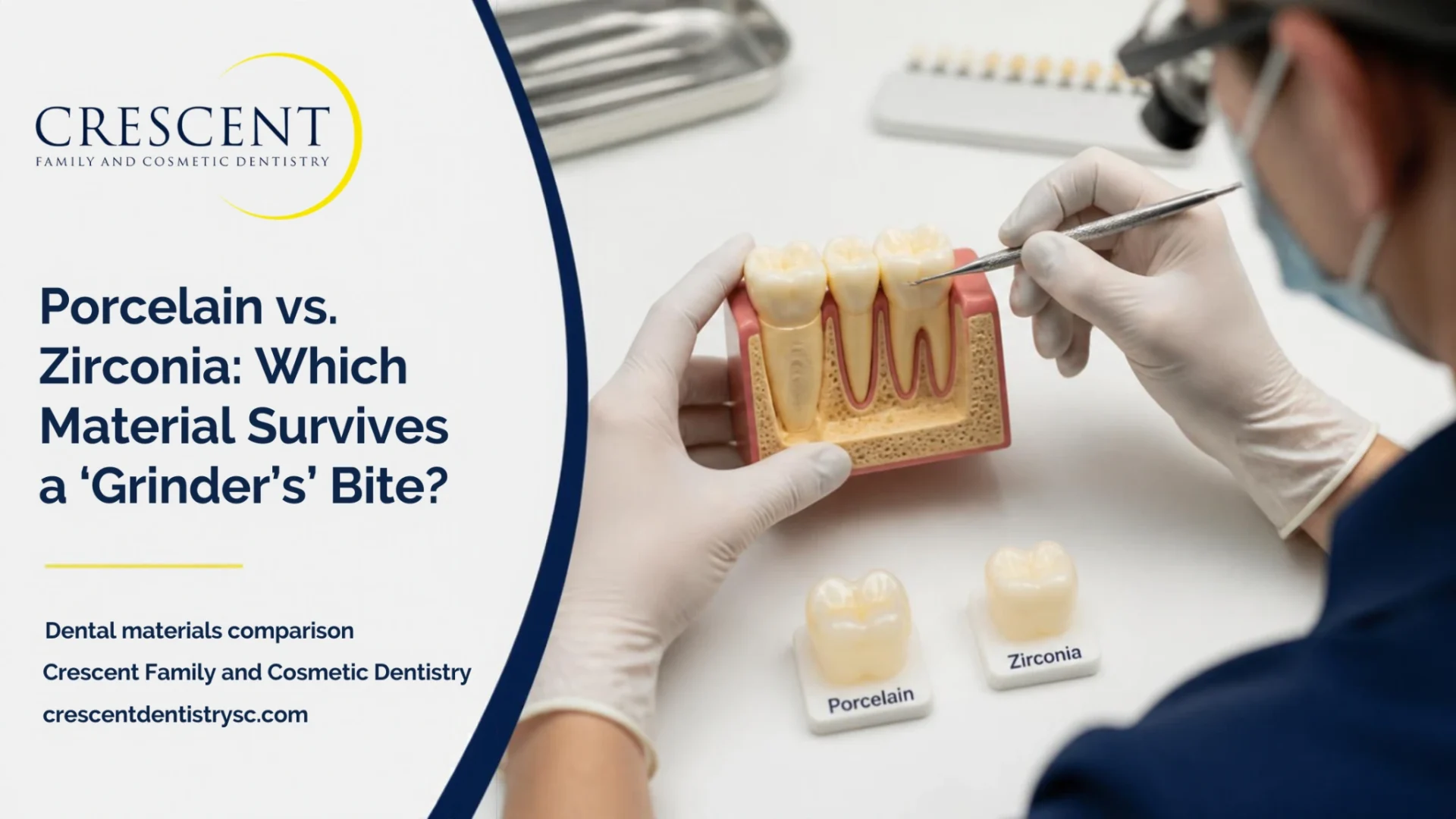
Porcelain vs. Zirconia: Which Material Survives a “Grinder’s” Bite?
Zirconia is generally stronger and more fracture-resistant than traditional dental porcelain, making it a common option for patients who grind or clench their teeth. However, modern porcelain-based ceramics, including lithium disilicate, can also perform well under heavy biting forces when properly selected and placed.
At Crescent Family and Cosmetic Dentistry, we help patients in Columbia and Sumter choose dental restorations that balance appearance, function, and long-term protection. If you have a history of teeth grinding, understanding how porcelain and zirconia crowns respond to pressure can help you make a more informed treatment decision.
Grinding Your Teeth? Protect Your Dental Crowns!
Find out whether porcelain or zirconia is right for your bite. Call now for a professional consultation!
Why Does Teeth Grinding Affect Dental Crowns?
Teeth grinding, medically known as bruxism, occurs when someone repeatedly clenches, grinds, or presses their teeth together.
It can happen during sleep or while awake.
Occasional grinding may not cause significant problems, but frequent or forceful bruxism can damage natural teeth and dental restorations.
Common signs include:
- Flattened or worn tooth surfaces
- Chipped or cracked teeth
- Morning jaw soreness
- Frequent headaches
- Tooth sensitivity
- Damaged fillings or crowns
- Tightness in the chewing muscles
Dental crowns are designed to restore damaged teeth, but they still experience the forces produced during chewing and clenching.
Grinding can expose a crown to repeated pressure, sliding movements, and concentrated stress.
Over time, these forces may contribute to ceramic fractures, chipping, restoration loosening, or damage to the underlying tooth.
This is why material selection becomes especially important for patients with significant bruxism.
What Is the Difference Between Porcelain and Zirconia Crowns?
Both materials can be used to create tooth-colored dental restorations, but their composition and mechanical properties differ.
Porcelain Dental Crowns
The term porcelain is often used broadly to describe tooth-colored ceramic restorations.
However, not all dental ceramics are the same.
Common types include:
Traditional feldspathic porcelain: Known for its natural translucency and appearance, but generally less resistant to fracture under heavy stress.
Lithium disilicate: A stronger glass-ceramic commonly used for crowns and other restorations. It provides a combination of strength, translucency, and natural-looking aesthetics.
Porcelain-fused-to-metal (PFM): A restoration with a metal framework covered by porcelain. The metal provides structural support, while the porcelain creates a tooth-colored appearance.
These materials have different mechanical properties, so comparing all porcelain crowns as though they were identical can be misleading.
Zirconia Dental Crowns
Zirconia is made from zirconium dioxide, a high-strength ceramic material.
Unlike traditional glass-based porcelain, zirconia has a crystalline structure associated with greater fracture resistance.
Modern zirconia restorations can be manufactured as a single solid structure or with an added porcelain layer.
Monolithic zirconia crowns are made primarily from one solid piece of zirconia, reducing the risk of an outer porcelain layer chipping.
For patients with significant biting forces, this structural difference can be useful.
Porcelain vs. Zirconia: A Comparison for Teeth Grinders
| Feature | Porcelain-Based Crowns | Zirconia Crowns |
| Strength | Varies significantly by ceramic type | Generally high |
| Fracture resistance | Traditional porcelain is more vulnerable; lithium disilicate is stronger | Often preferred for high-load situations |
| Appearance | Excellent translucency and color matching | Natural-looking, with differences between zirconia grades |
| Chipping risk | Depends on material and design | Lower risk with monolithic designs than layered restorations |
| Opposing tooth wear | Depends on ceramic and surface finish | Depends strongly on polishing and surface condition |
| Front teeth | Frequently suitable | Also suitable when aesthetics and strength are balanced |
| Back teeth | Strong ceramics may perform well | Common option for heavily loaded molars |
| Grinding protection | May benefit from a nightguard | May benefit from a nightguard |
Neither material is indestructible.
The tooth’s condition, crown thickness, bite forces, and quality of the restoration all influence long-term performance.
Which Crown Material Is Stronger Against Teeth Grinding?
Zirconia generally has higher flexural strength than traditional porcelain and many glass-based ceramics.
Flexural strength describes how much bending stress a material can withstand before breaking.
This property matters because dental crowns are exposed to substantial pressure during chewing and clenching.
Why Zirconia Handles Heavy Pressure
Zirconia has a dense crystalline structure and high fracture toughness compared with conventional porcelain.
Some zirconia materials also have a mechanism that helps resist crack propagation.
This means a small crack may be less likely to spread rapidly through the material.
These characteristics make certain zirconia formulations suitable for restorations exposed to substantial chewing forces.
However, not every zirconia product has identical strength.
Highly translucent zirconia materials may sacrifice some mechanical strength to achieve a more natural appearance.
Can Modern Porcelain Handle Bruxism?
Yes, in appropriately selected cases.
Lithium disilicate is considerably stronger than traditional feldspathic porcelain and has demonstrated favorable clinical performance in dental crowns.
A 2026 randomized clinical trial following 109 patients found high three-year survival rates for both monolithic lithium disilicate and zirconia molar crowns, including patients with sleep bruxism.
The study found no statistically significant difference in survival or complications between the materials.
Although these findings are encouraging, they don’t establish that both materials will perform identically over decades or under every grinding pattern.
Zirconia may offer a mechanical advantage in some high-stress situations, but that doesn’t mean every patient who grinds needs zirconia.
Are Monolithic Zirconia Crowns Better for Heavy Grinders?
Monolithic zirconia crowns are often considered when reducing the risk of ceramic chipping is a priority.
Traditional layered restorations have a stronger internal framework covered by an aesthetic porcelain layer.
Under repeated stress, that outer layer may chip even when the underlying structure remains intact.
Monolithic crowns avoid this particular layered construction.
A recent systematic review comparing dental crown designs found that monolithic lithium disilicate and monolithic zirconia restorations experienced fewer ceramic fractures and chipping complications than certain veneered alternatives.
However, the results do not mean monolithic crowns never fracture.
Their performance still depends on adequate crown thickness, proper preparation, precise fit, and carefully adjusted biting contacts.
At Crescent Family and Cosmetic Dentistry, we consider how a restoration will function in the patient’s mouth rather than recommending a material based on strength alone.
Can Zirconia Crowns Damage Opposing Natural Teeth?
Yes, zirconia crowns can contribute to wear on opposing teeth, particularly when their surfaces become rough.
However, the amount of wear depends on more than material hardness.
A smooth, properly polished zirconia crown may behave very differently from a roughened restoration.
Why Surface Finish Matters
When a crown repeatedly contacts a natural tooth, friction can gradually wear the opposing enamel.
A rough ceramic surface may increase abrasion.
Clinical research has produced varying results when comparing zirconia with other ceramics, partly because studies use different materials, polishing methods, and measurement techniques.
Some research suggests carefully polished zirconia performs favorably.
Other studies have found measurable opposing enamel wear associated with zirconia restorations.
The important point is that zirconia’s high strength does not automatically make it harmful to surrounding teeth.
The crown’s surface condition and the patient’s grinding pattern are important considerations.
What Happens When a Crown Is Adjusted?
Sometimes a new crown needs minor adjustments to ensure the patient can bite comfortably.
Grinding or adjusting a ceramic surface can change its smoothness.
Appropriate polishing after adjustments is important for reducing roughness.
Patients who notice that a crown feels rough or catches against another tooth should contact their dentist.
Which Looks More Natural: Porcelain or Zirconia?
Traditional porcelain and lithium disilicate are known for their ability to reproduce natural tooth translucency.
Natural teeth aren’t completely opaque.
Light passes through the enamel and interacts with the underlying dentin, creating subtle differences in color and brightness.
Glass-based ceramics can reproduce these characteristics effectively.
Porcelain for Front Teeth
For highly visible front teeth, aesthetic considerations may favor certain porcelain-based materials.
Lithium disilicate crowns can provide lifelike translucency while offering greater strength than traditional porcelain.
However, the restoration must still be appropriate for the patient’s biting forces.
Zirconia for a Natural-Looking Smile
Modern zirconia crowns are available in different shades and translucency levels.
They can produce attractive results, including in visible areas.
However, some stronger zirconia formulations are more opaque than glass-based ceramics.
More translucent zirconia varieties may provide improved aesthetics but can have different strength characteristics.
The most appropriate choice depends on tooth location, underlying tooth color, available space, and the desired appearance.
Does Crown Location Matter for Teeth Grinders?
Yes. Front teeth and back teeth perform different functions and experience different patterns of loading.
Front Teeth
Front teeth help cut food and play an important role in the appearance of your smile.
They can also experience significant sideways forces during grinding.
A patient who moves their jaw repeatedly from side to side may place considerable stress on front tooth restorations.
Material selection should account for these movements as well as appearance.

Professional In-Office Whitening vs. Crest White Strips: The Sensitivity Test
Most people interested in teeth whitening are not asking one question. They are asking two. First: “Which one works better?”…

Back Teeth
Molars handle substantial chewing pressure.
For patients who grind or clench heavily, their back teeth may experience significant repetitive loading.
Zirconia is frequently considered for posterior crowns because of its strength and fracture resistance.
However, lithium disilicate may also be suitable for selected molars.
The decision should reflect available crown thickness, remaining tooth structure, bite relationships, and other individual factors.
How Long Do Porcelain and Zirconia Crowns Last?
Both materials can provide many years of service when properly designed, placed, and maintained.
A 2026 systematic review of dental crown studies reported estimated five-year survival rates of approximately:
- 98.5% for monolithic lithium disilicate crowns
- 96.8% for monolithic densely sintered zirconia crowns
- 97.3% for veneered zirconia crowns
These figures represent pooled results across different patient populations and clinical circumstances.
They are not specific survival predictions for people with severe bruxism.
They also should not be interpreted as proving that one material always lasts longer.
A crown can remain functional for years but still develop wear, loosening, chipping, or other complications.
At Crescent Family and Cosmetic Dentistry, we encourage patients to think of dental crowns as long-term restorations that still require maintenance.
Can a Nightguard Protect Porcelain and Zirconia Crowns?
A properly fitted nightguard can help protect dental crowns and natural teeth from damage associated with sleep bruxism.
A nightguard is an oral appliance worn over the teeth during sleep.
It creates a protective surface between the upper and lower dental arches.
For patients with restorations, this can help limit direct tooth-to-tooth contact.
Benefits of a Custom Nightguard
A professionally fitted nightguard may help:
- Protect crowns from direct grinding contact
- Reduce damage to natural tooth surfaces
- Distribute contact forces across the appliance
- Protect existing fillings and restorations
- Reduce certain symptoms associated with clenching in some patients
However, a nightguard does not necessarily eliminate the underlying grinding activity.
It is primarily a protective device, and its effect on jaw pain varies.
Do Zirconia Crowns Still Need Nightguards?
Possibly.
Even if a zirconia crown resists cracking, excessive forces can still affect the supporting tooth, surrounding tissues, or opposing teeth.
Patients with ongoing bruxism may benefit from an individualized nightguard recommendation regardless of crown material.
Why Does Crown Design Matter as Much as Material?
Choosing a strong ceramic is only one part of creating a successful restoration.
Poor crown design can create problems even when a strong material is used.
Several factors influence the result.
Available Tooth Structure
A crown needs adequate support from the underlying tooth.
If a tooth has extensive decay, large previous fillings, or substantial fractures, additional restorative work may be necessary.
A high-strength crown cannot compensate for every problem involving the tooth beneath it.
Crown Thickness
Different ceramics have minimum thickness requirements.
A crown that is too thin in a high-stress area may be more vulnerable to fracture.
Our treatment planning considers the space available for the restoration and the amount of healthy tooth structure that can be preserved.
Fit and Bite Contacts
A crown must fit properly around the prepared tooth and contact neighboring teeth appropriately.
Bite contacts also need to be evaluated.
A restoration that receives excessive concentrated pressure may experience complications regardless of its material.
Bonding and Cementation
The method used to secure a crown affects its stability.
Different ceramic materials require different surface treatments and cementation protocols.
Appropriate preparation and placement are essential for reliable long-term performance.
What If You Already Have a Broken Porcelain Crown?
A cracked or chipped crown should be evaluated before the damage becomes more extensive.
Small areas of damage may sometimes be repaired or smoothed, depending on the material and location.
However, a crown with a significant fracture, poor fit, or compromised underlying tooth may need replacement.
Signs Your Crown Needs Attention
Contact a dentist if you notice:
- A visible crack or broken piece
- Sharp edges irritating your tongue
- Pain when biting or chewing
- A loose or shifting crown
- New sensitivity beneath the restoration
- A change in how your teeth meet
Avoid chewing hard foods on the affected side until the crown has been assessed.
If the crown comes off, keep it in a safe container and contact your dentist. Don’t attempt to reattach it using household adhesives.
How Does Crescent Family and Cosmetic Dentistry Choose Crown Materials?
At Crescent Family and Cosmetic Dentistry, we provide restorative dental care, including custom dental crowns, for patients in Columbia, Sumter, and surrounding communities.
Our goal is to restore damaged teeth while considering the patient’s bite, oral health, and appearance preferences.
For patients who grind their teeth, we begin by examining existing tooth wear and checking for cracked teeth or damaged restorations.
We also review symptoms such as jaw soreness, clenching, and recurring crown fractures.
When discussing crown materials, we consider:
- Grinding history: Whether the patient regularly clenches or grinds their teeth.
- Tooth location: Whether the crown will restore a front tooth or back tooth.
- Remaining tooth structure: How much natural tooth support remains.
- Aesthetic goals: The desired color, translucency, and appearance.
- Restorative requirements: Which available material and crown design are appropriate.
We can also discuss protective measures and whether additional evaluation for bruxism is needed.
Not every patient requires the same type of restoration, and a material that works well for one person may not be the most appropriate choice for someone else.
How Can You Help Your Dental Crown Last Longer?
Patients who grind their teeth can take several steps to protect their restorations.
Wear a recommended nightguard. Consistent use may help reduce direct grinding-related damage.
Avoid chewing ice and hard objects. Biting pens, hard candy, or ice can place unnecessary stress on teeth and crowns.
Maintain good oral hygiene. Brush twice daily and clean between your teeth to protect the tooth and gums surrounding the restoration.
Address daytime clenching. If you notice yourself pressing your teeth together while concentrating, practice keeping your teeth slightly apart when your jaw is at rest.
Attend regular dental examinations. Routine visits help identify crown wear, bite changes, and early signs of complications.
Report changes promptly. A crown that suddenly feels loose, painful, or unusually high should be checked.
Protecting the underlying tooth is just as important as protecting the crown itself.
Frequently Asked Questions About Porcelain and Zirconia Crowns
Is zirconia better than porcelain for teeth grinders?
Zirconia generally has greater fracture resistance than traditional porcelain and may be preferred for heavily loaded teeth. However, stronger porcelain-based ceramics, including lithium disilicate, can also perform well in selected patients.
Can teeth grinding break a zirconia crown?
Yes. Although zirconia is strong, repeated excessive forces can contribute to fractures, loosening, and other complications. No dental crown is completely resistant to damage.
Are zirconia crowns harder on opposing teeth?
They can contribute to opposing tooth wear, particularly if the surface is rough. Proper polishing, crown design, and bite assessment are important for managing this risk.
Can I get porcelain crowns if I grind my teeth at night?
Possibly. The appropriate material depends on the type of porcelain, tooth location, grinding severity, and other factors. Your dentist may also recommend a protective nightguard.
Do zirconia crowns look like natural teeth?
Yes. Modern zirconia crowns can be designed to resemble natural teeth. However, certain glass-based ceramics may provide greater translucency for highly visible front teeth.
Which dental crown lasts longer, porcelain or zirconia?
Both can last many years. Long-term performance depends on the specific material, crown design, oral hygiene, grinding habits, and condition of the supporting tooth.
Protect Your Smile With Dental Crowns at Crescent Family and Cosmetic Dentistry
If you grind your teeth, choosing a dental crown involves more than selecting the strongest available material. You also need a restoration that fits your bite, protects the underlying tooth, and looks natural when you smile.
At Crescent Family and Cosmetic Dentistry, we help patients throughout Columbia, Sumter, and nearby South Carolina communities make informed decisions about restorative dental treatment.
Whether you have a cracked tooth, a worn-down molar, a damaged porcelain crown, or concerns about nighttime teeth grinding, our team can evaluate your dental health and discuss suitable treatment options.
We provide custom dental crowns using quality restorative materials and can help you understand the differences between available ceramic choices. If grinding is a concern, we can also discuss ways to protect your teeth and restorations from further damage.
Our approach focuses on restoring comfortable function while preserving as much healthy tooth structure as possible.
Concerned about how teeth grinding may affect your dental crowns? Schedule a consultation with Crescent Family and Cosmetic Dentistry today.
Let our team help you find a restoration that supports your bite, oral health, and long-term dental needs.
Strong Crowns Start With the Right Material!
Don't let teeth grinding damage your smile. Call today to explore durable dental crown options!