
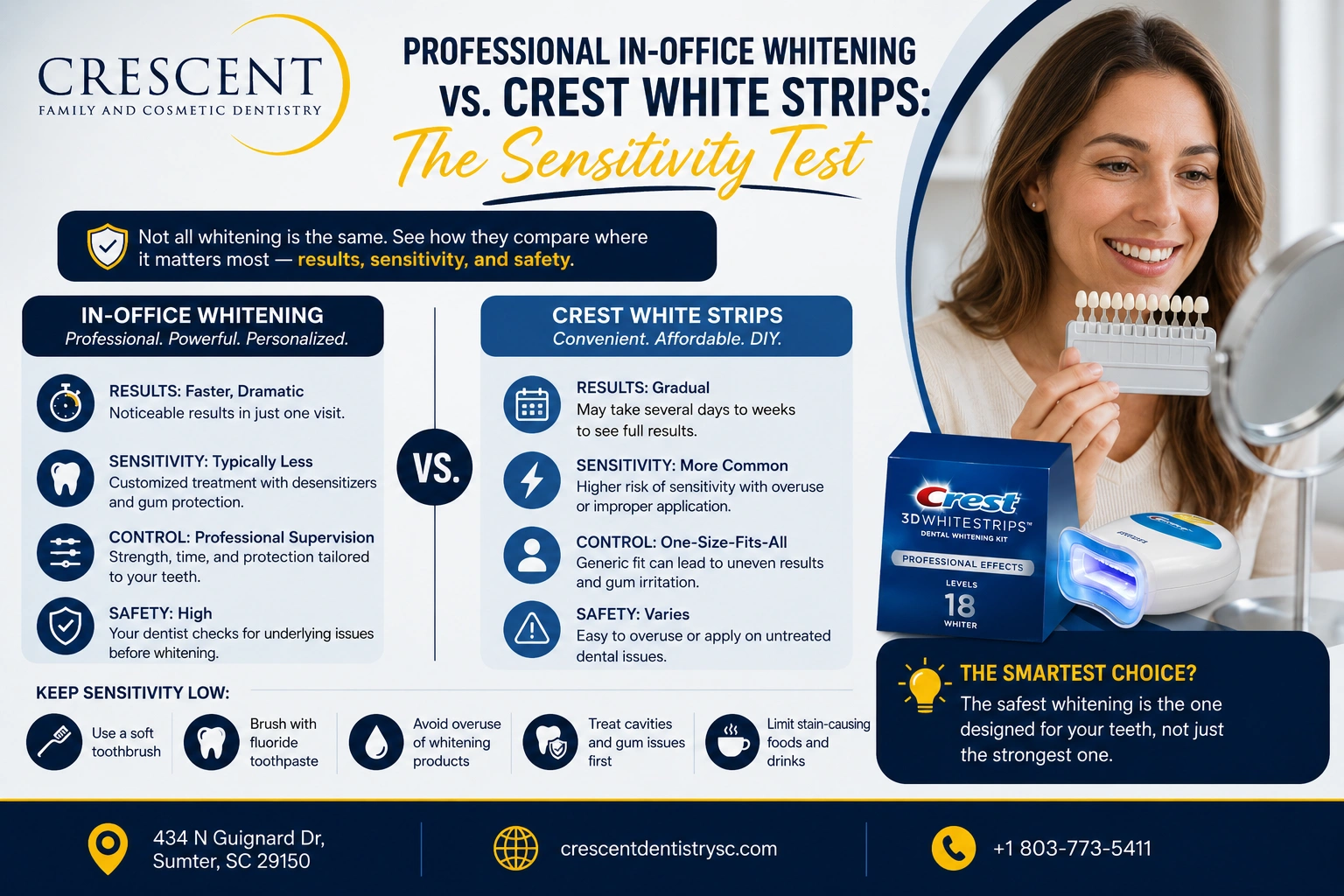
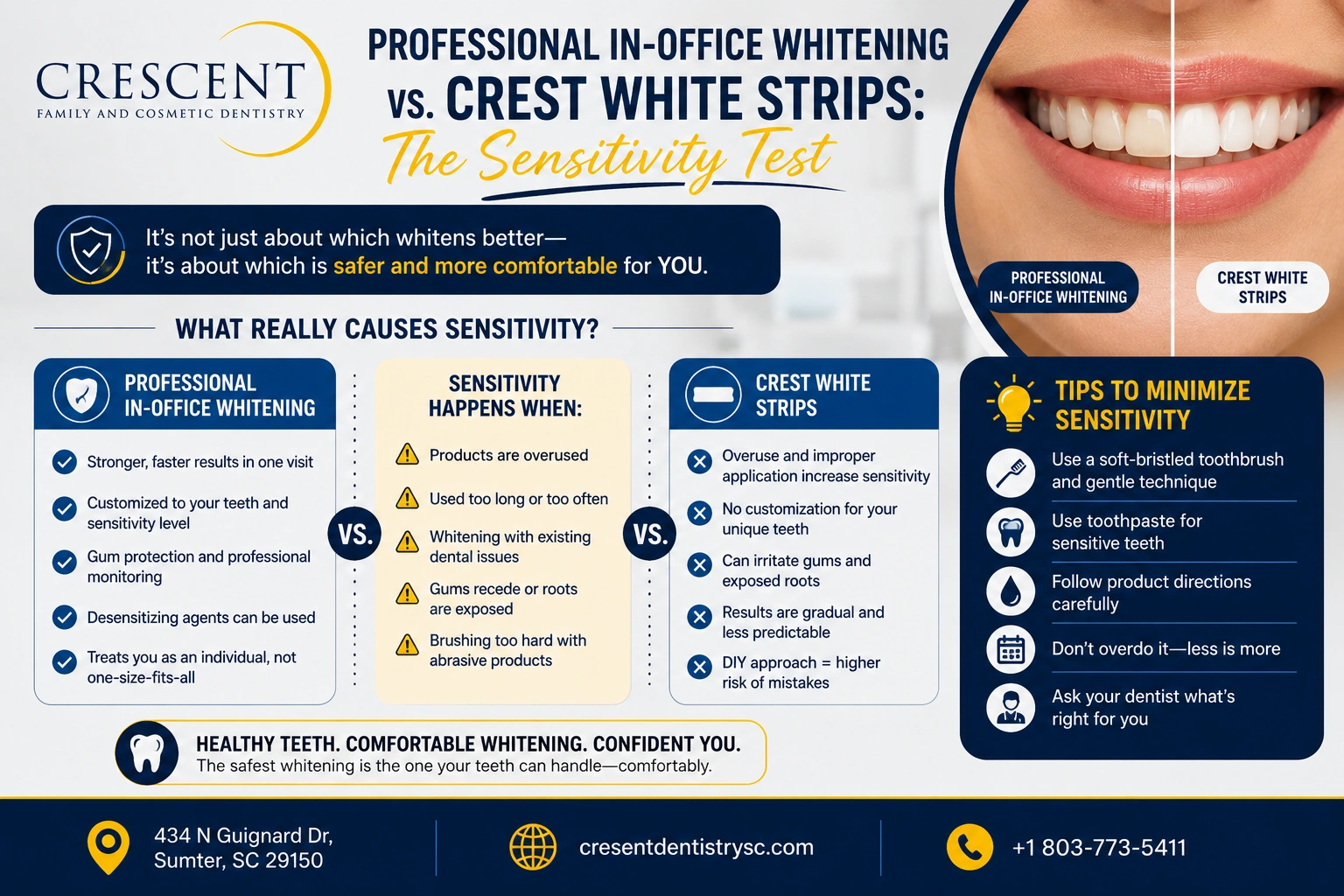
Professional In-Office Whitening vs. Crest White Strips: The Sensitivity Test
Most people interested in teeth whitening are not asking one question.
They are asking two.
First:
“Which one works better?”
But immediately after that comes the bigger concern:
“Which one is going to hurt less?”
Because almost everyone knows someone who tried whitening strips and spent the next two days wincing while drinking cold water.
Tooth sensitivity is the number one reason patients quit whitening early.
And honestly, it is also the reason many people assume professional whitening must be even worse.
Surprisingly, that is not always true.
At Crescent Family & Cosmetic Dentistry in Sumter and Columbia, patients constantly compare professional in-office whitening to Crest Whitestrips and other store-bought whitening systems.
And while whitening strips absolutely can work, the sensitivity experience is usually where the biggest differences show up.
Want Whiter Teeth Without the Sensitivity?
Get professional in-office whitening designed for powerful results with greater comfort. Call now to schedule your whitening treatment.
Here is the honest breakdown of:
- which option whitens faster
- which causes more sensitivity
- which patients are good candidates
- when strips are perfectly reasonable
- and when professional whitening is worth the higher cost
Because the truth is, most people do not actually need the strongest whitening possible.
They need the safest whitening their teeth can comfortably tolerate.
The Short Answer
Professional in-office whitening usually produces faster, stronger results.
But whitening strips often create more prolonged sensitivity because patients use them incorrectly, overuse them, or whiten without supervision.
That surprises people.
Many assume “professional” automatically means “more painful.”
Not necessarily.
In-office whitening is typically:
- more controlled
- more customized
- professionally monitored
- designed around gum protection
- adjusted for sensitivity risk
Meanwhile, over-the-counter whitening often becomes a DIY experiment.
Some patients use strips:
- too long
- too often
- on unhealthy teeth
- over exposed roots
- while already sensitive
That is where problems begin.
First: Why Whitening Causes Sensitivity at All
This part matters.
Whitening works because peroxide penetrates the enamel and breaks apart stain molecules inside the tooth.
That process temporarily increases tooth sensitivity in some people.
Especially if patients already have:
- gum recession
- enamel wear
- cracked teeth
- cavities
- exposed roots
- untreated grinding
- existing sensitivity
The whitening itself is not “damaging” healthy teeth when properly used.
But it can absolutely aggravate underlying issues.
That is why some people whiten comfortably while others feel sharp zingers for days.
Crest Whitestrips Actually Work Better Than People Think
Dentists are usually pretty honest about this.
Whitening strips are not fake.
They can genuinely improve tooth color.
Especially for:
- mild yellow staining
- coffee stains
- tea stains
- younger patients
- patients with naturally lighter enamel
For many adults, Whitestrips are a perfectly reasonable starting point.
Especially if:
- the staining is mild
- the budget is limited
- the patient has low sensitivity
- expectations are realistic
This is important because some dental offices unfairly pretend strips do nothing.
That is not true.
They can work surprisingly well in the right situations.
But Here Is the Big Limitation of Whitening Strips
Whitening strips are generic.
Your teeth are not.
That becomes a problem quickly.
Strips cannot account for:
- uneven tooth color
- crowns or veneers
- gum recession
- exposed roots
- cracked enamel
- sensitive areas
- existing dental work
- bite-related wear
Professional whitening can.
That customization is one reason in-office treatment often feels safer and more predictable.
The Biggest Whitening Mistake Patients Make
Overuse.
By far.
Patients often think:
“If some whitening is good, more must be better.”
So they:
- wear strips longer than directed
- use multiple rounds back-to-back
- combine strips with whitening toothpaste
- use whitening mouthwash simultaneously
- ignore developing sensitivity
That is when teeth start protesting.
And honestly, many whitening horror stories come from over-whitening, not whitening itself.
In-Office Whitening Usually Produces Faster Results
This part is straightforward.
Professional whitening systems are stronger and more efficient.
Many patients see significant improvement in a single appointment.
That is especially helpful for:
- weddings
- job interviews
- graduations
- photos
- special events
Whitening strips generally work more gradually over days or weeks.
That slower pace is not necessarily bad.
But patients expecting dramatic overnight whitening from strips often end up disappointed.
Professional Whitening Is Usually Better for Sensitive Teeth
This surprises patients the most.
A dentist-supervised whitening plan is often safer for sensitive teeth because the treatment can be adjusted.
That may include:
- lower concentrations
- desensitizing agents
- custom trays
- shorter applications
- gum protection
- staged whitening sessions
Dentists also evaluate whether whitening should happen at all.
For example, if a patient has:
- cavities
- gum recession
- exposed roots
- cracked fillings
- severe enamel wear
…whitening may need to wait.
Whitening unhealthy teeth is where many sensitivity problems begin.
Some Patients Should Avoid Whitening Altogether — At Least Temporarily
This is where honest dentistry matters.
Not everyone is a good whitening candidate immediately.
Patients may need treatment first if they have:
- untreated cavities
- active gum disease
- major enamel erosion
- exposed dentin
- severe tooth cracks
Whitening over these issues can become extremely uncomfortable.
A good dentist should tell patients when whitening is likely to create problems instead of simply selling treatment.

Beyond Aesthetics: The Hidden Health Benefits of Dental Crowns You Didn’t Know About
When you think about dental crowns, the first thing that probably comes to mind is their ability to restore a…
Whitening Toothpaste Is Usually the Worst Offender for Sensitivity
This is something many people misunderstand.
Whitening toothpaste does not work the same way as peroxide whitening.
Many whitening toothpastes rely heavily on abrasives.
Over time, aggressive whitening toothpaste can contribute to:
- enamel wear
- gum irritation
- worsening sensitivity
Especially when combined with:
- hard brushing
- electric toothbrush overpressure
- whitening strips
Sometimes patients think the strips caused their sensitivity when the real issue is abrasive brushing habits.
The “Hollywood White” Problem
A lot of whitening disappointment comes from unrealistic expectations.
Natural teeth are not paper white.
And not every person can safely achieve ultra-bright celebrity-level whitening.
Tooth color depends on:
- genetics
- enamel thickness
- dentin color
- age
- medications
- existing restorations
Some teeth whiten dramatically.
Others improve modestly.
The healthiest whitening is usually conservative whitening.
Not chasing unnaturally bright shades that require repeated aggressive treatment.
Dental Work Does Not Whiten
This matters a lot.
Whitening only affects natural tooth structure.
It does not whiten:
- crowns
- veneers
- bonding
- fillings
That means patients with visible dental work may experience uneven color changes.
This is one reason professional evaluation matters before whitening.
Especially for adults with older restorations. For patients thinking beyond whitening, comparing porcelain vs composite veneers can also help clarify which cosmetic option may be better suited to changing tooth color, shape, or overall appearance.
Coffee, Tea, Wine, and Smoking Matter More Than Whitening Brand
Patients often obsess over product comparisons while continuing habits that restain teeth constantly.
The biggest staining contributors are usually:
- coffee
- tea
- red wine
- smoking
- vaping
- dark sodas
No whitening system permanently overrides lifestyle habits.
Maintenance matters.
So Which Causes More Sensitivity?
Honestly?
Usually the option being misused.
For many patients, properly supervised professional whitening causes less overall sensitivity because:
- treatment is customized
- gums are protected
- underlying problems are screened first
- desensitizers can be used
- patients are monitored
Meanwhile, DIY whitening becomes riskier when patients:
- overdo it
- ignore instructions
- whiten damaged teeth
- combine multiple products aggressively
Who Is a Good Candidate for Whitening Strips?
Whitening strips are often reasonable for:
- mild staining
- younger patients
- patients with low sensitivity
- touch-up whitening
- budget-conscious patients
- patients without major restorations
For many people, they are a perfectly acceptable entry point.
Who Usually Benefits More From Professional Whitening?
Professional whitening often makes more sense for:
- heavy staining
- wedding prep
- fast results
- sensitive teeth
- uneven discoloration
- older dental work
- previous whitening failure
- patients wanting more predictable results
The Safest Whitening Is Usually Gradual Whitening
This is something dentists tend to agree on.
Slow, controlled whitening is usually healthier than aggressively trying to change tooth color overnight.
Extreme whitening trends often create:
- sensitivity
- enamel irritation
- unrealistic expectations
- repeated over-treatment
Natural-looking healthy teeth generally age better aesthetically than aggressively over-bleached teeth.
What the Crescent Team Usually Recommends
Honestly?
It depends on the patient.
For some people, Crest Whitestrips are completely reasonable.
For others, professional whitening is safer, more effective, and ultimately more comfortable.
The recommendation depends on:
- tooth sensitivity
- current dental health
- restorations
- whitening goals
- staining severity
- budget
- timeline
Good dentistry is not about pushing the most expensive option.
It is about matching the right option to the right patient.
The Bottom Line
Crest Whitestrips can absolutely work.
Professional in-office whitening usually works faster and more predictably.
But the real deciding factor for many patients is sensitivity.
And surprisingly, professionally supervised whitening is often more comfortable long term because it is customized to the patient instead of treated like a one-size-fits-all DIY project.
At Crescent Family & Cosmetic Dentistry, the goal is not unnaturally white teeth at any cost.
It is helping patients in Sumter and Columbia whiten safely, realistically, and comfortably without creating avoidable sensitivity problems in the process. This more personalized approach also reflects how cosmetic dentistry became a language of self-expression, with patients increasingly choosing treatments that match how they want their smiles to look and feel.
FAQs About Whitening Sensitivity
Do Crest Whitestrips actually work?
Yes.
They can noticeably improve mild to moderate staining for many patients.
Is professional whitening stronger?
Usually yes.
Professional systems are typically more concentrated and produce faster results.
Why do my teeth hurt after whitening?
Whitening temporarily increases tooth sensitivity in some patients, especially those with enamel wear, recession, or underlying dental issues.
Can whitening damage enamel?
Properly used whitening products are generally considered safe, but overuse and abrasive products can contribute to sensitivity and irritation.
What whitening option is best for sensitive teeth?
Often professionally supervised whitening because it can be customized and monitored.
Why are some teeth whitening unevenly?
Crowns, fillings, bonding, veneers, and natural tooth variation can all affect whitening uniformity.
How long does whitening last?
It depends heavily on diet, smoking, oral hygiene, and maintenance habits.
Is whitening worth it?
For many patients, yes.
Whitening is one of the simplest cosmetic dental treatments for improving smile appearance when done safely and realistically.
Skip the Strips. Get a Brighter Smile.
Choose professional teeth whitening for faster, more noticeable results without weeks of whitening strips. Call today to book your appointment.