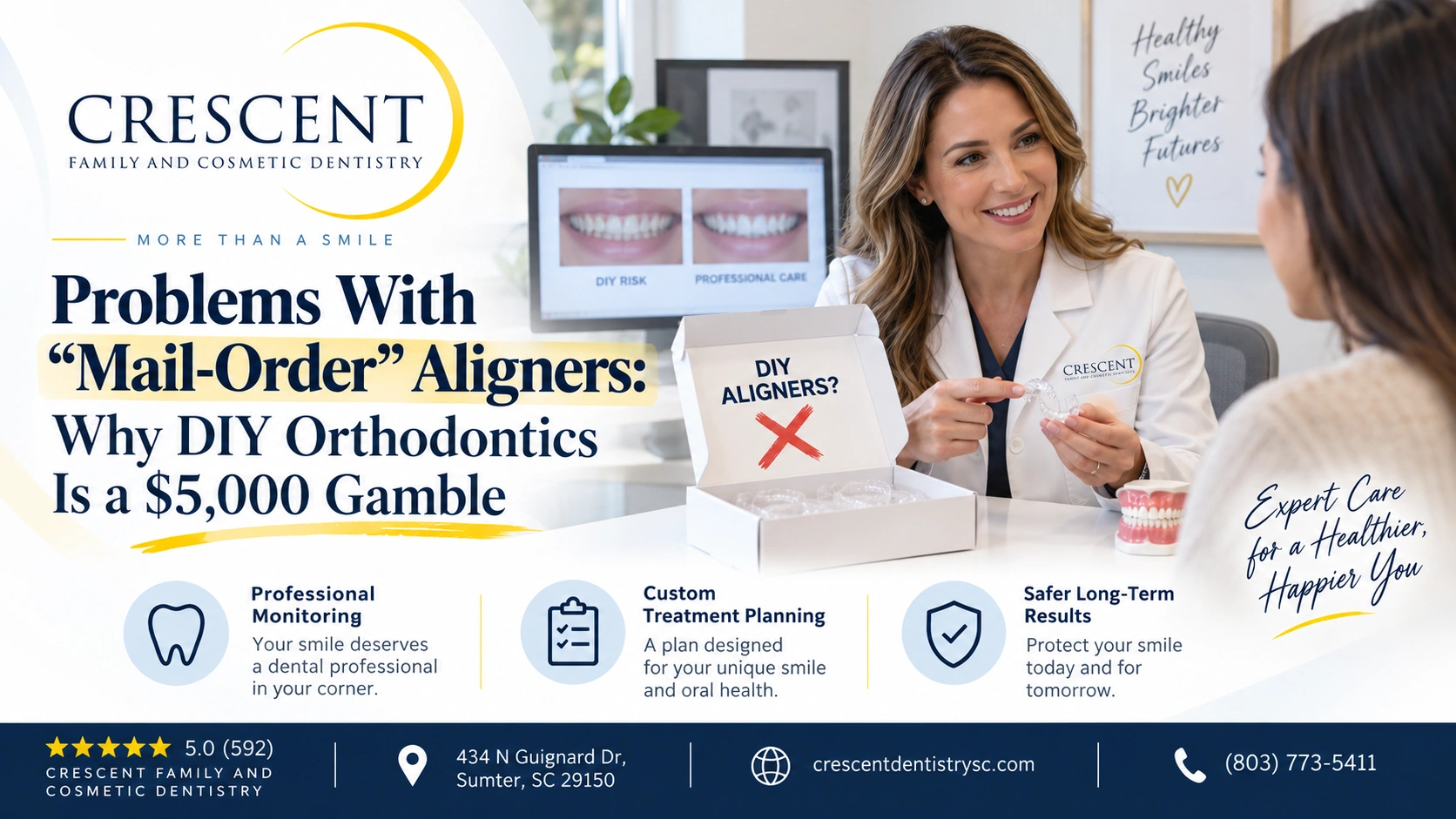
Problems With “Mail-Order” Aligners: Why DIY Orthodontics Is a $5,000 Gamble
Clear aligners have changed the way many adults think about orthodontic treatment. They are discreet, removable, and often easier to fit into a busy lifestyle than traditional braces.
That convenience has also created a market for mail-order aligner companies that promise straighter teeth with minimal in-person dental care.
At first glance, the appeal is obvious. You take impressions or scans, receive trays in the mail, and follow the treatment plan from home.
But orthodontic treatment is more than moving teeth from one position to another.
At Crescent Family and Cosmetic Dentistry, we want patients to understand that tooth movement affects the entire oral system, including the gums, roots, bite, jaw relationships, and supporting bone.
When aligner treatment is planned without a thorough dental evaluation or consistent professional monitoring, what looks like a money-saving shortcut can become an expensive problem to correct.
For some patients, the cost of repairing unsuccessful DIY orthodontic treatment can rival or even exceed the cost of professionally supervised aligner therapy.
That is why mail-order aligners can become a financial gamble rather than a bargain.
Why Mail-Order Aligners Look So Attractive
The marketing is simple.
Straighter teeth. Lower cost. Fewer appointments. Treatment from home.
For adults with work, family, and other responsibilities, avoiding multiple dental visits can sound convenient.
Mail-order aligner companies may also advertise treatment at a lower upfront price than traditional orthodontic care.
That price difference can make DIY treatment seem like the smarter financial choice.
But there is an important question to ask:
What is missing from that lower price?
Orthodontic treatment usually involves much more than receiving a series of trays.
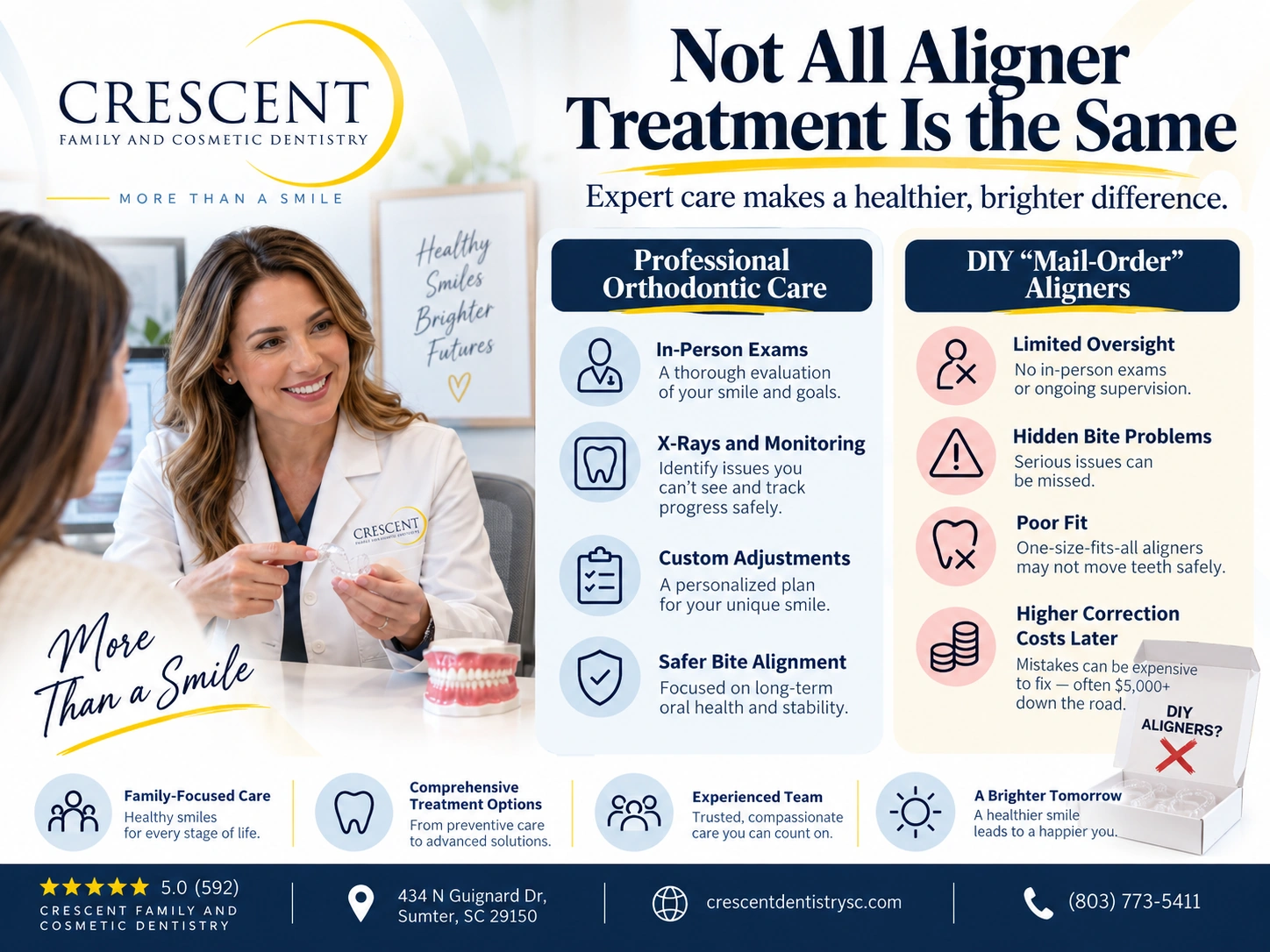
A professionally supervised treatment plan may include a comprehensive oral examination, diagnostic imaging when indicated, bite evaluation, gum health assessment, treatment planning, progress checks, modifications, and management of unexpected problems.
Removing some of those steps may reduce the advertised price.
It may also remove important safeguards.
Teeth Do Not Move in Isolation
One of the biggest misconceptions about orthodontics is that treatment simply pushes crooked teeth into straighter positions.
In reality, teeth are held in place by roots, periodontal ligaments, gums, and supporting bone.
Orthodontic movement creates controlled biological changes in those tissues.
That movement needs to be planned carefully.
A tooth that looks slightly crooked in a photograph may have a root position that requires special consideration. A patient may also have underlying gum disease, bone loss, cavities, impacted teeth, or bite problems that are not visible from a simple impression or selfie.
Without a complete evaluation, it can be difficult to understand the entire situation.
Moving teeth without knowing what is happening below the gumline can create unnecessary risk.
The Problem With Skipping X-Rays
One limitation of some remote orthodontic models is the lack of comprehensive diagnostic imaging before treatment.
X-rays can provide information that cannot be obtained from looking at the visible portions of the teeth alone.
Depending on the patient, dental imaging may help identify:
- Root positions
- Bone levels
- Impacted teeth
- Previous dental treatment
- Areas of infection
- Tooth decay
- Root abnormalities
- Wisdom teeth concerns
- Signs of periodontal bone loss
An impression may show where the crown of a tooth sits.
It does not necessarily tell us everything about what is happening underneath the gums.
Orthodontic treatment should take both visible alignment and underlying anatomy into consideration.
Gum Disease Can Make DIY Orthodontics Riskier
Before moving teeth, periodontal health matters.
If a patient has active gum disease, the supporting tissues around the teeth may already be compromised.
Moving teeth in the presence of uncontrolled periodontal disease may increase the risk of additional problems.
Some people do not realize they have gum disease because it can progress without significant pain.
Warning signs can include:
- Bleeding gums
- Persistent bad breath
- Gum recession
- Swollen gums
- Loose teeth
- Changes in the way teeth fit together
A dental professional can evaluate these concerns before orthodontic treatment begins.
With mail-order aligners, that screening may be limited or absent depending on the system being used.
Saving money on the initial treatment does not help if you later require periodontal care because an existing condition was overlooked.
Your Bite Matters Just as Much as Your Smile
Many patients pursue clear aligners because they want straighter front teeth.
That is understandable.
But orthodontic treatment cannot focus only on appearance.
The way your upper and lower teeth come together, known as your bite, affects chewing forces and how pressure is distributed across your teeth.
Moving the front teeth without carefully considering the back teeth can sometimes create bite problems.
Patients may notice:
- Teeth no longer meeting properly
- Difficulty chewing
- New areas of excessive pressure
- Tooth sensitivity
- Uneven contact
- Jaw discomfort
A smile can look straighter while the bite becomes less functional.
Professional orthodontic planning should consider both appearance and function.
DIY Treatment Cannot Always Adapt When Teeth Do Not Move as Planned
Orthodontic treatment does not always progress exactly according to the original digital simulation.
Teeth may move slower than expected.
One tooth may not track properly inside the aligner. An attachment may be needed. Interproximal reduction may be appropriate in certain cases. A treatment plan may require modification.
This is normal.
The important difference is how those problems are handled.
With professionally supervised treatment, progress can be evaluated and adjustments can be made when necessary.
With a largely remote system, a patient may continue wearing aligners without realizing that certain teeth are no longer following the intended movement.
If that continues for several stages, correcting the problem can become more complicated.
What Happens When the Aligners Stop Fitting?
One common warning sign of clear aligner problems is a tray that no longer fits properly.
You may notice:
- A visible gap between the aligner and a tooth
- The tray will not fully seat
- One tooth appears stuck in the same position
- Increasing pressure in an unexpected area
- A tooth moving differently than expected
With professionally monitored treatment, these changes can be evaluated before the patient moves too far into the sequence.
Continuing to the next set of trays when the teeth are not tracking correctly may make the treatment less predictable.
When a plan goes significantly off course, new scans, revised aligners, or additional orthodontic treatment may be necessary.
A Cheap Treatment Can Become Expensive Twice
This is where the financial gamble becomes important.
Imagine choosing mail-order aligners because they appear significantly less expensive than professionally supervised orthodontic treatment.
You complete part or all of the program but end up unhappy with your bite, tooth position, or appearance.
You may then need to pay for:
- A new orthodontic evaluation
- Diagnostic imaging
- New scans or impressions
- Professionally supervised clear aligners
- Traditional braces
- Dental restorations
- Gum treatment
- Bite correction
- Retainers
- Additional follow-up care
You effectively pay once for the DIY system and again for corrective treatment.
Depending on the complexity of the problem, the total cost can approach or exceed several thousand dollars.
That is why a lower starting price does not necessarily mean a lower final cost.
Could a $5,000 Professional Treatment Actually Be the Less Expensive Option?
Suppose professionally supervised clear aligner treatment costs around $5,000.
That figure can feel intimidating.
But if the treatment includes appropriate evaluation, personalized planning, monitoring, adjustments, and professional oversight, the cost represents more than a set of plastic trays.
Now compare that with a lower-cost mail-order program that does not achieve the desired result.
If you spend money on the original program and then require several thousand dollars in corrective orthodontics or restorative dentistry, the supposed savings disappear.
The exact numbers will vary from patient to patient.
The important point is that orthodontic value should be evaluated according to the entire treatment process, not just the initial advertised price.
What About Cavities During Aligner Treatment?
Dental health can change during orthodontic treatment.
A cavity can develop.
A filling can break.
A crown can become damaged.
A patient may develop gum inflammation.
These problems need to be identified and managed appropriately.
Routine dental care remains important throughout clear aligner treatment.
When orthodontics is coordinated with a dental team, changes in oral health can be addressed while treatment is underway.
A remote model may make that coordination more difficult if patients are not also keeping regular appointments with their local dentist.
Root Health Is Another Reason Monitoring Matters
Orthodontic forces affect the roots of the teeth.
Most patients complete properly planned orthodontic treatment without major root complications, but tooth movement still needs to be controlled.
Certain patients may have anatomical or dental factors that require closer evaluation.
This is another reason professional diagnosis matters.
It is difficult to assess root health from photographs or impressions alone.
When indicated, imaging can help dental professionals evaluate root position and supporting structures before or during treatment.
Online Simulations Are Not Guarantees
Seeing a digital preview of your future smile can be exciting.
But a simulation is still a treatment projection.
Your teeth are biological structures, not objects being rearranged on a computer screen.
Actual movement depends on factors such as anatomy, compliance, periodontal health, tooth shape, bone response, and treatment complexity.
A digital image showing perfectly aligned teeth does not guarantee that every tooth will move exactly as displayed.
Professional monitoring helps determine whether the real treatment is matching the digital plan.
Who Is a Good Candidate for Clear Aligners?
Many adults are excellent candidates for clear aligner therapy.
Clear aligners can potentially address concerns such as:
- Crowding
- Gaps between teeth
- Rotated teeth
- Certain bite issues
- Mild to moderate alignment concerns
However, not every case should be treated the same way.
Some patients may need additional orthodontic techniques, attachments, restorative treatment, periodontal care, or another treatment approach altogether.
The purpose of an orthodontic evaluation is not simply to sell aligners.
It is to determine what type of treatment is appropriate for your actual dental condition.
Why Professional Supervision Adds Value
When you receive professionally supervised clear aligner treatment, you are not simply purchasing trays.
You are paying for professional judgment.
Your dental provider evaluates where your teeth are now, where they should move, how they should move, and whether your gums and supporting structures are healthy enough for treatment.
Your progress can also be reviewed throughout the process.
If something unexpected happens, the treatment plan can be adjusted.
That ability to respond to real-world changes is a major part of the value.
What Should You Ask Before Starting Any Aligner Program?
Before committing money to any orthodontic system, ask several important questions.
Will I receive a complete dental evaluation first?
Your teeth and gums should be healthy enough for orthodontic treatment.
Will X-rays be taken if they are clinically necessary?
Some problems cannot be detected from an impression or scan alone.
Who is responsible for monitoring my treatment?
Know whether you will have access to a dentist or orthodontic provider if something does not feel right.
What happens if my teeth stop tracking?
Ask how refinements or treatment changes are handled.
Is my bite being evaluated or only my front teeth?
Cosmetic alignment should not come at the expense of function.
What happens if I develop a dental problem during treatment?
You should understand how cavities, broken restorations, gum problems, or other issues will be managed.
Are retainers included?
Maintaining the result after orthodontic treatment is an important part of the process.
Clear Aligners Are a Medical and Dental Treatment
The word “cosmetic” sometimes makes people assume orthodontics is similar to buying a whitening kit or another beauty product.
It is not.
Orthodontic treatment intentionally changes the position of teeth within the jaw.
That is a biological process involving living tissues.
Even when the primary goal is a better-looking smile, the treatment still affects oral health and function.
That is why professional oversight matters.
Saving Money Is Smart. Gambling With Your Teeth Is Different.
We understand why patients look for affordable options.
Dental and orthodontic treatment can represent a meaningful financial commitment, and comparing costs is responsible.
But the lowest advertised price is not always the best value.
The real question should be:
What level of evaluation, planning, supervision, and follow-up am I receiving for my money?
A professionally managed treatment may cost more upfront, but avoiding preventable complications can make it the more sensible investment in the long run.
Considering Clear Aligners? Start With an Evaluation
At Crescent Family and Cosmetic Dentistry, we believe patients should understand what is happening with their teeth before making a major orthodontic decision.
If you are considering clear aligners, especially after seeing an inexpensive mail-order offer, schedule an evaluation first.
We can examine your teeth and gums, evaluate your bite, discuss your smile goals, and help determine whether clear aligner therapy is appropriate for you.
And if you have already completed or started a mail-order aligner program and something does not feel right, we can evaluate your current dental condition and discuss possible next steps.
Before risking thousands of dollars on orthodontic treatment you may later need to redo, talk with the team at Crescent Family and Cosmetic Dentistry. A straighter smile should be planned around your long-term oral health, not just the lowest price on the screen.