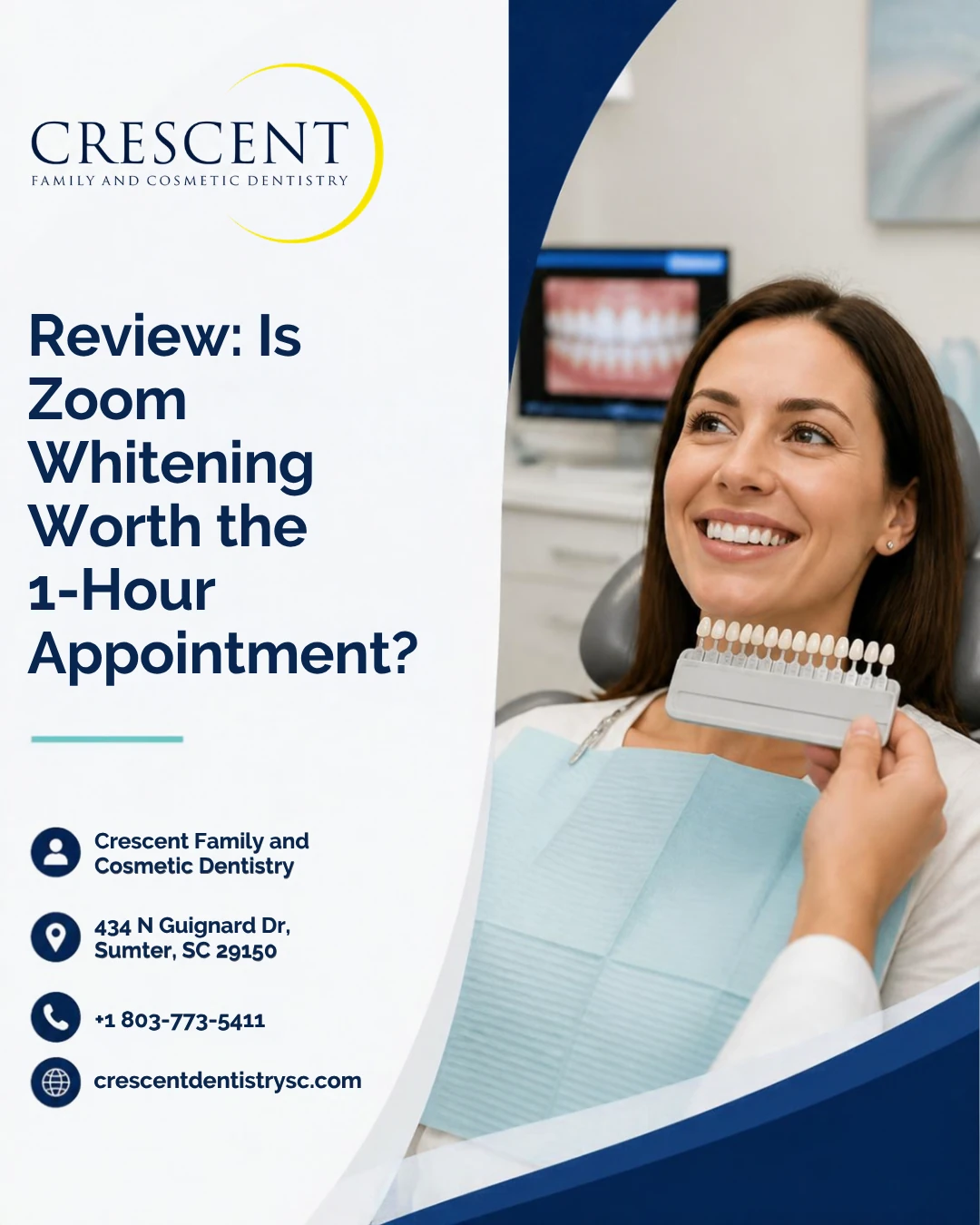
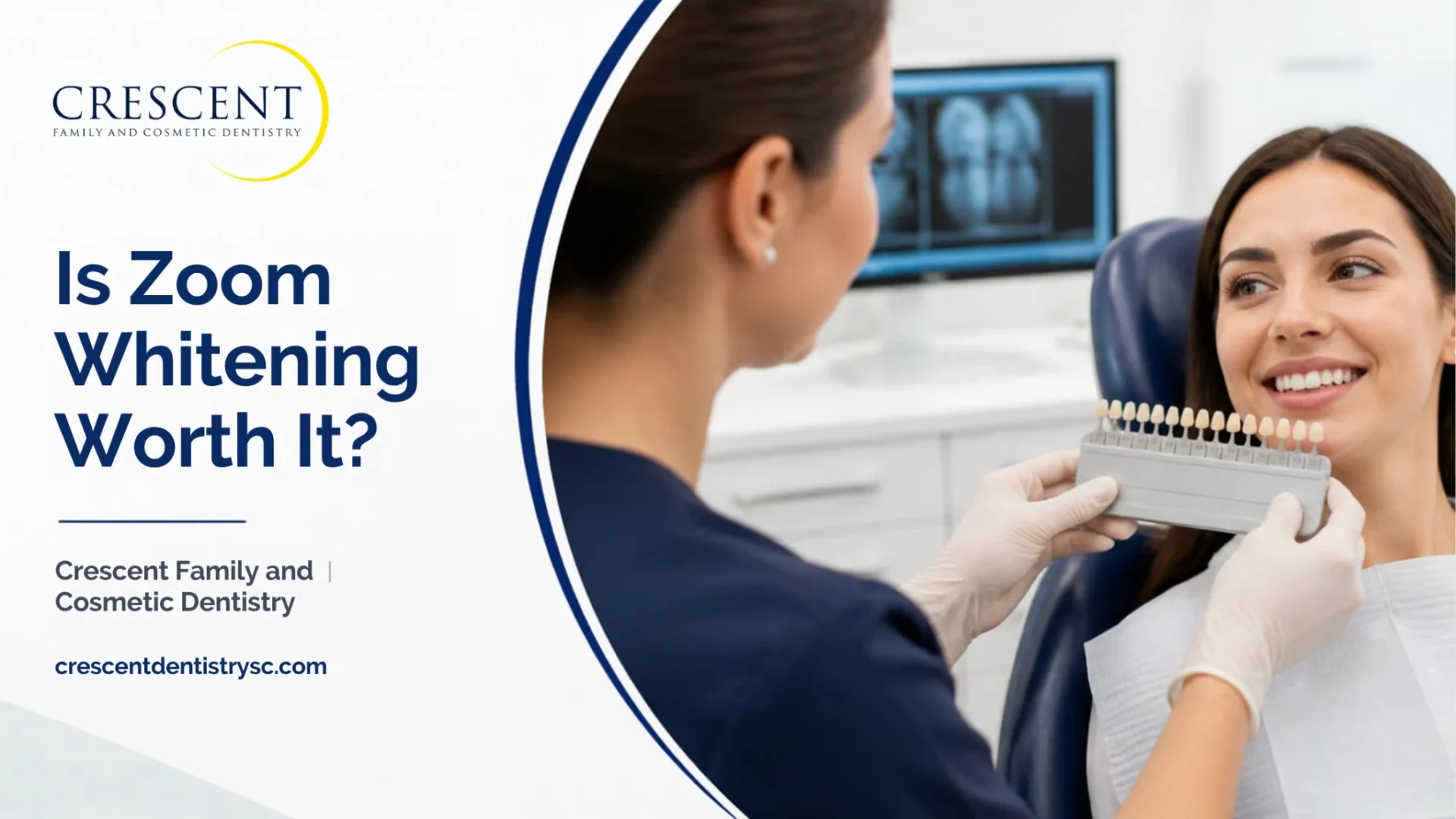
Review: Is Zoom Whitening Worth the 1-Hour Appointment?
Zoom whitening can be worth the one-hour dental appointment if you want a noticeably brighter smile quickly and would rather complete most of the whitening process in one visit instead of using trays or strips for days or weeks. Philips currently describes its Zoom WhiteSpeed system as a professional treatment capable of producing results in about 45 minutes, although the complete appointment may take longer once preparation and evaluation are included.
At Crescent Family and Cosmetic Dentistry, we think the more important question is not whether Zoom is the fastest option. It is whether professional in-office whitening makes sense for your teeth, sensitivity level, existing dental work, budget, and timeline.
What Is Zoom Teeth Whitening?
Philips Zoom is a professional whitening system designed to be used in a dental office.
The WhiteSpeed version combines hydrogen peroxide whitening gel with a blue LED lamp. Philips currently lists a 25% hydrogen peroxide procedural gel for the system and describes the standard treatment as three 15-minute whitening cycles, with an optional additional cycle when appropriate.
Before treatment begins, the dental team protects the gums and other soft tissues so the whitening material can be concentrated on the teeth.
The goal is to break down stain molecules within the teeth rather than simply polishing stains off the surface.
That difference matters.
A professional cleaning can remove plaque, tartar, and certain surface stains, but bleaching agents such as hydrogen peroxide can alter the color of natural tooth structure itself.
The American Dental Association explains that hydrogen peroxide and carbamide peroxide are the main active ingredients used in professional and consumer tooth-whitening products.
Does Zoom Really Take Only 45 Minutes?
The active whitening portion can take about 45 minutes.
Philips describes the WhiteSpeed procedure as three 15-minute sessions. Depending on the patient’s response and the dental professional’s judgment, a fourth cycle may sometimes be used.
However, patients should not assume they will walk into a dental office, sit down for exactly 45 minutes, and immediately leave.
A complete appointment may also include:
- Reviewing your dental history
- Checking your teeth and gums
- Discussing sensitivity
- Recording your starting shade
- Protecting your lips and gums
- Applying the whitening gel
- Completing the whitening cycles
- Rinsing and evaluating the result
- Discussing aftercare
That is why the popular description of Zoom as a “one-hour whitening treatment” is reasonable as shorthand, but the exact appointment length can vary.
The main advantage is still speed.
Instead of applying whitening products every evening for one or two weeks, you can achieve most of the change during one supervised visit.
Ready to Whiten Your Smile Fast?
Get professional Zoom Whitening with noticeable results in about an hour. Call now to book your visit.
How Much Whiter Can Zoom Make Your Teeth?
Philips advertises whitening of up to eight shades in one visit with its WhiteSpeed system.
The phrase “up to” is important.
Not every patient will become eight shades lighter.
Your result depends on several factors, including:
- Your starting tooth shade
- The type of staining
- Age
- Enamel thickness
- Previous whitening
- Smoking or tobacco use
- Coffee, tea, or wine consumption
- Certain medications
- Existing dental restorations
Yellowish staining often responds more predictably than some gray, blue, or deeply internal discoloration.
The ADA also notes that bleaching outcomes vary according to the cause of discoloration and the characteristics of the patient’s teeth.
Whitening should therefore be viewed as a way to brighten your natural shade, not as a guarantee that every patient will reach the same bright-white result.
Is Zoom Better Than Whitening Strips?
It depends on what you mean by “better.”
If your priority is speed, professional in-office whitening has an obvious advantage.
Whitening strips can work, but they normally require repeated use over a period of days or weeks. The ADA notes that professional in-office procedures use different concentrations and protocols from over-the-counter whitening products, while strips generally contain lower concentrations of peroxide.
In-office whitening also gives your dentist greater control over:
- Where the gel is placed
- How the gums are protected
- How long whitening continues
- How sensitivity is managed
- Whether whitening should be performed at all
That last point is often overlooked.
Someone can buy whitening strips without knowing that a sensitive area is actually caused by a cavity, cracked filling, exposed root, or another problem.
At Crescent Family and Cosmetic Dentistry, we already encourage patients to have the condition of their teeth evaluated before aggressive whitening. That can help avoid applying peroxide to teeth that first need treatment.
Store-bought whitening is not inherently bad. For a patient with healthy teeth, mild staining, plenty of time, and a smaller budget, it may be entirely reasonable.
Zoom mainly changes the equation when speed and professional supervision matter.
Is Zoom Better Than Professional Take-Home Trays?
This is a closer comparison.
Dentist-provided take-home systems can also produce substantial whitening.
Custom trays are designed to fit the patient’s teeth and hold professional whitening gel in controlled contact with the enamel.
The main difference is time.
Take-home whitening usually occurs gradually over several days or weeks.
Zoom concentrates the process into one appointment.
The ADA notes that professionally supervised take-home systems may contain approximately 10% to 38% carbamide peroxide, with wear time determined by the specific concentration and protocol.
Crescent Family and Cosmetic Dentistry currently offers both in-office whitening and customized take-home whitening options. Our existing cosmetic dentistry information also describes custom trays as an option for patients who prefer gradual whitening on their own schedule.
So which one is better?
If you have an event next weekend, in-office treatment may make more sense.
If you are happy to whiten gradually and want more control over the pace, custom trays may be a better fit.
What Are You Actually Paying for With Zoom Whitening?
Professional whitening costs more than buying strips at a pharmacy.
That is not surprising.
You are paying for more than the gel itself.
The fee typically reflects:
- Professional evaluation
- Dental-team time
- Gum and soft-tissue protection
- Higher-strength whitening material
- Controlled application
- Equipment
- Sensitivity monitoring
- Faster results
- Clinical follow-up
Published national cost data from CareCredit list Zoom whitening at an average of roughly $583, with a reported range of approximately $463 to $1,011. These are national planning figures rather than Crescent’s fees, and actual prices vary by practice and location.
Dentist-provided take-home whitening is generally less expensive, while drugstore whitening costs much less again.
That means Zoom usually is not the economical choice if your only goal is to spend as little as possible.
Its value is largely in speed, supervision, and convenience.
So, Is the Extra Cost Worth It?
For some patients, yes.
Imagine you have:
- A wedding in two weeks
- Graduation photos
- A major presentation
- Family photographs
- A reunion
- An important social event
Spending several weeks experimenting with strips may not be appealing.
A supervised one-visit treatment can be valuable simply because the timeline is predictable.
On the other hand, if you have no deadline and do not mind whitening gradually, paying more for speed may not make sense.
That is why “worth it” depends more on your priorities than on whether Zoom works.
The whitening chemistry works.
The real decision is how much you value getting the result quickly.
Does the Zoom Light Make the Difference?
Zoom WhiteSpeed includes an LED lamp as part of its treatment protocol, and Philips says the light is designed to work with the whitening gel.
However, patients should not think of the lamp as a device that somehow whitens teeth by itself.
Peroxide remains the bleaching agent.
The ADA describes light-activated whitening as one form of professional treatment but also notes that in-office bleaching can be performed with or without light activation.
This distinction is useful because patients sometimes assume they are paying hundreds of dollars solely for a special blue light.
The real benefit of professional whitening is the complete clinical system: whitening chemistry, controlled application, gum protection, professional assessment, monitoring, and speed.

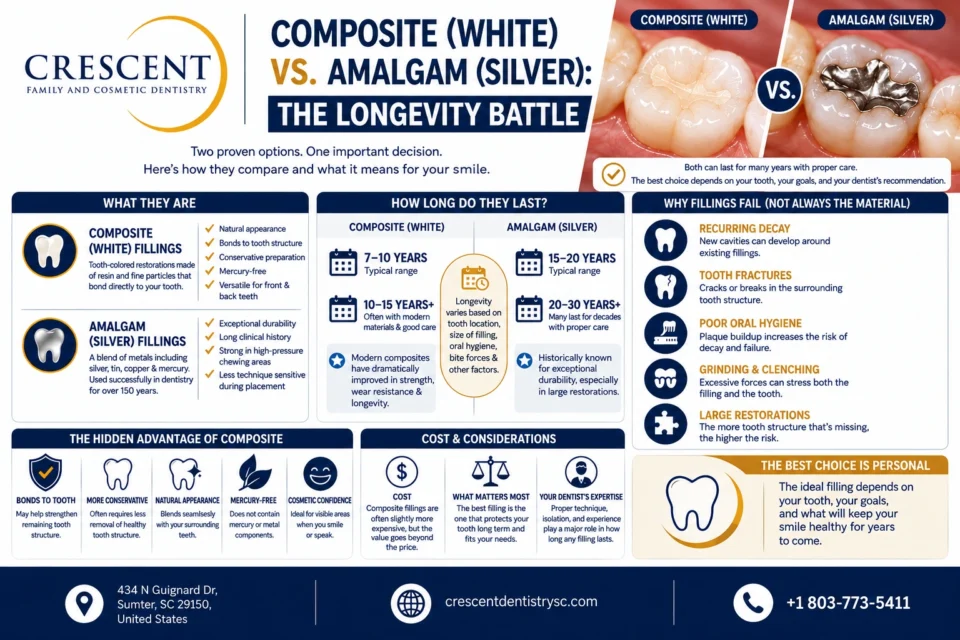
Composite (White) vs. Amalgam (Silver) Fillings: The Longevity Battle
If your dentist tells you that you need a filling, one of the first questions you might ask is: "Which…
Does Zoom Whitening Hurt?
It can cause temporary sensitivity.
That is probably the most important downside to understand before scheduling.
The ADA identifies temporary tooth sensitivity and gum irritation as the most common adverse effects associated with bleaching. Sensitivity tends to be more common with stronger concentrations and is usually temporary.
Some patients feel nothing more than mild tingling.
Others experience short, sharp sensations sometimes described as “zingers.”
The risk can be higher if you already have:
- Sensitive teeth
- Gum recession
- Exposed roots
- Enamel wear
- Cracked teeth
- Worn fillings
- Previous whitening sensitivity
The dental team can often adjust treatment based on your sensitivity history.
Philips WhiteSpeed also incorporates adjustable intensity settings into the system.
At Crescent, we believe sensitivity matters more than simply chasing the whitest possible shade. A slightly more conservative whitening plan may provide a better experience for someone whose teeth already react strongly to cold.
Who Should Have Their Teeth Checked Before Whitening?
Ideally, everyone.
Whitening works best when the mouth is healthy first.
Before bleaching, a dentist may identify:
- Cavities
- Cracked teeth
- Leaking fillings
- Gum recession
- Gum inflammation
- Exposed roots
- Significant enamel wear
- Dental infections
The ADA recommends a dental examination before bleaching so conditions contributing to discoloration and sensitivity can be identified.
If a cavity is causing sensitivity, making the tooth whiter does not solve the real problem.
The same applies to gum disease or a cracked restoration.
Cosmetic treatment should come after urgent dental problems have been addressed.
Will Zoom Whiten Crowns, Veneers, or Fillings?
No.
This is one of the most important limitations of every bleaching system.
Whitening changes the color of natural teeth.
It does not lighten:
- Porcelain veneers
- Dental crowns
- Composite fillings
- Bonding
- Implant crowns
The ADA specifically advises patients that tooth-colored restorations will not respond to whitening agents the way natural enamel does.
This can create a mismatch if you have visible restorations on your front teeth.
For example, imagine you have two crowns that match your current tooth shade. If your surrounding natural teeth become significantly lighter, those crowns may suddenly appear darker.
That is why cosmetic treatment planning matters.
Sometimes whitening should be completed before a new crown, veneer, or bonding restoration is made so the restoration can be matched to the new shade.
How Long Do Zoom Whitening Results Last?
Whitening is not permanent.
Teeth gradually accumulate new staining from foods, beverages, aging, and lifestyle habits.
How quickly that happens depends heavily on what you consume.
Common staining factors include:
- Coffee
- Black tea
- Red wine
- Dark sodas
- Tobacco
- Strongly pigmented foods
Good brushing, professional cleanings, and occasional whitening touch-ups can help maintain the result.
Patients who regularly drink coffee do not necessarily need to stop forever.
They should simply understand that lifestyle habits influence how long a cosmetic result remains noticeable.
Can You Make the Results Last Longer?
Yes.
After whitening, practical habits include:
- Brush twice daily
- Clean between the teeth
- Keep regular dental appointments
- Limit tobacco use
- Rinse with water after heavily staining beverages
- Use touch-up whitening only as directed
- Avoid repeatedly bleaching beyond professional recommendations
The ADA also advises maintaining good oral hygiene and limiting exposure to stain-producing beverages when trying to preserve whitening results.
Do not fall into the trap of whitening constantly.
More bleaching is not always better.
Overuse can increase sensitivity and irritation without producing a meaningful cosmetic improvement.
Who Is Zoom Whitening Best For?
A one-visit whitening procedure may be particularly appealing if you:
- Want rapid results
- Have generally healthy teeth and gums
- Have yellow or externally stained natural teeth
- Have an upcoming event
- Do not want to manage trays every evening
- Prefer professional supervision
- Have realistic expectations about the final shade
It may be less useful if your smile contains many visible crowns or veneers because those restorations will not change color.
It may also not be the first choice for someone with severe sensitivity or untreated dental problems.
Who Might Prefer Take-Home Whitening Instead?
Custom take-home whitening can make more sense if:
- You are not in a hurry
- You want to spread treatment out
- You have a history of sensitivity
- You want reusable custom trays
- You prefer whitening at home
- Your budget is lower than the cost of in-office treatment
For some patients, a combination of professional whitening and occasional take-home maintenance offers a useful middle ground.
There is no reason every person needs the same whitening protocol.
FAQs About Zoom Whitening
Is Zoom whitening really done in one visit?
Yes. Philips describes WhiteSpeed as a single-visit treatment, with about 45 minutes of active whitening time. Preparation and evaluation can make the entire appointment longer.
Can Zoom make teeth eight shades whiter?
Philips advertises results of up to eight shades. Individual outcomes vary significantly according to starting shade and the type of discoloration.
Does Zoom hurt?
Some patients experience temporary sensitivity. Others experience little discomfort. Sensitivity is a recognized side effect of professional whitening generally.
Is Zoom permanent?
No. Teeth can gradually become stained again, and future touch-ups may be necessary.
Does Zoom whiten veneers?
No. Whitening agents work on natural teeth, not porcelain crowns, veneers, implants, or composite restorations.
Is professional whitening safer than doing it yourself?
Professional treatment allows a dentist to assess your teeth, protect the gums, control application, and respond to sensitivity. OTC whitening can also be safe when an appropriate product is used exactly as directed.
Our Verdict: Is a One-Hour Whitening Appointment Worth It?
If your main priorities are speed, professional supervision, and a substantial change in one visit, an in-office system such as Zoom can justify the higher price.
If your only goal is eventually getting whiter teeth and you do not care whether it takes a couple of weeks, custom take-home trays or appropriately used whitening strips may provide better value.
At Crescent Family and Cosmetic Dentistry, we do not believe the most aggressive whitening option is automatically the best one. We look at the current condition of your teeth, existing restorations, sensitivity, staining, timeline, and desired result before recommending a whitening approach.
Crescent offers professional in-office and take-home whitening options in South Carolina. If you are considering Zoom or another professional whitening system, schedule a cosmetic consultation with our team. We can help you determine whether a rapid in-office treatment makes sense or whether a slower, more gradual whitening plan would give you the result you want with less sensitivity and expense.
Want a Brighter Smile in Just One Visit?
See if Zoom Whitening is right for you. Call today to schedule your professional whitening appointment.