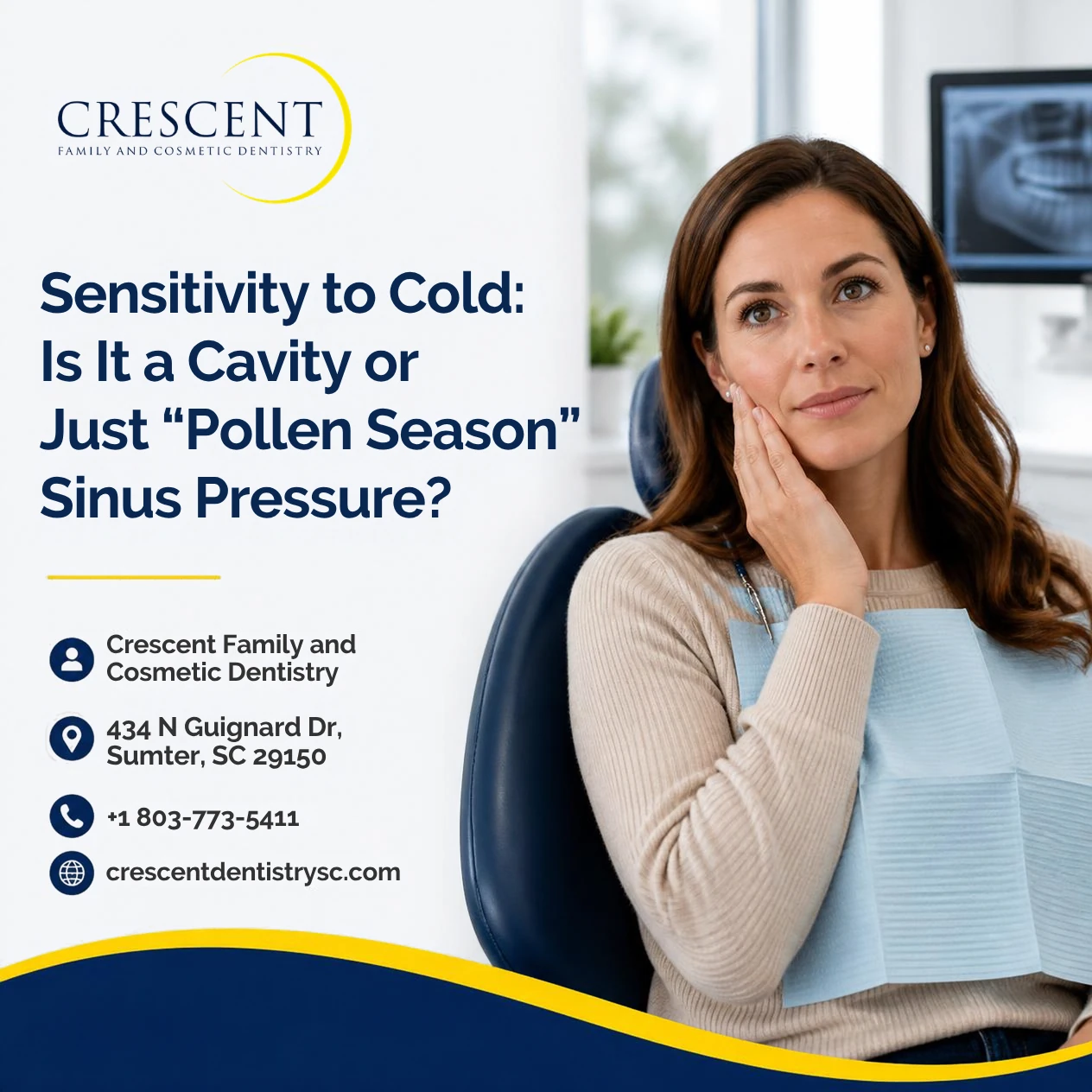
Sensitivity to Cold: Is It a Cavity or Just “Pollen Season” Sinus Pressure?
A sudden zing in your teeth when you drink ice water can make you wonder whether you have a cavity or whether seasonal allergies are somehow responsible. Sinus pressure caused by allergies can create aching or pressure in the upper teeth, but sensitivity specifically triggered by cold is more commonly associated with a dental issue, such as exposed dentin, enamel wear, gum recession, a cavity, or a cracked tooth.
At Crescent Family and Cosmetic Dentistry, we encourage patients not to automatically blame tooth discomfort on pollen season. Sinus symptoms and dental problems can overlap, and sometimes the only reliable way to tell them apart is through a dental examination.
Sharp Pain When You Drink Something Cold?
Persistent sensitivity may need dental attention. Schedule an evaluation today and get clear answers.
Can Pollen Season Really Make Your Teeth Hurt?
Yes, but not usually because pollen is directly making the teeth more sensitive.
Seasonal allergic rhinitis, commonly known as hay fever, occurs when the immune system reacts to airborne allergens such as tree, grass, or weed pollen. Typical symptoms include sneezing, nasal congestion, a runny nose, itchy eyes, and nasal inflammation.
That inflammation can sometimes contribute to pressure around the sinuses.
The maxillary sinuses sit in the cheek area above the upper back teeth. Because the roots of some upper teeth are located very close to these sinus spaces, inflammation or pressure in the area can sometimes be interpreted by the brain as tooth pain.
Mayo Clinic notes that sinusitis can cause toothache, particularly in the upper rear teeth because of their close relationship to the maxillary sinuses.
Cleveland Clinic similarly notes that sinus pressure can radiate into the upper jaw and teeth.
So yes, pollen season can indirectly contribute to tooth discomfort when allergies lead to significant nasal and sinus inflammation.
However, there is an important difference between a general ache or pressure in the upper teeth and a sharp response every time something cold touches one specific tooth.
That difference can provide an important clue.
Is Cold Sensitivity More Likely to Be a Cavity?
It can be, particularly when the sensitivity affects one tooth consistently.
A healthy tooth has a hard outer layer of enamel protecting the more sensitive dentin underneath. Inside the tooth is the pulp, which contains nerves and blood vessels.
If decay damages the enamel and progresses toward the dentin, temperature changes may become easier for the tooth’s nerve to detect.
You might notice:
- A sharp sensation when drinking cold water
- Pain when eating ice cream
- Sensitivity to cold air
- Sensitivity to sweets
- Food catching around a certain tooth
- Discomfort when biting
- A visible dark area or hole in the tooth
Early cavities do not always hurt, however. Some can progress for quite some time without obvious symptoms.
Cold sensitivity therefore does not automatically mean that you have tooth decay, and an absence of sensitivity does not prove that you are cavity-free.
A dental examination and, when appropriate, X-rays can help identify decay that cannot easily be seen at home.
What Does Sinus-Related Tooth Pain Usually Feel Like?
Sinus discomfort tends to behave differently from pain originating within an individual tooth.
Because the maxillary sinus sits over several upper teeth, sinus pressure often makes multiple upper back teeth feel sore or heavy at the same time.
You may find it difficult to point to one specific tooth.
Common accompanying symptoms may include:
- Nasal congestion
- Facial pressure
- A runny nose
- Postnasal drainage
- Pressure around the cheeks or eyes
- Headache
- Reduced sense of smell
- Several upper teeth aching together
Sinus pressure may also become more noticeable when you bend your head forward.
Cleveland Clinic lists tooth pressure or pain among possible symptoms of sinusitis and notes that facial pressure is often felt around the nose, eyes, and forehead.
By comparison, dental pain is often easier to localize.
If the same tooth reacts every time you drink something cold, chew on that side, or eat something sweet, there may be more reason to investigate the tooth itself.
Does Sinus Pressure Normally Cause Sensitivity to Cold Drinks?
Not typically.
Sinus inflammation can create pressure, aching, or tenderness that feels as though it comes from the teeth. But a tooth that consistently reacts the moment cold liquid reaches it is responding directly to temperature.
That points more strongly toward the tooth.
Cold sensitivity can occur when dentin becomes exposed or when something has compromised the protective structure surrounding the nerve.
Possible causes include:
- Tooth decay
- Gum recession
- Enamel erosion
- Cracked teeth
- Worn fillings
- Teeth grinding
- Aggressive brushing
- Recent dental procedures
- Tooth whitening
- Dentin hypersensitivity
The American Dental Association describes dentin hypersensitivity as sensitivity that can be triggered by temperature, touch, and air movement.
This is why “it’s probably my sinuses” should not automatically be the explanation for repeated cold sensitivity.
Your sinuses can make teeth ache. They generally do not explain why one particular tooth hurts every time ice water touches it.
Could It Just Be Sensitive Teeth Instead of a Cavity?
Absolutely.
Cold sensitivity is common, and cavities are only one possible cause.
Gum Recession
Your tooth roots are not covered by the same thick enamel that protects the crowns of your teeth.
When gum tissue recedes, areas of the root can become exposed. Those surfaces may respond strongly to temperature changes.
Gum recession can occur with gum disease, aging, overly aggressive brushing, tooth positioning, or other factors.
Enamel Wear
Acidic foods and beverages can gradually erode tooth enamel.
Frequent exposure to soft drinks, sports drinks, citrus, acidic candies, or stomach acid from reflux can contribute to enamel erosion.
As enamel becomes thinner, the dentin underneath may become more sensitive.
Brushing Too Aggressively
Scrubbing your teeth hard does not necessarily make them cleaner.
Over time, aggressive brushing may contribute to gum recession and wear near the gumline, particularly when combined with abrasive toothpaste.
A soft-bristled toothbrush and gentle technique are generally preferable.
Tooth Whitening
Temporary sensitivity is a known side effect of some whitening treatments.
If sensitivity began shortly after whitening your teeth, that timing is useful information to give your dentist.
Recent Dental Treatment
A tooth may temporarily become more sensitive after certain procedures, including placement of a filling or crown.
The sensitivity should generally improve rather than progressively worsen.
If it continues, becomes severe, or starts lingering long after cold exposure has stopped, the tooth should be reevaluated.
Could a Cracked Tooth Cause Cold Sensitivity?
Yes.
A cracked tooth can be particularly confusing because the symptoms are not always constant.
You might experience:
- Sharp pain when chewing
- Pain when releasing your bite
- Intermittent cold sensitivity
- Sensitivity that seems difficult to locate
- Discomfort that comes and goes
Some cracks are easy to see. Others are extremely small and may require a careful dental examination to identify.
Cracks can also vary significantly in severity. A minor enamel crack may require little or no treatment, while a deeper crack affecting the internal structure of the tooth can be much more serious.
If a tooth suddenly becomes sensitive after biting something hard, do not assume the discomfort is caused by allergies simply because it happens to be pollen season.
Does It Matter How Long the Cold Sensitivity Lasts?
Yes. The duration of the pain can provide your dentist with useful information.
If you take a sip of cold water and experience a quick sensation that disappears almost immediately, exposed dentin or mild sensitivity may be responsible.
If pain continues well after the cold drink is gone, a deeper problem may need to be considered.
For example, inflammation inside the pulp of a tooth may cause temperature sensitivity that lingers.
The exact duration cannot diagnose the problem by itself. Dentists consider several factors, including:
- How long the pain lasts
- What triggers it
- Whether it occurs spontaneously
- Whether chewing causes pain
- Whether hot temperatures also trigger symptoms
- The condition of existing fillings or crowns
- X-ray findings
- Clinical testing of the tooth
A tooth that has progressed from briefly sensitive to increasingly painful deserves attention.
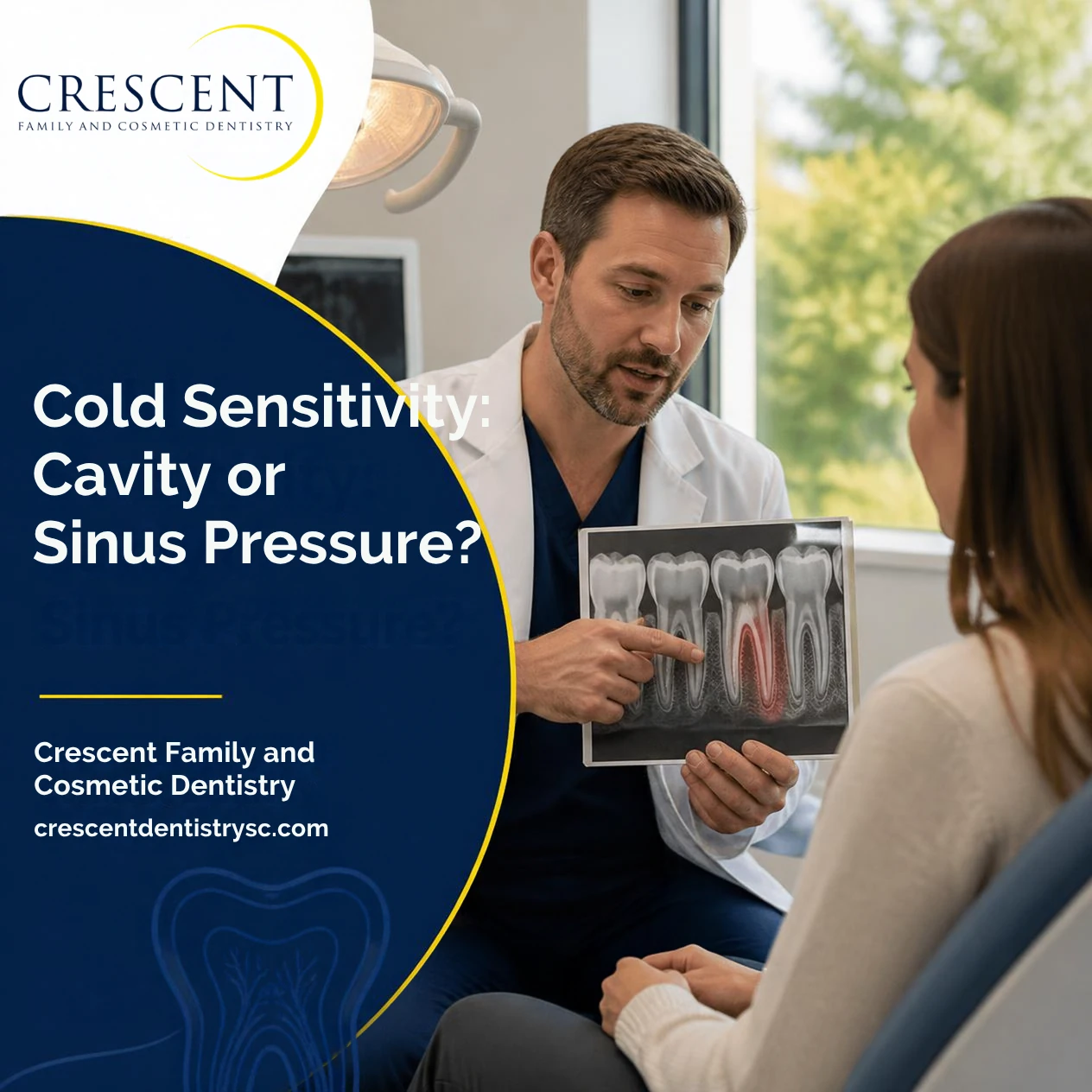
What If Several Upper Teeth Hurt at Once?
When several upper back teeth begin aching at the same time during a period of heavy congestion, sinus pressure becomes a more plausible explanation.
The location of the maxillary sinuses is the main reason.
Mayo Clinic explains that the roots of the upper teeth may lie very close to, and in some people extend toward, the sinus cavity. Inflammation in that area can therefore produce pain that feels dental even when the teeth themselves are healthy.
You may notice that the discomfort appears alongside:
- Stuffy nose
- Allergy symptoms
- Facial heaviness
- Pressure underneath the eyes
- Postnasal drip
- Sinus headache
If the teeth stop aching as the congestion improves, that also supports the possibility that sinus pressure contributed to the symptoms.
However, timing is not proof.
A dental problem can happen during pollen season too.
Someone can have allergies and a cavity at the same time.

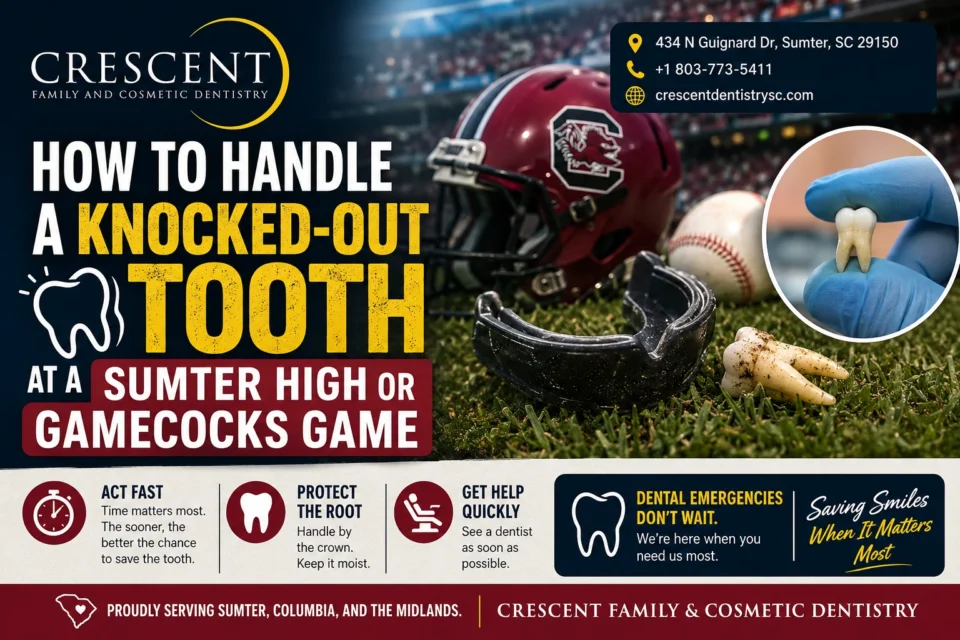
How to Handle a Knocked-Out Tooth at a Sumter High or Gamecocks Game
It happens faster than most parents expect. A baseball takes a bad hop. An elbow flies during a basketball rebound.…
How Can You Tell a Cavity From Sinus Pressure at Home?
You cannot reliably diagnose a cavity at home, but you can pay attention to patterns.
Signs That Point More Toward a Dental Problem
Consider scheduling a dental examination if:
- One particular tooth is sensitive
- Cold reliably triggers the pain
- Sweet foods trigger sensitivity
- Chewing hurts
- Flossing around one tooth is uncomfortable
- You can see a damaged area
- A filling or crown feels different
- Pain is becoming progressively worse
- Pain continues after the cold stimulus disappears
- You have symptoms without nasal congestion or allergy problems
Signs That Could Point Toward Sinus Pressure
Sinus-related discomfort may be more likely when:
- Several upper back teeth ache together
- You have significant nasal congestion
- Your cheeks feel full or tender
- The discomfort changes with your sinus symptoms
- You have pressure around the nose or eyes
- Pain feels broad rather than limited to one tooth
These are clues rather than diagnostic rules.
Mayo Clinic recommends seeing a dentist when you have toothache so that dental causes such as cavities, gum disease, or infection can be evaluated. If no dental cause is found, a healthcare provider can then assess whether a sinus condition may be responsible.
Can Seasonal Allergies Lead to a Sinus Infection?
They can contribute in some people.
Seasonal allergies cause inflammation and congestion in the nasal passages. When normal sinus drainage is disrupted, some people may become more susceptible to sinus problems.
The American Academy of Allergy, Asthma & Immunology notes that people with allergic rhinitis are more likely to experience chronic sinusitis because inflammation of the airways can affect normal sinus function.
However, allergies and sinus infections are not the same thing.
Typical allergic rhinitis symptoms include sneezing, an itchy nose or eyes, congestion, and clear nasal drainage.
Sinusitis may produce symptoms such as facial pressure, significant congestion, toothache, postnasal drainage, and sometimes fever or thicker nasal discharge.
If sinus symptoms are severe, prolonged, or worsening, your physician or another appropriate healthcare professional can determine whether additional treatment is needed.
Can a Dental Infection Cause Sinus Problems?
Yes, and this is another reason not to automatically assume that sinus symptoms started with pollen.
The relationship between upper teeth and the maxillary sinus works both ways.
Sinus inflammation may cause referred dental discomfort, but infection originating in an upper tooth can sometimes affect the nearby sinus.
Mayo Clinic notes that infection or damage involving a tooth can contribute to persistent sinusitis.
This is particularly important when sinus symptoms occur predominantly on one side alongside a painful upper tooth.
A dentist can examine the teeth and determine whether a dental source should be considered.
Should You Use Sensitive-Tooth Toothpaste?
Desensitizing toothpaste may help when the problem is uncomplicated dentin sensitivity.
Some products contain ingredients intended to reduce the transmission of sensations from exposed dentin to the nerve.
The ADA notes evidence supporting certain ingredients, including stannous compounds, potassium-containing formulations, and arginine-containing toothpastes, for reducing dentin hypersensitivity.
But toothpaste should not be used to cover up an unexplained toothache indefinitely.
If you actually have decay, a leaking filling, a fracture, or another dental condition, desensitizing toothpaste does not correct the underlying problem.
It is better to find out why the tooth is sensitive.
When Should Cold Sensitivity Be Checked by a Dentist?
Occasional mild sensitivity may not always indicate something serious, but make an appointment when:
- Sensitivity is new
- One tooth consistently hurts
- Symptoms last more than a few days
- Cold pain is becoming stronger
- Pain lingers after eating or drinking
- You also experience pain when biting
- Hot foods begin causing discomfort
- You notice a chipped or cracked tooth
- A filling or crown feels loose
- You develop spontaneous toothache
- The pain wakes you at night
Seek prompt care if you develop facial swelling, significant swelling around a tooth, or other signs suggesting a spreading dental infection.
Severe swelling that interferes with breathing or swallowing requires urgent medical attention.
The sooner the cause is identified, the greater the chance that treatment can remain straightforward.
What Will the Dentist Look for?
At Crescent Family and Cosmetic Dentistry, evaluating cold sensitivity starts with understanding exactly what you are experiencing.
We may ask:
- Which tooth seems sensitive?
- When did it begin?
- Does cold trigger it every time?
- How long does the sensation last?
- Do hot foods cause pain?
- Does the tooth hurt when chewing?
- Have you recently whitened your teeth?
- Do you grind or clench?
- Have you had recent dental work?
- Are you experiencing allergy or sinus symptoms?
The teeth and gums can then be examined for decay, gum recession, damaged restorations, cracks, wear, and other possible causes.
Dental X-rays may be recommended when they can provide information that cannot be obtained from a visual examination alone.
In some cases, additional tests may be used to compare the response of one tooth with neighboring teeth.
The aim is not simply to stop the sensitivity. It is to understand what is creating it.
FAQs About Cold-Sensitive Teeth and Sinus Pressure
Can pollen allergies make my teeth sensitive?
Pollen allergies can contribute to nasal and sinus inflammation, which may cause aching or pressure in the upper teeth. However, a tooth that reacts specifically to cold should also be evaluated for dental causes.
Which teeth usually hurt from sinus pressure?
Sinus-related dental discomfort most commonly affects the upper back teeth because their roots sit close to the maxillary sinuses.
Does a cavity always hurt when you drink something cold?
No. Some cavities cause cold sensitivity while others produce no noticeable symptoms, particularly during their early stages.
Why is only one tooth sensitive to cold?
A single sensitive tooth may have exposed dentin, decay, a crack, gum recession, an older restoration, or another localized issue. A dentist can determine the cause.
Can sinus pain affect just one tooth?
It is possible, but sinus pressure more commonly produces broad discomfort involving several upper teeth. Pain consistently localized to one tooth deserves a dental examination.
Will tooth sensitivity disappear when allergy season ends?
If sinus pressure is responsible for the discomfort, symptoms may improve as nasal and sinus inflammation settles. True cold sensitivity caused by exposed dentin, decay, or another dental problem may continue regardless of the season.
Don’t Assume Cold Sensitivity Is Just Your Allergies
Pollen season can make your nose congested, your face feel heavy, and even your upper teeth ache. What it does not typically explain is a single tooth that sends a sharp signal every time you drink something cold.
At Crescent Family and Cosmetic Dentistry, we would rather help patients identify the source of sensitivity early than have them spend weeks assuming their sinuses are responsible while an untreated dental problem progresses.
Sometimes the explanation is relatively simple, such as exposed dentin or temporary sensitivity. Other times, the tooth may need treatment for decay, a damaged restoration, a crack, or another condition.
If your teeth are suddenly sensitive to cold, particularly if one tooth stands out or the sensation keeps returning, schedule an appointment with Crescent Family and Cosmetic Dentistry. We can examine the tooth, rule out common dental causes, and help you determine whether your discomfort appears to be coming from your teeth or whether sinus pressure may be playing a role.
Cold Sensitivity Bothering You?
Don’t guess whether it’s a cavity or sinus pressure. Get your tooth checked and find the cause of your sensitivity.