
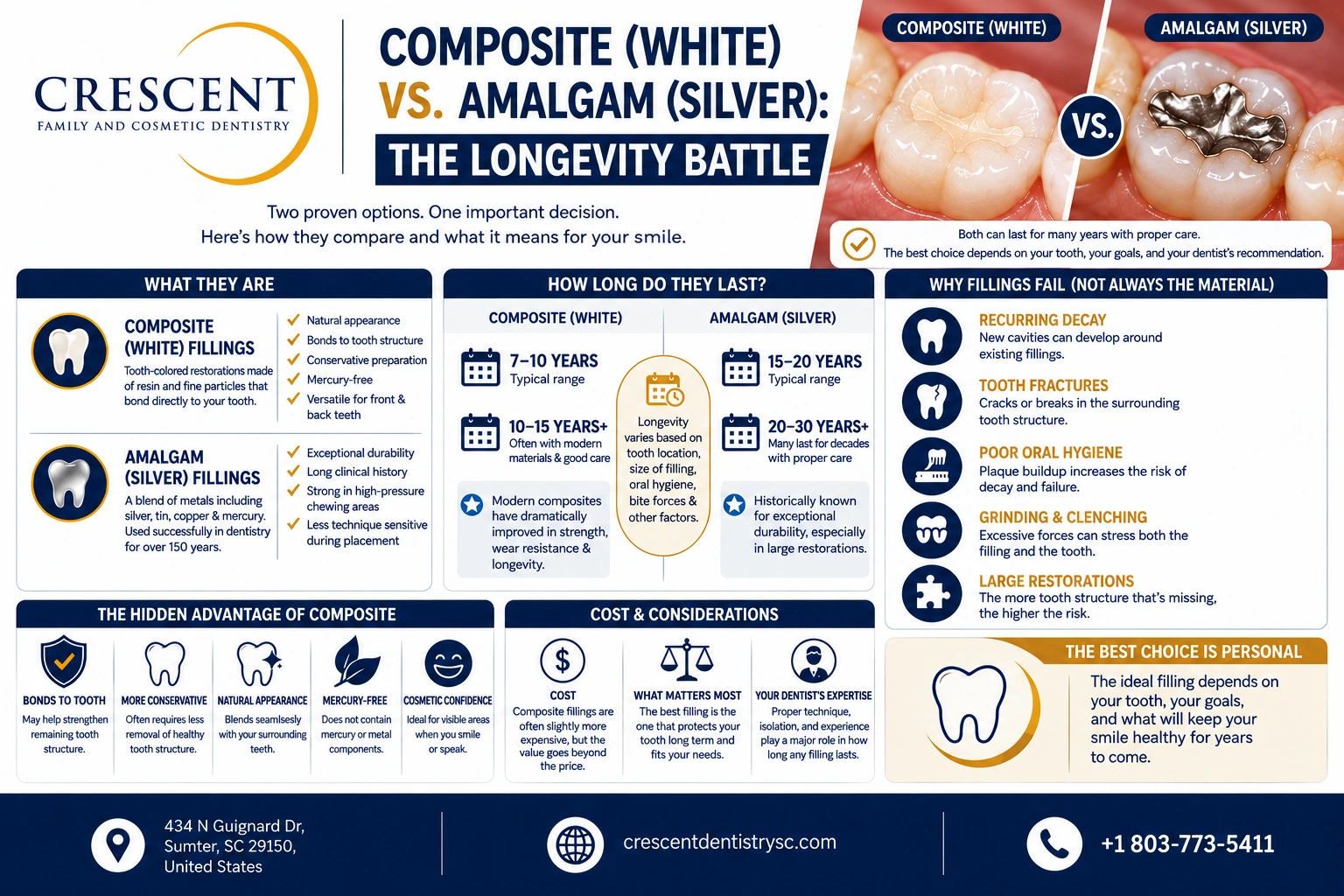
Composite (White) vs. Amalgam (Silver) Fillings: The Longevity Battle
If your dentist tells you that you need a filling, one of the first questions you might ask is:
“Which type lasts longer?”
It’s a fair question.
After all, most people don’t want to replace the same filling multiple times throughout their life. They want the restoration that offers the best combination of durability, value, appearance, and long-term tooth health.
For decades, silver amalgam fillings were considered the gold standard for longevity. Today, tooth-colored composite fillings have become the most common choice in many dental offices.
So has composite finally caught up?
Or do silver fillings still win when it comes to lasting the longest?
The short answer is:
Amalgam fillings have historically demonstrated exceptional longevity, particularly in large restorations. However, modern composite fillings have improved dramatically and can provide excellent long-term performance while offering significant cosmetic and structural advantages.
The better question isn’t simply which filling lasts longer.
It’s which filling makes the most sense for your specific tooth.
At Crescent Family & Cosmetic Dentistry, patients in Columbia and Sumter often assume the answer is straightforward. In reality, the decision involves much more than a simple durability comparison.
Let’s examine what the research, real-world experience, and modern dentistry tell us.
Need a Filling That Lasts?
Choose the right filling for your smile. Call today to discuss composite and amalgam options.
First, What Is the Difference Between Composite and Amalgam Fillings?
Before comparing longevity, it helps to understand how these materials work.
Composite (White) Fillings
Composite fillings are tooth-colored restorations made from a mixture of resin and fine particles.
Dentists place the material directly into the tooth and harden it using a specialized curing light.
Benefits include:
- Natural appearance
- Bonding to tooth structure
- Conservative preparation
- Mercury-free composition
- Versatility for front and back teeth
Because they blend with natural enamel, composite fillings are often difficult to detect.
Amalgam (Silver) Fillings
Amalgam fillings consist of a combination of metals, including:
- Silver
- Tin
- Copper
- Mercury
They have been used successfully for more than 150 years.
Benefits include:
- Exceptional durability
- Long clinical history
- Strong performance in high-pressure chewing areas
- Lower technique sensitivity during placement
Many patients still have amalgam fillings that were placed decades ago.
Which Filling Material Lasts Longer?
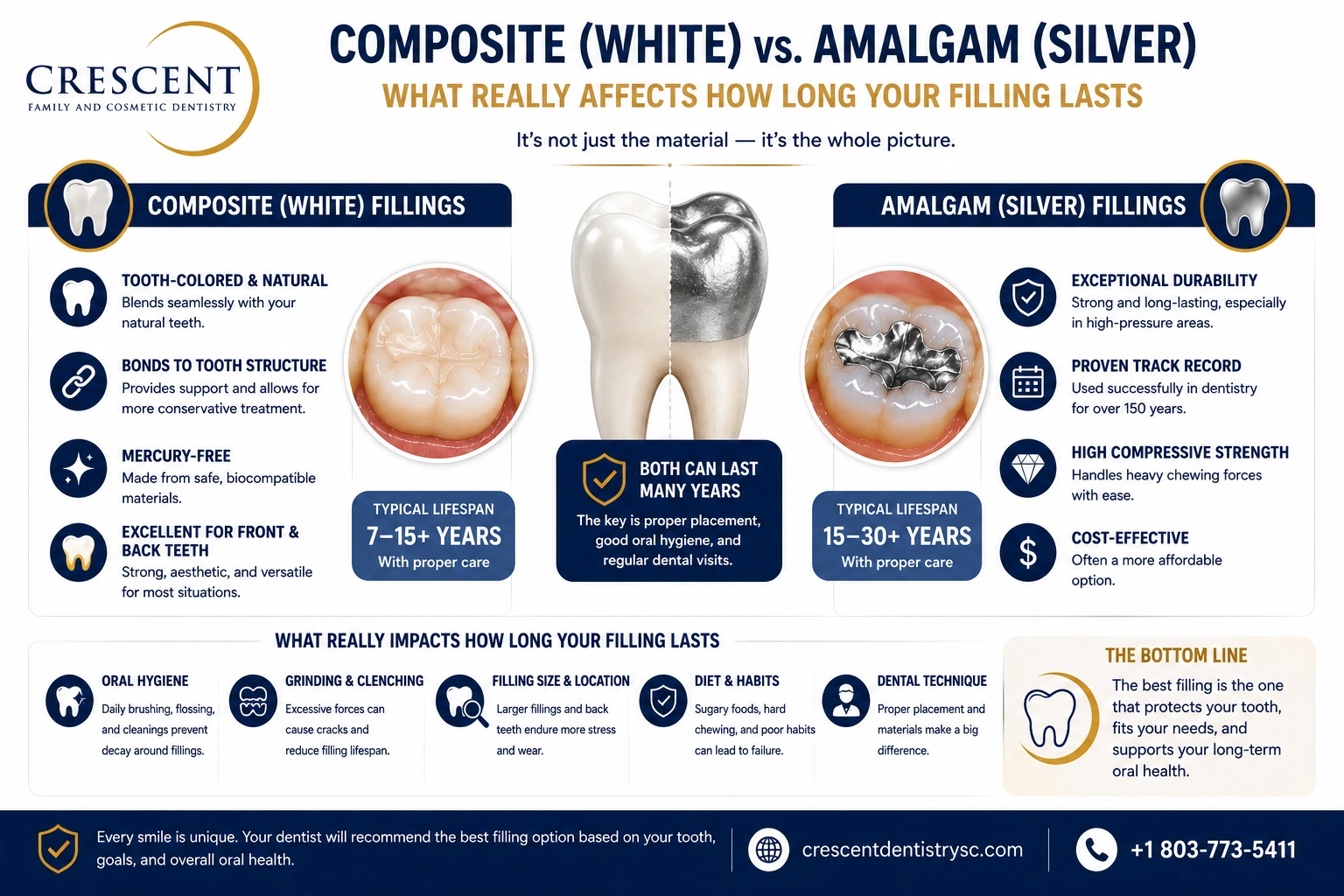
Historically, amalgam often had the edge.
Large silver fillings frequently remained functional for:
- 15 years
- 20 years
- 30 years
- Sometimes even longer
This impressive lifespan helped establish amalgam as the standard restorative material for generations.
However, modern composite materials have significantly narrowed the gap.
Today, many composite restorations routinely last:
- 7–10 years
- 10–15 years
- Sometimes much longer with proper care
The important thing to understand is that longevity varies tremendously from patient to patient.
The filling material is only one factor.
Why Some Silver Fillings Last So Long
Patients are often amazed when a dentist points out a silver filling that has survived for 25 years.
Several characteristics contribute to amalgam’s reputation.
Exceptional Compressive Strength
Back teeth experience enormous chewing forces.
Amalgam handles compression very well.
Less Technique Sensitive
Historically, amalgam could tolerate small amounts of moisture contamination better than composite during placement.
Long-Term Wear Resistance
Silver fillings generally wear slowly over time.
For many years, this made them particularly attractive for large restorations in molars.
This durability explains why some older patients still have functioning amalgam restorations from early adulthood.
Why Composite Fillings Have Improved So Much
Comparing modern composites to those used decades ago is like comparing a smartphone to an early flip phone.
The technology has evolved significantly.
Today’s composite materials offer improvements in:
- Strength
- Wear resistance
- Bonding capability
- Aesthetics
- Longevity
Dentists also have better adhesive systems and placement techniques than previous generations.
As a result, many composite restorations now perform extremely well in both front and back teeth.
The Biggest Reason Fillings Fail Isn’t Material Failure
This surprises many patients.
Fillings rarely fail simply because the material “wears out.”
More commonly, they fail because of:
Recurrent Decay
New cavities can develop around existing restorations.
Tooth Fractures
The surrounding tooth structure may crack.
Poor Oral Hygiene
Plaque accumulation increases cavity risk.
Grinding and Clenching
Excessive forces place stress on both the filling and tooth.
Large Existing Restorations
The more tooth structure that’s missing, the higher the risk of future complications.
In many cases, the tooth fails before the filling material does.
The Hidden Advantage of Composite Fillings
When patients focus only on longevity, they sometimes overlook an important benefit.
Composite fillings bond directly to the tooth.
This creates several advantages.
More Conservative Treatment
Dentists can often preserve more healthy tooth structure.
Historically, amalgam fillings required additional shaping to mechanically lock the restoration into place.
Composite bonding often allows a more conservative approach.
Improved Support
Bonding may help reinforce remaining tooth structure in certain situations.
Smaller Restorations
Less healthy enamel may need to be removed.
Preserving natural tooth structure often contributes to long-term success.
This is one reason many dentists prefer composite despite amalgam’s historical durability.
The Hidden Drawback of Large Silver Fillings
One concern with older amalgam restorations is how they interact with teeth over time.
Silver fillings can expand and contract differently than natural tooth structure.
Over many years, this may contribute to:
- Cracks
- Fractures
- Structural weakening
Dentists frequently discover cracked teeth surrounding large amalgam restorations.
In some cases, the filling remains intact while the tooth itself becomes compromised.
This is one reason longevity statistics don’t always tell the whole story.
A filling that lasts 25 years is impressive.
A filling that lasts 25 years while preserving the surrounding tooth is even better.

Between the Gaps: How Dental Bridges Reconnect More Than Just Teeth
But these bridges don’t just reconnect teeth; they reconnect confidence, comfort, and function. They help keep your bite steady and…
Which Filling Looks Better?
This category is easy.
Composite wins.
Most patients today prefer restorations that blend naturally with their teeth.
Composite fillings can be matched closely to surrounding enamel.
Silver fillings remain visible whenever you laugh, smile, or open your mouth.
For many patients, appearance matters.
Particularly for:
- Front teeth
- Premolars
- Visible areas of the smile
Even patients who aren’t concerned about cosmetics often appreciate a restoration that looks natural.
What About Mercury Concerns?
No comparison would be complete without discussing mercury.
Amalgam contains mercury as part of its composition.
This fact concerns some patients.
Major organizations, including the American Dental Association and FDA, have generally maintained that dental amalgam is considered safe for most patients when used appropriately.
However, many patients still prefer composite because it does not contain mercury.
For some people, the decision comes down to aesthetics.
For others, material preference plays a role.
Both considerations are reasonable discussion points during treatment planning.
Which Filling Costs More?
In many dental practices, composite fillings may cost slightly more than amalgam.
Factors influencing cost include:
- Filling size
- Tooth location
- Insurance coverage
- Material selection
- Treatment complexity
The difference varies significantly between practices.
However, many patients are willing to pay more for:
- Improved appearance
- Conservative treatment
- Metal-free restorations
The cheapest option is not always the least expensive long term.
When Composite Fillings Often Make the Most Sense
Composite restorations are frequently ideal when:
Appearance Matters
Most adults prefer tooth-colored restorations.
Smaller Cavities Exist
Conservative preparations often work exceptionally well.
Front Teeth Need Repair
Composite provides excellent cosmetic results.
Tooth Preservation Is a Priority
Bonding can help preserve healthy tooth structure.
When Amalgam May Still Be Considered
Although less common today, amalgam may still have a role in certain situations.
Examples may include:
Large Restorations
Some dentists still consider amalgam appropriate in specific high-load areas.
Challenging Moisture Control
Placement conditions sometimes influence material selection.
Patient Preference
Some individuals prefer maintaining existing treatment approaches.
However, the trend toward composite dentistry continues to grow.
So Who Wins the Longevity Battle?
The answer depends on how you define winning.
If you’re looking strictly at historical lifespan records, amalgam has an impressive track record.
Many silver fillings have lasted multiple decades.
But longevity alone doesn’t tell the whole story.
Modern dentistry increasingly focuses on:
- Preserving tooth structure
- Cosmetic appearance
- Conservative treatment
- Long-term tooth health
When those factors are considered alongside durability, composite fillings become extremely competitive.
For many patients, the slight difference in potential lifespan—if any exists in their specific situation—is outweighed by the benefits of a bonded, tooth-colored restoration.
The Best Filling Is the One That Protects Your Tooth Long-Term
Patients often approach this debate as though they’re comparing two products.
In reality, they’re choosing a strategy for protecting a tooth.
A filling’s success depends on much more than the material used. The dentist’s technique, the size of the restoration, your oral hygiene habits, bite forces, and overall dental health all influence longevity.
At Crescent Family & Cosmetic Dentistry, treatment recommendations are based on preserving healthy tooth structure, supporting long-term function, and helping patients understand the advantages and limitations of every option. The goal isn’t simply placing a filling—it’s helping the tooth remain healthy for years to come.
Before Replacing or Choosing a Filling, Understand Your Options
If you’re deciding between composite and amalgam fillings—or wondering whether older silver fillings should be replaced—the best place to start is with an informed conversation.
Every tooth is different.
Some restorations may benefit from modern composite materials. Others may still be functioning perfectly well and require no treatment at all.
At Crescent Family & Cosmetic Dentistry, patients in Columbia and Sumter receive honest guidance about restoration options, expected longevity, costs, and long-term outcomes. Understanding the tradeoffs allows you to make a confident decision based on your goals, not assumptions.
Because the longest-lasting filling isn’t always the one that serves your smile best.
Frequently Asked Questions
Do silver fillings last longer than white fillings?
Historically, many amalgam fillings have demonstrated exceptional longevity. However, modern composite fillings have improved significantly and often provide excellent long-term performance.
Should old silver fillings be replaced?
Not necessarily. Many older amalgam fillings continue functioning well. Replacement is typically recommended when there is evidence of decay, cracks, wear, or other clinical concerns.
Are composite fillings strong enough for molars?
In many cases, yes. Modern composite materials are commonly used in back teeth and can perform very well when properly placed.
Which filling is more natural-looking?
Composite fillings closely match natural tooth color and are generally considered the most aesthetic option.
Is composite safer than amalgam?
Both materials are widely used in dentistry. Composite fillings do not contain mercury, which is one reason some patients prefer them. The best material depends on the specific clinical situation and patient preferences.
Which Filling Is Right for You?
Compare composite and amalgam fillings with a dentist and choose with confidence. Call today.