The Truth About “Metal-Free” Dentistry: Zirconia vs. Titanium Implants
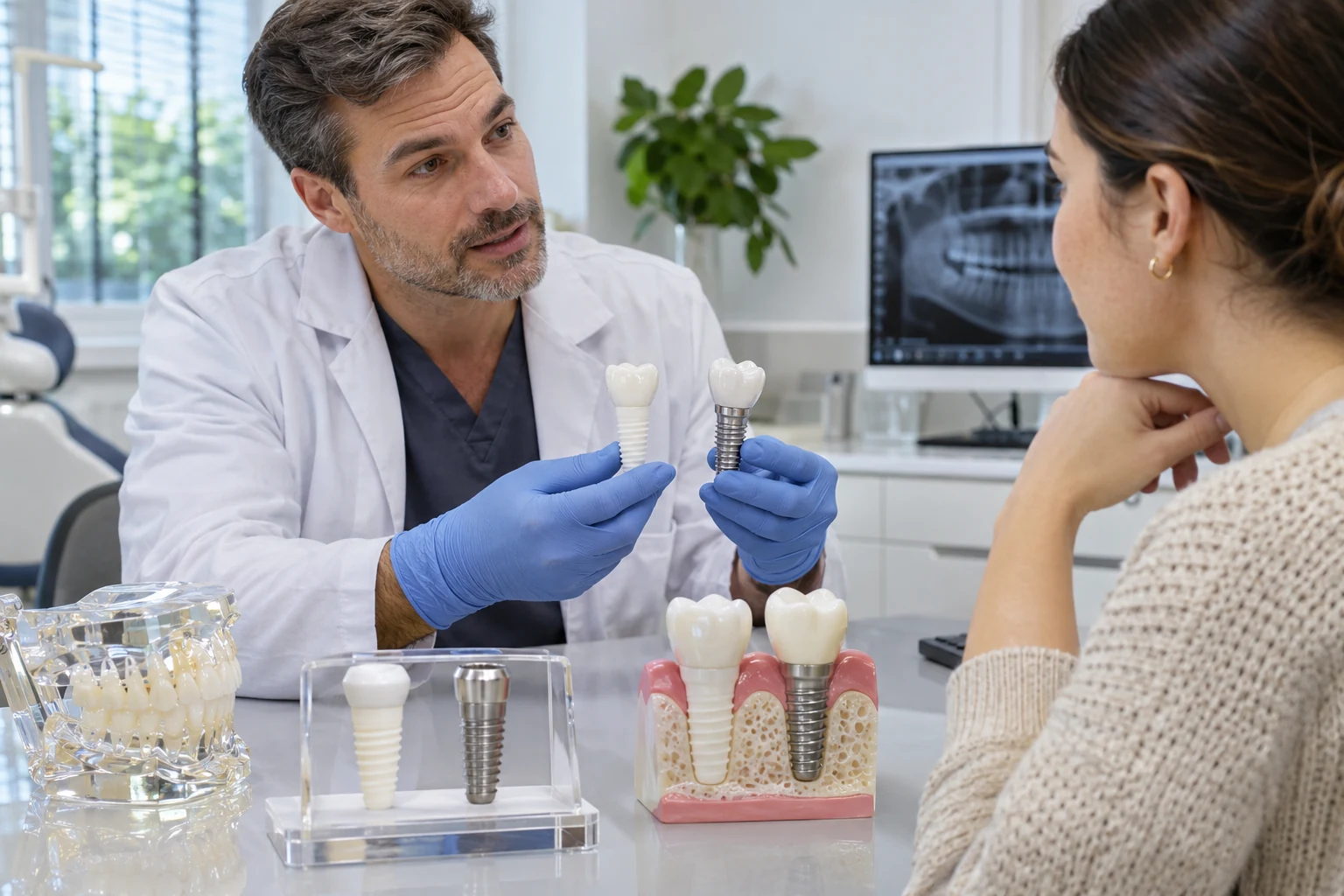
Zirconia dental implants are considered a metal-free alternative to traditional titanium implants, but neither material is automatically safer or more effective for every patient. Titanium has decades of clinical research supporting its use, while zirconia offers a tooth-colored ceramic option with encouraging clinical results and a shorter long-term track record.
At Crescent Family and Cosmetic Dentistry, we help patients understand their tooth replacement options before making treatment decisions. If you’re comparing zirconia vs. titanium dental implants, understanding their differences in appearance, strength, biocompatibility, longevity, and cost can help you choose an appropriate solution.
What Does “Metal-Free” Dentistry Actually Mean?
Metal-free dentistry refers to dental treatments and restorations that use nonmetallic materials instead of traditional metal-based alternatives.
Common examples include ceramic crowns, composite fillings, and zirconia dental implants.
However, the term can sometimes be misleading.
Zirconia is made from zirconium dioxide, a ceramic compound derived from the metallic element zirconium. Although zirconium itself is a metal, zirconium dioxide has ceramic properties and is classified as a nonmetallic dental material.
This distinction matters because zirconia doesn’t behave like a conventional metal implant.
Zirconia is tooth-colored, corrosion-resistant, and compatible with surrounding biological tissues.
However, metal-free does not automatically mean healthier, safer, or better than titanium.
Both materials have established applications in dentistry, and the best choice depends on the patient’s oral health, treatment needs, and implant design.
Additionally, some two-piece zirconia systems contain internal metal screws. Patients specifically seeking a completely metal-free restoration should ask about every component used.
What Are Zirconia and Titanium Dental Implants?
Dental implants are artificial tooth roots surgically placed into the jawbone to support replacement teeth.
A completed restoration typically includes an implant fixture, an abutment connecting the components, and a dental crown.
The two primary implant materials are titanium and zirconia.
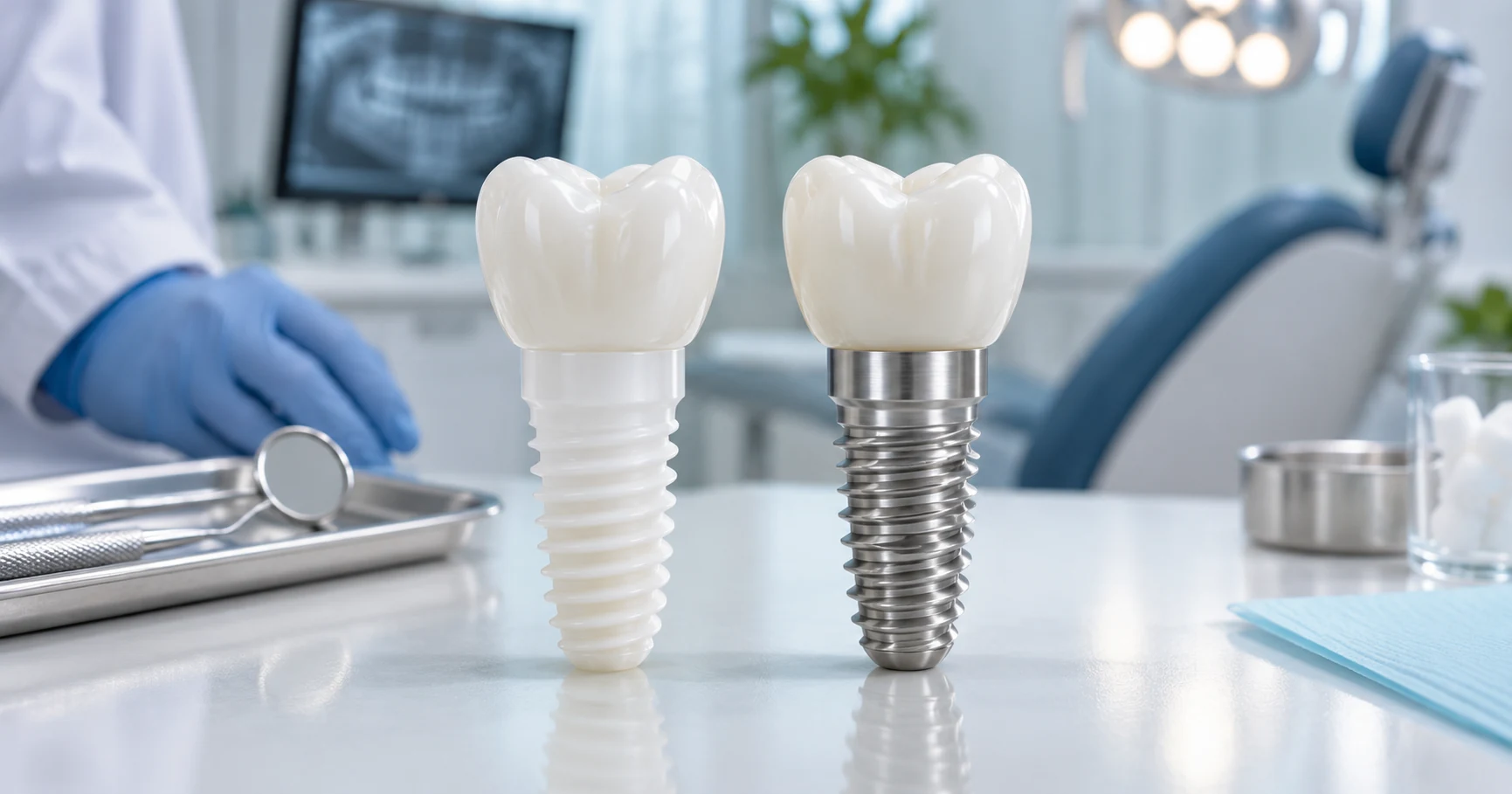
Titanium Dental Implants
Titanium implants have been used in modern implant dentistry for decades.
Titanium is valued for its strength, biocompatibility, and ability to integrate with surrounding jawbone.
This integration process, known as osseointegration, creates a stable foundation for a replacement tooth.
Titanium implants also come in numerous sizes and configurations, allowing clinicians to address different tooth replacement needs.
Zirconia Dental Implants
Zirconia implants are manufactured from a strong ceramic material, typically yttria-stabilized zirconium dioxide.
Their natural white appearance makes them appealing to patients concerned about visible metal near their gums.
Zirconia also supports osseointegration and can provide stable tooth replacement in appropriately selected cases.
However, zirconia implants have less extensive long-term clinical evidence than titanium systems.
It’s also important to distinguish a zirconia implant from a zirconia crown. A patient may have a zirconia crown attached to a titanium implant, which does not make the underlying implant metal-free.
Zirconia vs. Titanium Implants: What’s the Difference?
Both implant materials can replace missing teeth, but their properties and clinical applications differ.
| Feature | Zirconia Implants | Titanium Implants |
| Material | Zirconium dioxide ceramic | Titanium or titanium alloy |
| Appearance | White, tooth-colored | Metallic gray |
| Bone integration | Supported by clinical evidence | Extensively documented |
| Long-term research | Growing, but more limited | Decades of clinical evidence |
| Design options | One-piece and selected two-piece systems | Wide variety of two-piece and other systems |
| Material sensitivity | Nonmetallic ceramic alternative | Hypersensitivity is uncommon |
| Fracture considerations | Ceramic fracture risk depends on design and loading | Strong resistance to mechanical fatigue |
| Cost | May be more expensive | Often more widely available |
| Best application | Selected cases based on anatomy and patient preferences | Broad range of restorative applications |
Neither option guarantees lifelong results.
Successful treatment depends on appropriate planning, adequate bone support, implant positioning, restoration design, and ongoing oral hygiene.
Are Zirconia Implants as Strong as Titanium Implants?
Both zirconia and titanium are strong materials, but they respond differently to mechanical forces.
Titanium is relatively tough and can tolerate repeated loading and some deformation without fracturing.
Zirconia is hard and resistant to wear, but ceramics generally have less capacity to deform before breaking.
This distinction becomes important when implants are exposed to heavy biting forces.
Titanium and Long-Term Mechanical Strength
Titanium’s strength and extensive clinical history make it useful for a wide range of tooth replacement procedures.
It is available in different diameters, lengths, and connection designs.
This flexibility can be important when replacing back teeth or planning complex restorations.
Zirconia and Fracture Resistance
Modern zirconia implants have improved considerably compared with earlier designs.
Clinical research supports their use in selected situations, but fracture risk still depends on implant dimensions, manufacturing quality, positioning, and biting forces.
Patients who grind their teeth or have significant bite-related complications may need additional evaluation before choosing a ceramic implant.
At Crescent Family and Cosmetic Dentistry, we believe implant selection should account for how a restoration will function during everyday chewing, not simply how it looks.
Which Dental Implant Material Lasts Longer?
Titanium has the longer clinical track record.
Research spanning decades has documented favorable long-term outcomes for titanium implants when they are appropriately placed and maintained.
Zirconia also has encouraging survival data.
The International Team for Implantology reported an average five-year survival rate of approximately 97.2% for zirconia implants in a systematic review of selected clinical studies.
However, much of that evidence involved one-piece zirconia implants. Long-term data for newer two-piece designs remain more limited.
It’s important to understand that implant survival and implant success aren’t identical.
An implant may remain in place while developing gum inflammation, bone loss, or mechanical complications.
Neither a reported survival percentage nor a material’s reputation guarantees an individual patient’s outcome.
In 2026, titanium remains the more extensively studied choice, while zirconia is a reasonable alternative in appropriately selected cases.
Are Zirconia Implants Better for Patients With Metal Allergies?
Zirconia may be an option for patients with suspected or confirmed metal sensitivity, but titanium allergy is uncommon.
Most patients tolerate titanium dental implants without a clinically significant allergic reaction.
A history of nickel allergy also does not automatically mean someone is allergic to titanium.
However, rare cases of titanium hypersensitivity have been documented.
What If You Have a History of Metal Sensitivity?
Before undergoing implant treatment, tell your dentist about:
- Previous reactions to medical implants
- Diagnosed metal allergies
- Unexplained reactions to dental materials
- Relevant medical conditions
- Previous implant complications
An evaluation may help determine whether a material-related concern needs further investigation.
Testing for titanium hypersensitivity is not standardized, and available tests have limitations.
Zirconia can provide a nonmetallic ceramic option for patients who wish to avoid titanium, but it should not be advertised as completely allergy-proof.
No implant material is entirely free from the possibility of adverse reactions or complications.
Do Zirconia Implants Look More Natural Than Titanium?
Zirconia’s tooth-colored appearance can offer an aesthetic advantage, particularly when replacing visible front teeth.
Titanium implants are gray, but the implant fixture is normally positioned beneath the gum tissue and covered by the restoration.
For most patients, the implant post itself is not visible.
However, patients with thin gum tissue or gum recession may occasionally notice a darker appearance around underlying metallic components.
Zirconia’s white color can reduce certain concerns about gray show-through.
That doesn’t automatically make zirconia the better-looking restoration.
The final appearance also depends on gum thickness, implant positioning, crown material, and the shape of the surrounding tissues.
A well-planned titanium implant with an appropriate crown can produce a natural-looking result.
Is Zirconia Healthier for Your Gums and Jawbone?
Both zirconia and titanium are biocompatible materials that can support healthy bone integration.
Some laboratory studies suggest differences in how bacteria attach to various implant surfaces.
However, laboratory findings do not automatically translate into better clinical outcomes.
What About Peri-Implantitis?
Peri-implantitis is an inflammatory condition involving the tissues surrounding a dental implant, with progressive loss of supporting bone.
It can affect both titanium and zirconia implants.
A 2026 systematic review comparing the materials found no statistically significant difference in peri-implantitis prevalence, although the available comparative evidence remains limited.
Choosing zirconia does not eliminate the risk of infection, inflammation, or implant failure.
Plaque control, periodontal health, implant positioning, restoration design, and professional maintenance remain important regardless of material.
Patients with a history of gum disease should have their periodontal condition evaluated and managed before implant placement.
Are One-Piece or Two-Piece Zirconia Implants Better?
Implant design matters almost as much as the material itself.
One-Piece Zirconia Implants
A one-piece implant combines the portion placed in the jawbone with the supporting abutment.
Potential benefits include fewer component connections.
However, the design offers less flexibility when adjusting the restoration’s angle and position.
It may also require particular care during healing and crown placement.
Two-Piece Zirconia Implants
Two-piece systems separate the implant body from the abutment.
This can provide additional restorative flexibility.
However, newer two-piece zirconia designs have less long-term clinical evidence than traditional titanium systems.
Some also contain internal metal connecting screws.
Patients interested in a completely metal-free restoration should verify the exact components rather than relying on a general product description.
Do Titanium Dental Implants Release Harmful Metals Into the Body?
Titanium implants can release small amounts of particles or ions through wear, corrosion, and interactions within the oral environment.
This is an area of ongoing scientific research.
However, the presence of titanium particles does not automatically establish that an implant is harmful or causing systemic illness.
Most titanium implants are well tolerated.
Claims that titanium implants routinely poison the body, cause autoimmune diseases, or require removal for detoxification are not supported by strong clinical evidence.
Similarly, claims that zirconia universally prevents inflammation or systemic health problems go beyond the available research.
At Crescent Family and Cosmetic Dentistry, we encourage patients to evaluate implant materials based on established clinical evidence rather than alarming marketing claims.
Which Implant Material Costs More?
Zirconia implants may cost more than titanium implants because of differences in manufacturing, implant systems, availability, and treatment requirements.
However, material choice is only one factor affecting the total price.
Other costs may include:
- Initial consultations and diagnostic imaging
- Tooth extraction, when necessary
- Bone grafting or other preparatory procedures
- Surgical implant placement
- Abutments and dental crowns
- Temporary restorations
- Follow-up visits
A titanium restoration requiring bone grafting may cost more overall than a straightforward zirconia implant procedure.
Patients should compare complete treatment estimates rather than focusing only on the implant post.
Insurance coverage can also vary, so benefits should be verified before treatment.
Who Might Be a Good Candidate for Zirconia Implants?
Zirconia may be worth discussing if you have a strong preference for nonmetallic materials or an aesthetic concern involving the front of your mouth.
Patients with documented material sensitivities may also wish to explore ceramic alternatives.
However, an appropriate recommendation depends on factors such as:
- Available jawbone volume and quality
- Tooth location
- Gum thickness
- Bite alignment and chewing forces
- Bruxism or teeth grinding
- Medical history
- The specific implant system under consideration
Titanium may be more appropriate for complex restorative needs where implant design flexibility or a longer clinical evidence base is particularly important.
Neither material should be selected solely because it is labeled natural, holistic, or premium.
What Happens During a Dental Implant Consultation?
Choosing an implant involves more than deciding between ceramic and metal.
At Crescent Family and Cosmetic Dentistry, we begin by understanding your dental concerns, medical history, and tooth replacement goals.
An evaluation may involve examining your teeth and gums, assessing your bite, and reviewing appropriate diagnostic imaging.
We also consider conditions that may affect healing, including uncontrolled diabetes, smoking, and active periodontal disease.
When discussing treatment, we want you to understand:
- Whether an implant is appropriate for your situation
- What preparation may be needed before placement
- Which material and implant design may be suitable
- The anticipated healing and restoration process
- The expected costs and follow-up requirements
We provide dental implant services and can discuss material-related concerns, including whether a ceramic alternative warrants further evaluation or a specialist referral.
The availability of particular zirconia implant systems should be confirmed during consultation.
How Do You Maintain Zirconia and Titanium Dental Implants?
Both materials require ongoing care.
Even though implants cannot develop cavities, the surrounding gums and supporting bone can develop disease.
To protect your restoration:
- Brush twice daily with a soft-bristled toothbrush.
- Clean around implant restorations using recommended interdental tools.
- Attend regular professional dental examinations.
- Avoid smoking and tobacco products.
- Report persistent bleeding, discomfort, or looseness.
- Follow recommendations for managing teeth grinding.
Your dentist may also recommend a protective nightguard if excessive biting forces could damage the restoration.
Proper maintenance helps support long-term implant health regardless of material.
Frequently Asked Questions About Metal-Free Dental Implants
Are zirconia dental implants completely metal-free?
Zirconia implant bodies are made from nonmetallic ceramic. However, certain two-piece systems contain internal metal screws. Patients seeking a completely metal-free restoration should verify all components.
Are zirconia implants safer than titanium?
Current clinical evidence does not establish zirconia as universally safer. Both materials are biocompatible, and each has potential benefits and limitations.
Can zirconia implants replace multiple missing teeth?
Certain zirconia implant systems can support selected multi-tooth restorations. However, treatment suitability depends on the implant design, available bone, and overall restorative plan.
Do zirconia implants prevent gum disease?
No. Zirconia does not prevent peri-implantitis or eliminate the need for oral hygiene. Both zirconia and titanium implants require regular professional monitoring.
Is titanium still considered a good dental implant material in 2026?
Yes. Titanium remains a widely used implant material with extensive research supporting its long-term performance. Zirconia is an alternative for selected patients and clinical situations.
Can an existing titanium implant be replaced with zirconia?
Replacement may be possible in certain circumstances, but removing a functioning implant is a surgical procedure with risks. A healthy titanium implant generally should not be removed solely because another material is available.
Explore Your Dental Implant Options at Crescent Family and Cosmetic Dentistry
Choosing between zirconia and titanium dental implants should begin with your individual oral health needs, not marketing claims about one material being universally better.
At Crescent Family and Cosmetic Dentistry, we help patients throughout Columbia, Sumter, and nearby South Carolina communities make informed decisions about replacing missing teeth.
Whether you’re concerned about metal sensitivity, want a natural-looking restoration, or need to replace one or several missing teeth, our team can evaluate your dental health and explain the available treatment approaches.
We take time to review your jawbone condition, gum health, medical history, and restoration goals before recommending the next step.
Our goal is to help you understand the benefits, limitations, and expected costs of dental implant treatment so you can make a decision that fits your needs.
Schedule a dental implant consultation with Crescent Family and Cosmetic Dentistry today.
Let our team help you explore your tooth replacement options and determine an appropriate path toward restoring your smile.