Best Dental Emergency Kits for Midlands Youth Sports: What Parents and Coaches Should Pack
The best dental emergency kit for youth sports includes a tooth-preservation solution, sterile gauze, disposable gloves, a cold compress, and emergency contact information. These supplies help parents and coaches respond to knocked-out, broken, or injured teeth while arranging professional dental care.
At Crescent Family and Cosmetic Dentistry, we help families throughout Columbia, Sumter, and the South Carolina Midlands manage unexpected dental injuries. Whether your child plays football, basketball, baseball, soccer, or another sport, having the right supplies nearby can make a difference when an accident happens. Here’s what belongs in a youth sports dental emergency kit and how to use it safely.
Why Does Every Youth Sports Team Need a Dental Emergency Kit?
Dental injuries can occur during almost any athletic activity, including sports that don’t traditionally require mouthguards.
A collision during basketball, a baseball striking the mouth, or a fall during soccer practice can cause chipped, loosened, or completely knocked-out teeth.
These situations require different responses, and some are extremely time-sensitive.
For example, a permanent tooth that has been knocked out has the best chance of being saved when it’s replanted immediately. Delaying care or allowing the tooth to dry out can significantly reduce the likelihood of successful reimplantation.
A dental emergency kit provides essential supplies for the first few minutes after an injury.
However, a dental emergency kit is not a substitute for professional treatment.
Its purpose is to protect the injured area, preserve a displaced tooth when appropriate, and help an adult respond safely while arranging dental or medical care.
For Midlands youth sports organizations, keeping a kit at practices, games, and tournaments is a practical addition to an existing first-aid plan.
What Should Be Included in the Best Dental Emergency Kit?
A useful dental emergency kit doesn’t need to be complicated or expensive.
The most important consideration is having appropriate supplies organized and accessible.
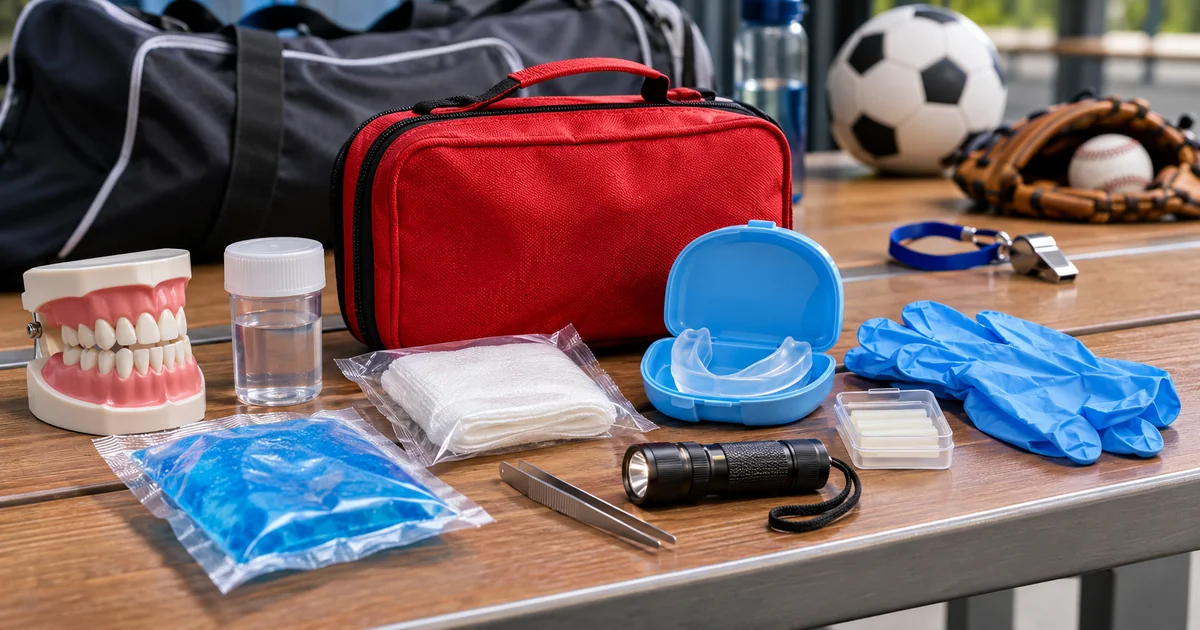
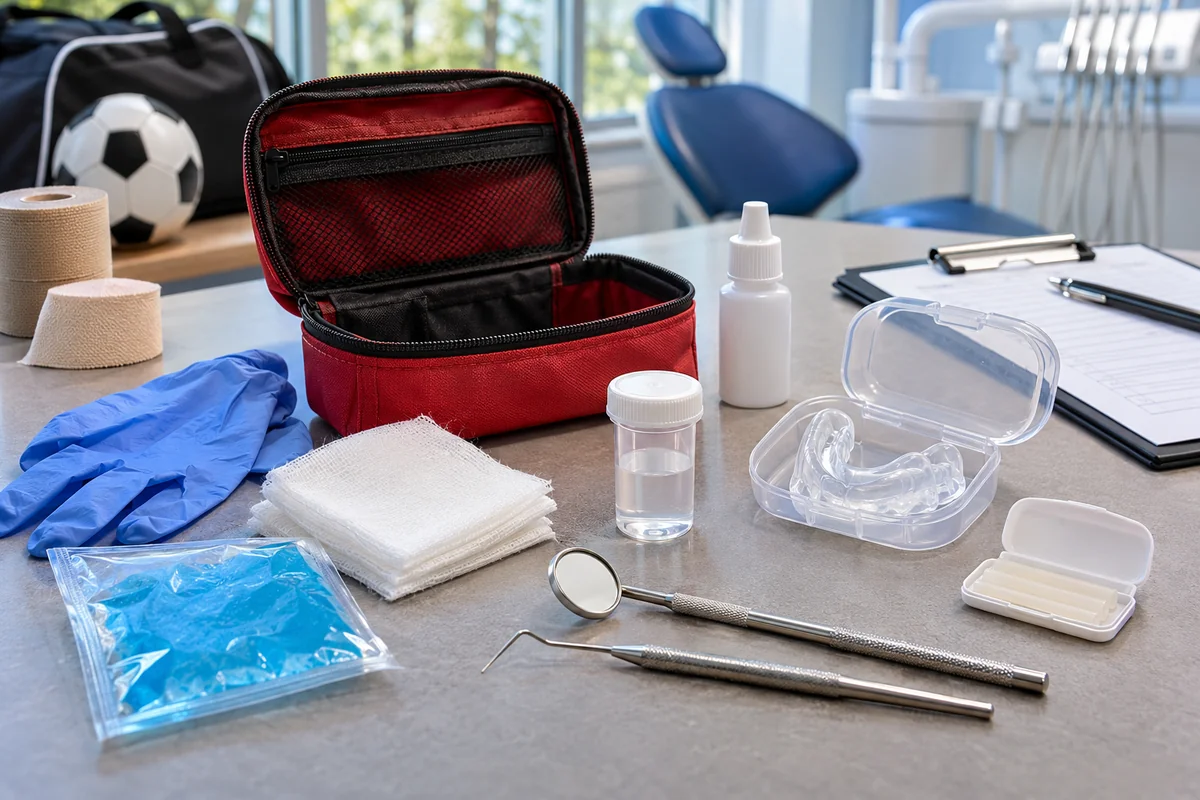
Essential Dental Emergency Kit Checklist
| Item | Purpose |
| Tooth-preservation kit | Keeps a knocked-out permanent tooth moist during transport |
| Sterile gauze pads | Helps control bleeding and protect injured areas |
| Disposable nitrile gloves | Reduces contact with blood and bodily fluids |
| Small leakproof container | Holds a broken tooth fragment or preservation liquid |
| Instant cold compress | Helps manage swelling and discomfort |
| Sterile saline solution | Allows gentle rinsing when appropriate |
| Clean bottled water | Helps rinse minor mouth injuries |
| Orthodontic wax | Temporarily covers irritating broken braces components |
| Emergency contact card | Provides access to parents, dentists, and emergency services |
| Simple dental injury instructions | Helps adults respond appropriately under pressure |
These supplies can fit inside a clearly labeled, water-resistant container.
Avoid storing loose medications, sharp instruments, or dental adhesives that could be misused by children.
1. Tooth-Preservation Kit: The Most Important Item
A tooth-preservation kit is one of the most valuable additions to a youth sports first-aid bag.
Products such as Save-A-Tooth are specifically designed to store a knocked-out permanent tooth in a solution that helps preserve cells on its root surface.
These cells are important for successful reimplantation.
A tooth-preservation product is especially useful because ordinary water is not an ideal long-term storage liquid for an avulsed tooth.
How to Use a Tooth-Preservation Kit
If a permanent tooth is knocked out and cannot be safely repositioned:
- Locate the tooth immediately.
- Pick it up by the crown, not the root.
- Avoid scrubbing or touching the root surface.
- Place the tooth into the preservation container according to the manufacturer’s directions.
- Seek emergency dental care immediately.
A preservation kit does not guarantee that the tooth can be saved.
However, it provides an appropriate storage option when immediate reimplantation isn’t possible.
Check the product’s expiration date and storage instructions before each sports season.
2. Sterile Gauze and Disposable Gloves
Gauze and gloves are basic supplies that every youth sports dental kit should contain.
Sterile gauze can help control bleeding from minor injuries involving the lips, cheeks, or gums.
Disposable gloves protect the adult providing assistance and reduce unnecessary contact with bodily fluids.
When to Use Gauze
For a minor oral cut, an adult can apply gentle, steady pressure using clean gauze.
If bleeding continues despite appropriate pressure, medical evaluation may be necessary.
Significant bleeding, deep facial wounds, or injuries involving breathing difficulties require urgent medical attention.
Keep several individually packaged gauze pads in the kit so replacements are available during longer tournaments.
3. Instant Cold Compresses
Cold compresses can help manage swelling and discomfort after an impact to the mouth or face.
For example, an athlete struck by an elbow during basketball may develop swelling around the lips or jaw.
A cold compress can provide temporary relief while the injury is assessed.
Always place a thin cloth or protective barrier between the cold pack and the skin.
Avoid placing ice directly against the skin or applying excessive pressure to a suspected fracture.
An instant cold pack is useful because it doesn’t require access to a freezer.
However, persistent swelling, severe pain, or difficulty moving the jaw warrants professional evaluation.
4. Sterile Saline and a Small Storage Container
Sterile saline can be useful for gently rinsing certain mouth injuries and cleaning visible debris.
It may also be used for brief rinsing of a knocked-out permanent tooth, although a dedicated tooth-preservation solution or milk is preferable for transport when available.
A small, clean, leakproof container provides a place to store tooth fragments or a displaced tooth with an appropriate liquid.
Never allow a knocked-out permanent tooth to dry out while traveling to the dentist.
If a commercial preservation product isn’t available, milk can be used to keep the tooth moist.
Saliva collected in a container is another temporary option.
Avoid placing a loose tooth inside a young child’s mouth because of the risk of swallowing or choking.
5. Orthodontic Wax for Athletes With Braces
Children and teenagers wearing braces may experience irritation or damage to orthodontic components during sports.
A collision can occasionally loosen a bracket or cause a wire to irritate the inside of the mouth.
Orthodontic wax can temporarily cover a sharp component until the athlete receives professional care.
However, wax does not repair damaged braces.
Parents should contact their child’s orthodontist for instructions after an appliance-related injury.
Coaches should not attempt to force brackets back into position or cut orthodontic wires without professional guidance.
6. Emergency Contact Information
Even a well-stocked kit has limited value if nobody knows whom to contact.
Every youth sports team should have an established emergency communication plan.
A dental emergency information card should include:
- Parent or guardian contact details
- The athlete’s designated dental provider, when available
- Nearby emergency medical facilities
- Relevant medical information maintained according to team policies
- Instructions for contacting emergency services
Coaches should also know who is responsible for accompanying an injured athlete and notifying their family.
Keep sensitive personal information secure rather than displaying it publicly inside the equipment bag.
Which Dental Emergency Kit Is Best for Your Child’s Sport?
The best option depends on where the athlete plays, how often the team travels, and who is responsible for first aid.
Basic Personal Dental Kit
Best for: Individual athletes, parents, and recreational sports.
A small personal kit should contain gauze, gloves, a tooth-preservation product, and emergency contact details.
This compact option can be stored with a parent’s sports supplies.
Sideline Team Dental Kit
Best for: Football, basketball, soccer, baseball, and school athletic programs.
A team kit should contain enough gauze, gloves, and cold compresses for multiple incidents.
Include a clearly labeled tooth-preservation container and simple written instructions for dental injuries.
The kit should be accessible to coaches, athletic trainers, or designated first-aid personnel.
Tournament Travel Dental Kit
Best for: Traveling teams and weekend competitions.
Travel kits should include the same essential supplies as a sideline kit, with additional quantities for multiple games.
Before traveling, team organizers should identify nearby dental and emergency medical services.
A kit should never be used as a reason to postpone urgent treatment until the team returns home.
Ready-Made vs. DIY Dental Emergency Kits: Which Is Better?
Parents can purchase a commercially assembled dental emergency kit or build one using individually purchased supplies.
Both approaches can work.
| Factor | Ready-Made Kit | DIY Kit |
| Convenience | Supplies are packaged together | Requires individual assembly |
| Customization | Limited to included contents | Can match team requirements |
| Tooth preservation | Check whether a suitable storage solution is included | Can select a dedicated preservation product |
| Maintenance | Check expiration dates of included supplies | Requires separate inventory checks |
| Best use | Quick preparation | Customized team or family needs |
The most important feature isn’t the packaging.
Look for a kit containing a suitable tooth-preservation medium, rather than one marketed for dental emergencies that only includes pain-relief products or temporary filling materials.
A general first-aid kit can also be supplemented with a tooth-preservation container and a dental injury instruction card.
What Should You Do if a Permanent Tooth Gets Knocked Out?
A knocked-out permanent tooth is one of the most urgent dental injuries in youth sports.
The International Association of Dental Traumatology recommends immediate reimplantation when appropriate.
First Steps After a Permanent Tooth Is Knocked Out
- Stop the activity and assess the athlete for other injuries.
- Locate the missing tooth.
- Hold the tooth only by its crown.
- If dirty, gently rinse it with milk or saline without scrubbing.
- If the athlete is alert, cooperative, and it is safe to do so, carefully reinsert the tooth into its socket without forcing it.
- If reinsertion isn’t possible, place the tooth in an appropriate preservation solution or milk.
- Seek emergency dental treatment immediately.
The best outcomes are associated with extremely prompt action, ideally within the first 15 to 30 minutes.
However, treatment may still be possible after a longer delay.
Do not assume a tooth cannot be saved simply because more than 30 minutes have passed.
What if a Baby Tooth Gets Knocked Out During Sports?
The response is different for primary teeth.
Never attempt to reimplant a knocked-out baby tooth.
Doing so can damage the developing permanent tooth underneath.
Instead, control any bleeding with gentle pressure and arrange a dental evaluation.
Children commonly begin losing baby teeth around age six, but the timing varies.
Some elementary-school athletes have a mixture of primary and permanent teeth.
If you’re unsure which type of tooth was knocked out, do not attempt to force it back into place. Contact a dental professional immediately.
How Should You Handle a Chipped or Broken Tooth?
A chipped tooth doesn’t always require the same level of urgency as a completely knocked-out permanent tooth.
However, the extent of the injury may not be obvious without a dental examination.
For a broken tooth:
- Rinse the mouth gently with clean water.
- Save any fragments in a clean container.
- Apply a cold compress if swelling occurs.
- Avoid chewing on the injured side.
- Arrange a prompt dental evaluation.
A small superficial chip may require bonding or smoothing.
A deeper fracture may expose sensitive internal tissue and require more extensive treatment.
Severe pain, visible bleeding from inside the tooth, or significant tooth movement warrants urgent assessment.
When Should a Youth Athlete Go to the Emergency Room?
Not every dental injury requires hospital treatment.
However, emergency medical services are necessary when an athlete has potentially serious injuries beyond a damaged tooth.
Seek emergency medical attention for:
- Difficulty breathing or swallowing
- Uncontrolled bleeding
- Suspected jaw or facial fractures
- Loss of consciousness
- Significant head trauma or concerning concussion symptoms
- Serious injuries involving multiple facial structures
A suspected concussion requires immediate removal from play and assessment under an appropriate concussion protocol.
An athlete should never return to the game simply because dental bleeding has stopped.
For isolated dental injuries, prompt evaluation by a dentist is usually the appropriate next step.
How Can Midlands Coaches Prepare for Dental Emergencies?
A kit is most effective when coaches and team personnel understand how to use it.
At the beginning of each sports season, teams can review basic procedures for responding to dental trauma.
We recommend assigning responsibility for checking the kit, contacting parents, and arranging professional assistance.
Create a Simple Sideline Response Plan
A practical plan should answer three questions:
Who responds? Identify the designated adult or athletic trainer responsible for first aid.
Where are the supplies? Keep the dental emergency kit with the team’s accessible first-aid equipment.
Where does the athlete go? Know how to contact local dental providers and when emergency medical services are necessary.
A laminated instruction card can help adults identify the correct steps during a stressful situation.
Coaches should also follow school or league policies regarding medications. Pain relievers should not be administered to children without appropriate authorization and dosing guidance.
How Can Mouthguards Reduce the Risk of Sports Dental Injuries?
An emergency kit helps after an accident. A mouthguard helps reduce the likelihood and severity of certain injuries before they happen.
The American Academy of Pediatric Dentistry encourages properly fitted mouthguards for organized sports with a risk of orofacial injury.
Types of Sports Mouthguards
Stock mouthguards are inexpensive and ready to use, but their fit may be limited.
Boil-and-bite mouthguards can be molded to improve fit when used according to the manufacturer’s instructions.
Custom-made mouthguards are professionally fabricated to fit an athlete’s teeth and bite.
A mouthguard should fit securely without interfering unnecessarily with breathing or communication.
Children with braces may need specialized mouthguards that accommodate orthodontic appliances.
No mouthguard prevents every dental or facial injury, and it should not be considered concussion-proof.
For Midlands families participating in football, basketball, soccer, baseball, and other recreational activities, mouthguard use is an important preventive consideration.
How Often Should You Check a Dental Emergency Kit?
We recommend checking the kit before the beginning of each sports season and periodically throughout the year.
Replace supplies that have been opened, damaged, or used.
Pay particular attention to expiration dates on tooth-preservation solutions.
Keep equipment clean, dry, and protected from excessive heat according to the manufacturers’ storage instructions.
South Carolina’s hot weather makes storage conditions especially relevant for bags left in vehicles or exposed to direct sunlight.
A dedicated checklist makes it easier for team volunteers to maintain the kit.
How Crescent Family and Cosmetic Dentistry Helps With Sports Dental Injuries
At Crescent Family and Cosmetic Dentistry, we provide emergency dental care for patients experiencing broken teeth, knocked-out teeth, dental pain, and other injuries.
Families throughout Columbia, Sumter, and nearby Midlands communities can contact us for guidance when a sports-related dental emergency occurs.
Our team evaluates the injury and determines which treatments may be appropriate.
Depending on the condition, care may involve diagnostic imaging, dental bonding, restorative treatment, or referral for specialized services.
We also provide preventive dental care and can discuss ways to reduce future injury risks.
Whether your child experiences a small chip during basketball practice or a more serious injury involving a permanent tooth, prompt assessment is important.
Contact our office immediately after a significant dental injury so we can advise you on appropriate next steps and appointment availability.
Frequently Asked Questions About Youth Sports Dental Emergency Kits
What is the most important item in a dental emergency kit?
A tooth-preservation product is especially valuable because it helps protect a knocked-out permanent tooth during transport when immediate reimplantation isn’t possible. Gauze, gloves, and emergency contact information are also essential.
Can you put a knocked-out tooth in water?
Water is not recommended for storing a knocked-out permanent tooth. A dedicated tooth-preservation solution or milk is preferable. Saliva collected in a container may also be used temporarily.
Should every youth sports coach carry a dental emergency kit?
Yes, having appropriate dental supplies available is a sensible precaution for sports involving collision, falls, or facial impacts. Team personnel should also understand basic dental first aid.
Can a knocked-out permanent tooth be saved?
Sometimes. Successful reimplantation depends on several factors, especially how quickly the tooth receives appropriate care and whether it has been stored correctly.
Do children with braces need a different dental emergency kit?
The basic supplies are similar, but orthodontic wax can be useful for temporarily covering irritating wires or brackets. Athletes should contact their orthodontist after appliance-related injuries.
Is a dental emergency kit enough to treat a sports injury?
No. Emergency supplies provide temporary assistance. Broken, displaced, or knocked-out teeth still require professional evaluation and appropriate treatment.
Be Prepared for Youth Sports Dental Emergencies in the Midlands
Youth sports should be an opportunity for children to stay active, build friendships, and develop confidence. However, accidents can happen during practices, games, and recreational activities, even when athletes wear appropriate protective equipment.
At Crescent Family and Cosmetic Dentistry, we encourage Midlands parents and coaches to prepare before an injury occurs.
A well-stocked dental emergency kit, a properly fitted mouthguard, and a clear plan for obtaining professional care can make an unexpected situation easier to manage.
Our team provides family, preventive, and emergency dental services for patients in Columbia, Sumter, and surrounding South Carolina communities.
If your child experiences a chipped, broken, or knocked-out tooth, we can evaluate the injury, explain appropriate treatment options, and help you understand the next steps.
Need guidance after a youth sports dental injury? Contact Crescent Family and Cosmetic Dentistry promptly.
For our Columbia office, call (803) 784-1304. For our Sumter office on North Guignard Drive, call (803) 773-5411.
If your child has serious facial trauma, uncontrolled bleeding, or difficulty breathing, seek emergency medical care immediately.