The True Price of “Same-Day” Crowns vs. Traditional Lab Crowns
If your dentist tells you that you can walk out with a crown in a single visit, it sounds like an easy decision.
No temporary crown. No second appointment. No waiting two or three weeks for a dental lab.
So why doesn’t every dentist use same-day crowns?
And if same-day crowns are faster, do they cost more?
These are the questions many patients ask when comparing treatment options.
The short answer is that same-day crowns and traditional lab crowns can both be excellent solutions, but the lowest upfront cost is not always the best value, and the fastest option is not always the right one.
At Crescent Family & Cosmetic Dentistry, patients in Columbia and Sumter often want to understand the real differences before making a decision. The answer involves more than price alone. It includes durability, convenience, materials, complexity, long-term value, and your specific dental situation.
Let’s look at what you’re actually paying for when choosing between same-day and traditional crowns.
Need a Crown Without the Wait?
See if a same-day crown fits your needs and budget. Call today to schedule your dental visit.
First, What Is a Dental Crown?
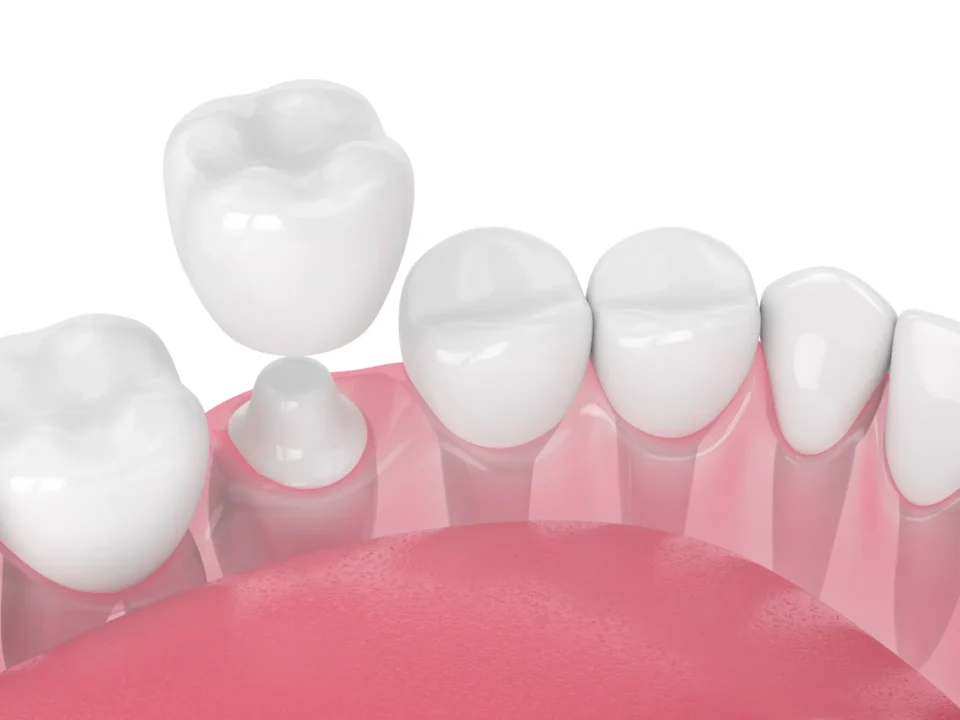
A dental crown is a custom-made restoration that covers and protects a damaged tooth.
Crowns are commonly recommended when a tooth is:
- Cracked
- Severely worn down
- Broken
- Weakened after a root canal
- Too damaged for a filling
- Requiring cosmetic improvement
The goal is to restore strength, function, and appearance while helping preserve the natural tooth underneath.
Both same-day and traditional crowns accomplish this goal.
The difference lies in how they’re made.
What Is a Same-Day Crown?
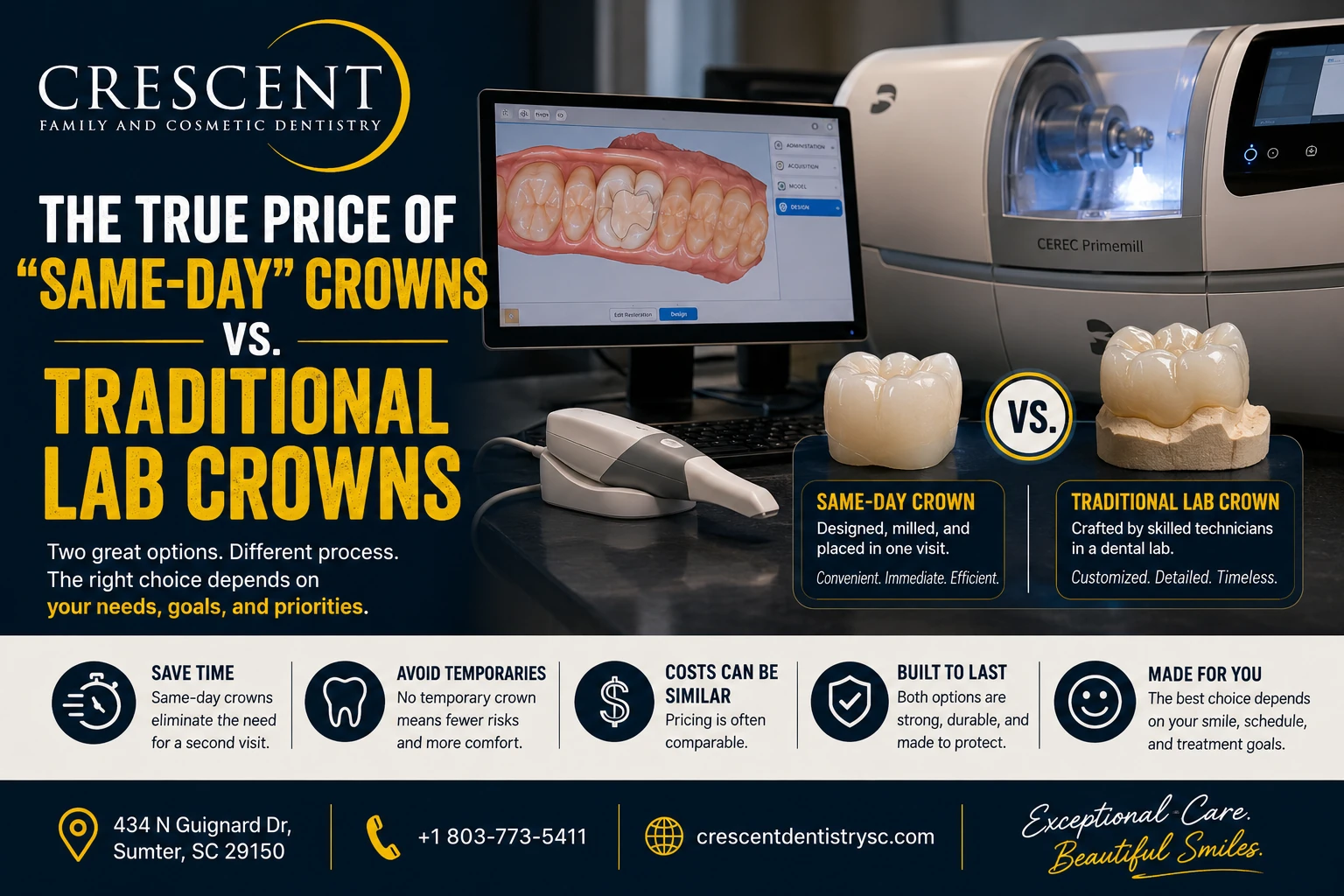
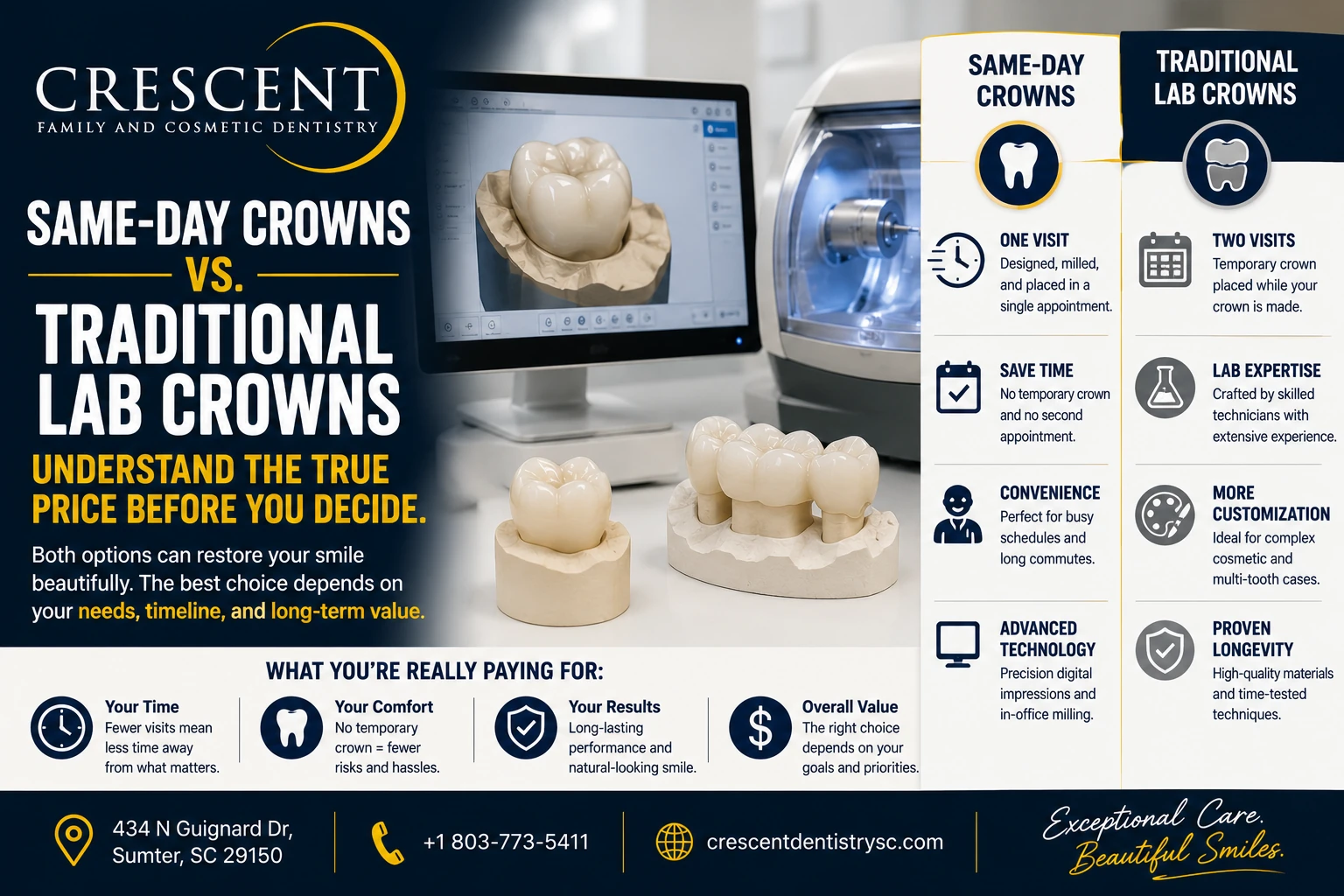
A same-day crown is designed, milled, and placed during a single appointment.
Using digital scanning technology and in-office CAD/CAM equipment, your dentist creates a virtual model of the tooth and fabricates the crown while you wait.
The process typically includes:
- Preparing the tooth
- Taking a digital scan
- Designing the restoration
- Milling the crown in-office
- Bonding the crown the same day
Most appointments take between two and three hours.
You leave with your final restoration instead of a temporary crown.
What Is a Traditional Lab Crown?
Traditional crowns require at least two visits.
During the first appointment:
- The tooth is prepared
- Impressions or digital scans are taken
- A temporary crown is placed
The information is then sent to a dental laboratory where technicians fabricate the final restoration.
At the second appointment, usually one to three weeks later, the permanent crown is delivered and cemented into place.
Although this process takes longer, it allows extensive customization and technician involvement.
Do Same-Day Crowns Cost More?
This is where many patients get surprised.
In most cases, same-day crowns and traditional crowns are priced similarly.
Depending on the office, location, materials used, and complexity of treatment, both options often fall within similar price ranges.
A typical crown may cost anywhere from:
- $1,000 to $2,000+
- Sometimes more depending on materials and complexity
The actual price depends on factors such as:
- Tooth location
- Restoration material
- Insurance coverage
- Existing dental damage
- Need for additional treatment
- Complexity of the case
The bigger question is not always what the crown costs.
It’s what the total experience costs you.
The Hidden Cost of Traditional Crowns
When patients compare treatment options, they often focus only on the dental fee.
But there are other costs worth considering.
Additional Time Away From Work
Traditional crowns require multiple appointments.
For busy professionals in Columbia, that may mean:
- Additional PTO usage
- Lost billable hours
- Schedule disruptions
- Childcare arrangements
For some patients, missing work twice is more expensive than any difference in treatment fees.
Temporary Crown Problems
Most temporary crowns perform well.
However, they can occasionally:
- Come loose
- Break
- Shift
- Cause sensitivity
If a temporary crown fails, an additional visit may be required.
Extended Treatment Timeline
Waiting several weeks may not seem significant until you are dealing with:
- A cracked tooth
- Temperature sensitivity
- Bite discomfort
- Cosmetic concerns
Many patients simply prefer completing treatment immediately.
The Hidden Cost of Same-Day Crowns
Same-day dentistry sounds ideal, but it also has tradeoffs.
Technology Costs
The equipment required for same-day crown systems can cost dental practices hundreds of thousands of dollars.
That investment affects overhead and operating expenses.
Material Limitations
Not every material used in traditional laboratory restorations can be produced chairside.
While same-day crowns use highly durable ceramics, some complex cases may benefit from materials or fabrication methods available only through a laboratory.
Case Selection Matters
A same-day crown is not automatically the best option for every patient.
Complex cosmetic cases sometimes benefit from additional customization performed by skilled laboratory technicians.
The technology is excellent, but technology alone does not replace judgment.
Which Crown Lasts Longer?
Patients often assume traditional crowns last longer because they involve a laboratory.
That is not necessarily true.
Longevity depends on factors such as:
- Bite forces
- Oral hygiene
- Grinding or clenching habits
- Material selection
- Crown design
- Placement quality
Both same-day and traditional crowns can last many years when properly planned and maintained.
A well-designed same-day crown can perform exceptionally well.
Likewise, a poorly fitting laboratory crown may fail prematurely.
The skill of the dentist matters more than whether the crown was milled in-office or fabricated externally.
Are Traditional Lab Crowns More Precise?
Years ago, this was often true.
Modern digital dentistry has narrowed that gap considerably.
Today’s advanced scanning systems can produce highly accurate digital impressions that eliminate some of the distortion associated with traditional molds.
However, there are situations where laboratory technicians provide an advantage.
Particularly complex cases involving:
- Multiple teeth
- Extensive cosmetic design
- Challenging bite relationships
- Full smile rehabilitations
may benefit from additional laboratory artistry and customization.
For straightforward single-tooth restorations, digital same-day solutions are often highly accurate and predictable.
Which Option Looks Better?
Most patients cannot distinguish between a well-made same-day crown and a well-made traditional crown.
The quality of the final appearance depends on:
- Shade matching
- Tooth position
- Smile line
- Material selection
- Dentist expertise
For highly visible front teeth, some cases may benefit from the advanced layering and characterization techniques available through specialty laboratories.
For many back teeth and routine restorations, the difference may be negligible.

The Silent Comeback of Dental Crowns and Why Patients are Choosing Them Again
Some dental treatments never really go out of style. Dental crowns are one of them. While trends in dentistry come…
When Same-Day Crowns Often Make the Most Sense
Same-day crowns can be an excellent choice when:
You Have a Busy Schedule
Professionals, business owners, teachers, healthcare workers, and parents often appreciate reducing treatment from two visits to one.
You Live Far From the Office
Minimizing travel can be valuable for patients with longer commutes.
You Want to Avoid Temporary Crowns
Many patients prefer completing treatment immediately.
The Case Is Straightforward
Single-tooth restorations often fit well within same-day workflows.
When Traditional Lab Crowns May Be Worth Considering
Traditional laboratory crowns may be preferable when:
Cosmetic Precision Is Critical
Some highly visible front-tooth restorations benefit from additional laboratory artistry.
Multiple Teeth Are Being Restored
Complex rehabilitation cases often involve advanced planning and customization.
Specialized Materials Are Needed
Certain situations may require materials not available through chairside milling systems.
Your Dentist Recommends It
A good dentist should recommend the option that serves your specific needs—not simply the technology available in the office.
The Biggest Mistake Patients Make
Many people ask:
“Which crown is cheaper?”
A better question is:
“Which option creates the most value for my situation?”
For example:
A professional who earns several hundred dollars during a workday may find a same-day crown saves money overall by avoiding a second appointment.
Meanwhile, a patient undergoing a highly cosmetic front-tooth restoration may decide that additional laboratory customization is worth the extra time.
The best choice depends on your priorities.
Questions to Ask Before Choosing a Crown
Before moving forward, consider asking:
- Why are you recommending this type of crown?
- What material will be used?
- How long is the crown expected to last?
- Are there cosmetic limitations?
- Is this a good candidate for same-day treatment?
- What are the risks and benefits of each option?
- Will insurance cover either choice differently?
A trustworthy dentist should be able to explain the reasoning behind the recommendation in plain language.
If they cannot, ask more questions.
The Real Cost Isn’t the Crown—It’s Making the Wrong Choice
The true price of a dental crown isn’t simply what appears on the treatment estimate.
It’s choosing a restoration that doesn’t fit your goals, schedule, expectations, or long-term dental needs.
Both same-day crowns and traditional laboratory crowns can be outstanding solutions when used appropriately. The key is understanding the tradeoffs rather than assuming newer automatically means better or older automatically means superior.
At Crescent Family & Cosmetic Dentistry, patients receive recommendations based on their individual circumstances—not on a one-size-fits-all approach. Our doctors work closely with patients to explain treatment options, expected outcomes, costs, and long-term considerations so they can make informed decisions with confidence.
Before You Commit to a Crown, Understand All Your Options
A crown can protect a damaged tooth for years, but the best treatment choice depends on more than convenience or price alone.
If you’re weighing the pros and cons of same-day versus traditional crowns in Columbia or Sumter, a consultation can help clarify which option aligns with your dental health, cosmetic goals, timeline, and budget.
Sometimes the fastest option is the best value. Sometimes the extra customization of a laboratory crown is worth the wait.
The important thing is knowing why you’re choosing one over the other—and feeling confident in that decision before treatment begins.
Frequently Asked Questions
Are same-day crowns more expensive than traditional crowns?
Not necessarily. In many dental practices, pricing is similar. The overall value often depends on convenience, treatment complexity, and time savings.
Are same-day crowns as strong as traditional crowns?
Modern same-day crowns are highly durable and perform very well in many situations. Material selection and case planning are more important than the manufacturing location alone.
Do same-day crowns last as long?
They can. Longevity depends on oral hygiene, bite forces, grinding habits, materials, and placement quality.
Why would a dentist recommend a traditional crown?
Complex cosmetic cases, multiple restorations, or specialized material needs may benefit from laboratory fabrication.
Which crown is better for front teeth?
It depends on the specific case. Some front-tooth restorations benefit from advanced laboratory customization, while others can achieve excellent results with same-day technology. A thorough evaluation is the best way to determine the right approach.
Don’t Overpay for Your Dental Crown
Understand the true price of your crown options. Call today for professional guidance and personalized care.