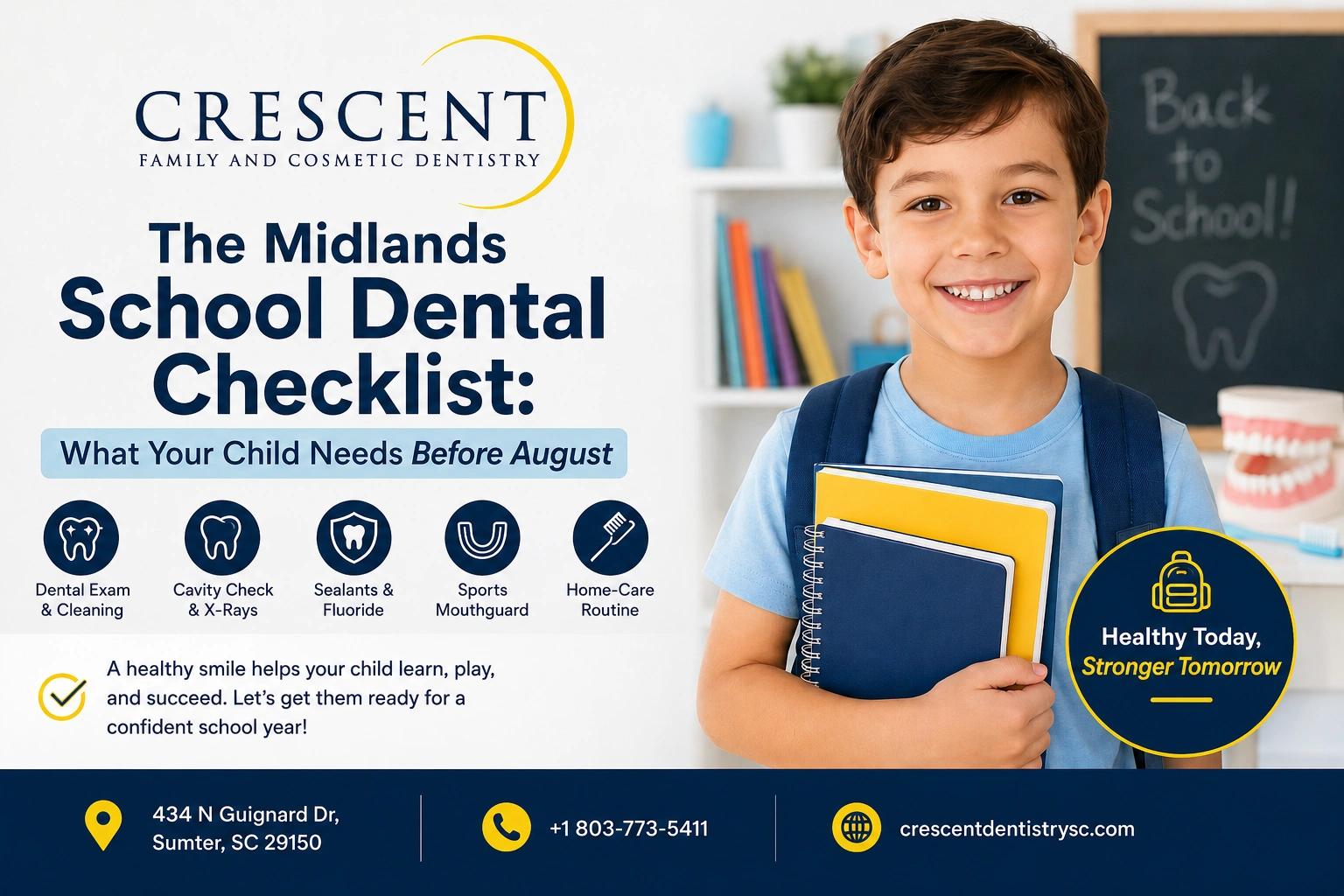
The Midlands School Dental Checklist: What Your Child Needs Before August
Back-to-school season in the Midlands gets busy fast.
School supplies. Physicals. Sports forms. Immunization records. New shoes. Haircuts. After-school plans.
Dental care usually falls to the bottom of the list until a child says, “My tooth hurts,” three days before school starts.
That is the problem.
Dental issues do not wait for a convenient week in August.
A small cavity can become a toothache. A loose spacer can shift teeth. A sports season can start before a child has a mouthguard. A nervous child may need more time than one rushed appointment allows.
Here is the short answer:
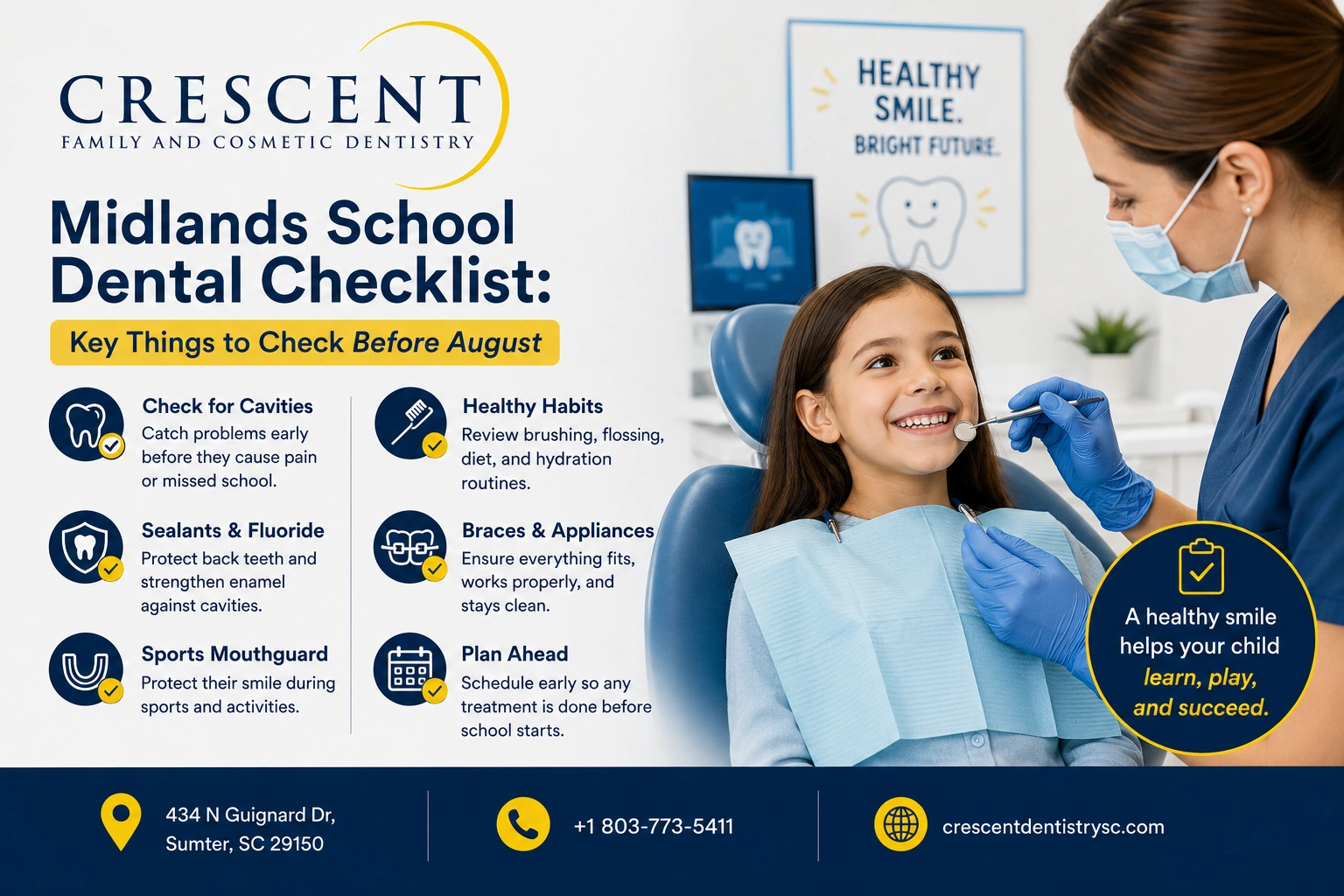
Before school starts in August, your child should ideally have a dental exam, cleaning, updated x-rays if needed, cavity check, fluoride discussion, sealant evaluation, orthodontic screening, sports mouth guard plan, and a realistic home-care routine.
South Carolina has school-based dental screening and prevention programs in public school settings, including screening and referral efforts for children in kindergarten, third, seventh, and tenth grades or upon entry into a South Carolina school in targeted programs.
But parents should not wait for a school screening to find out whether a child has a dental problem.
A school screening is helpful.
It is not the same as a full dental exam.
1. Schedule the Dental Exam Before the August Rush
The best time for a back-to-school dental visit is June or July.
Why?
Because if your child needs treatment, you still have time.
A cavity found the week before school may mean:
- missed class
- rushed scheduling
- discomfort during the first week
- avoidable stress for the child
A summer exam gives families breathing room.
At Crescent Family & Cosmetic Dentistry, this is especially helpful for families in Sumter and Columbia with multiple children, sports schedules, and school calendars to manage.
2. Get a Cleaning, Not Just a “Quick Check”
A back-to-school dental visit should include a professional cleaning when appropriate.
Brushing at home matters, but kids commonly miss:
- back molars
- gumlines
- crowded areas
- behind lower front teeth
- around orthodontic appliances
A cleaning helps remove plaque and tartar before the school year begins.
It also gives the dental team a chance to see where your child is struggling with brushing.
That is more useful than simply telling a child, “Brush better.”
3. Check for Cavities Before They Become Toothaches
Cavities are not always painful at first.
That is what makes them easy to ignore.
A child can have decay and still eat, sleep, and play normally.
By the time a cavity hurts, treatment may be more involved.
A small filling is usually much easier than dealing with:
- infection
- swelling
- tooth pain during school
- emergency treatment
- missed activities
This is one of the biggest reasons dental visits belong on the school checklist.
Not because every child has cavities.
Because finding them early is almost always better.
4. Ask Whether X-Rays Are Needed
Not every child needs x-rays at every visit.
But some cavities hide between teeth where a visual exam cannot catch them early.
Dental x-rays may be recommended based on:
- cavity history
- age
- spacing between teeth
- symptoms
- eruption pattern
- previous dental work
Parents sometimes worry about x-rays, which is understandable.
A good dental office should explain why x-rays are recommended and whether they are necessary for your child’s situation.
5. Ask About Sealants for Back Molars
Dental sealants are one of the most practical cavity-prevention tools for kids.
They are thin protective coatings placed on the chewing surfaces of back teeth.
Those deep grooves are where food and bacteria love to sit.
Sealants are especially helpful for:
- newly erupted permanent molars
- kids with deep grooves
- children with previous cavities
- kids who struggle with brushing back teeth
Sealants do not replace brushing.
But they can significantly reduce risk in the areas most kids miss.
6. Review Fluoride Needs
Fluoride helps strengthen enamel and reduce cavity risk.
Most children benefit from fluoride toothpaste.
Some may also benefit from professional fluoride treatment, especially if they:
- get cavities often
- drink mostly bottled water
- have braces
- snack frequently
- have dry mouth
- struggle with brushing
This is not about over-treating.
It is about matching prevention to risk.
Some kids need more cavity protection than others.
7. Check Baby Teeth Even If They Are “Just Going to Fall Out”
This is one of the most common parent misconceptions.
Baby teeth matter.
They help children:
- chew properly
- speak clearly
- hold space for adult teeth
- avoid pain and infection
A cavity in a baby tooth should not automatically be ignored.
Sometimes monitoring is reasonable.
Sometimes treatment is necessary.
The decision depends on the child’s age, the tooth involved, the size of the cavity, and how soon that tooth is expected to fall out.
A good dentist should explain the tradeoff clearly.
8. Look at Tooth Eruption and Crowding
Back-to-school visits are a good time to check growth and development.
Parents should ask:
- Are adult teeth coming in normally?
- Is crowding developing?
- Are baby teeth being lost on schedule?
- Is a tooth blocked from erupting?
- Should we consider an orthodontic evaluation?
Not every child needs braces.
But early screening can catch issues before they become harder to manage.
9. Get a Sports Mouthguard Before Practice Starts
If your child plays football, basketball, soccer, baseball, softball, lacrosse, wrestling, cheer, or martial arts, mouth protection matters.
A mouthguard helps reduce risk of:
- chipped teeth
- knocked-out teeth
- lip injuries
- tongue injuries
- jaw trauma
Store-bought mouthguards are better than nothing.
Custom mouthguards usually fit better and are easier to wear.
The best mouthguard is the one your child will actually keep in during practice and games.
10. Talk About Snacks and Drinks Before School Starts
Most school-year cavities are not caused by one birthday cupcake.
They are caused by repeated exposure.
Common culprits include:
- juice boxes
- sports drinks
- sweet tea
- sticky fruit snacks
- gummies
- chewy granola bars
- crackers eaten all day
- flavored milks
The goal is not perfect eating.
It is reducing constant sugar and starch exposure.
Better everyday options include:
- water
- cheese
- yogurt with low added sugar
- apples
- nuts if school-safe
- vegetables with hummus
- boiled eggs
- fresh berries
Frequency matters.
A treat with lunch is usually less risky than sipping juice or snacking on sticky carbs all afternoon.
11. Build the School-Night Brushing Routine Early
Do not wait until the first week of school to restart structure.
A strong routine looks simple:
- brush twice daily
- use fluoride toothpaste
- floss where teeth touch
- brush for two minutes
- avoid snacks after brushing at night
For younger kids, parents should still supervise.
Most children do not have the coordination to brush perfectly on their own just because they are old enough to argue about it.
12. Check Braces, Retainers, and Appliances
If your child has orthodontic appliances, add this to the checklist.
Before school starts, make sure:
- retainers still fit
- aligners are not cracked
- wires are not irritating
- bands are being worn as directed
- oral hygiene around brackets is acceptable
Back-to-school routines can disrupt orthodontic habits quickly.
A child who stops wearing a retainer for a few weeks may notice teeth shifting.
13. Do Not Ignore Dental Anxiety
Some children are not difficult.
They are scared.
If your child avoids dental visits, cries before appointments, gags easily, or has had a bad experience elsewhere, schedule earlier.
Rushed appointments make anxiety worse.
A calm visit before school starts gives the team time to move slowly, explain what is happening, and build trust.
That matters.
Children who learn not to fear the dentist are more likely to become adults who do not delay care.
14. Know What Can Wait and What Cannot
Some dental issues are not emergencies.
Others should be seen quickly.
Call a dentist soon if your child has:
- tooth pain
- swelling
- a broken tooth
- a loose permanent tooth
- bleeding that does not stop
- a pimple-like bump on the gums
- pain when chewing
- a lost filling
- a knocked-out tooth
Do not wait for school to start if your child has swelling or significant pain.
That is not a “watch it for a few weeks” situation.
The Bottom Line
The best back-to-school dental plan is not complicated.
Get the exam early. Clean the teeth. Check for cavities. Ask about sealants and fluoride. Protect teeth for sports. Build a realistic home routine before August.
South Carolina school screening programs can help identify children who need follow-up care, but they do not replace a full dental relationship.
If you are getting your family ready for school in Sumter, Columbia, or the surrounding Midlands, Crescent Family & Cosmetic Dentistry can help you understand what your child needs before the school year begins.
No pressure.
Just a clear plan before August gets hectic.