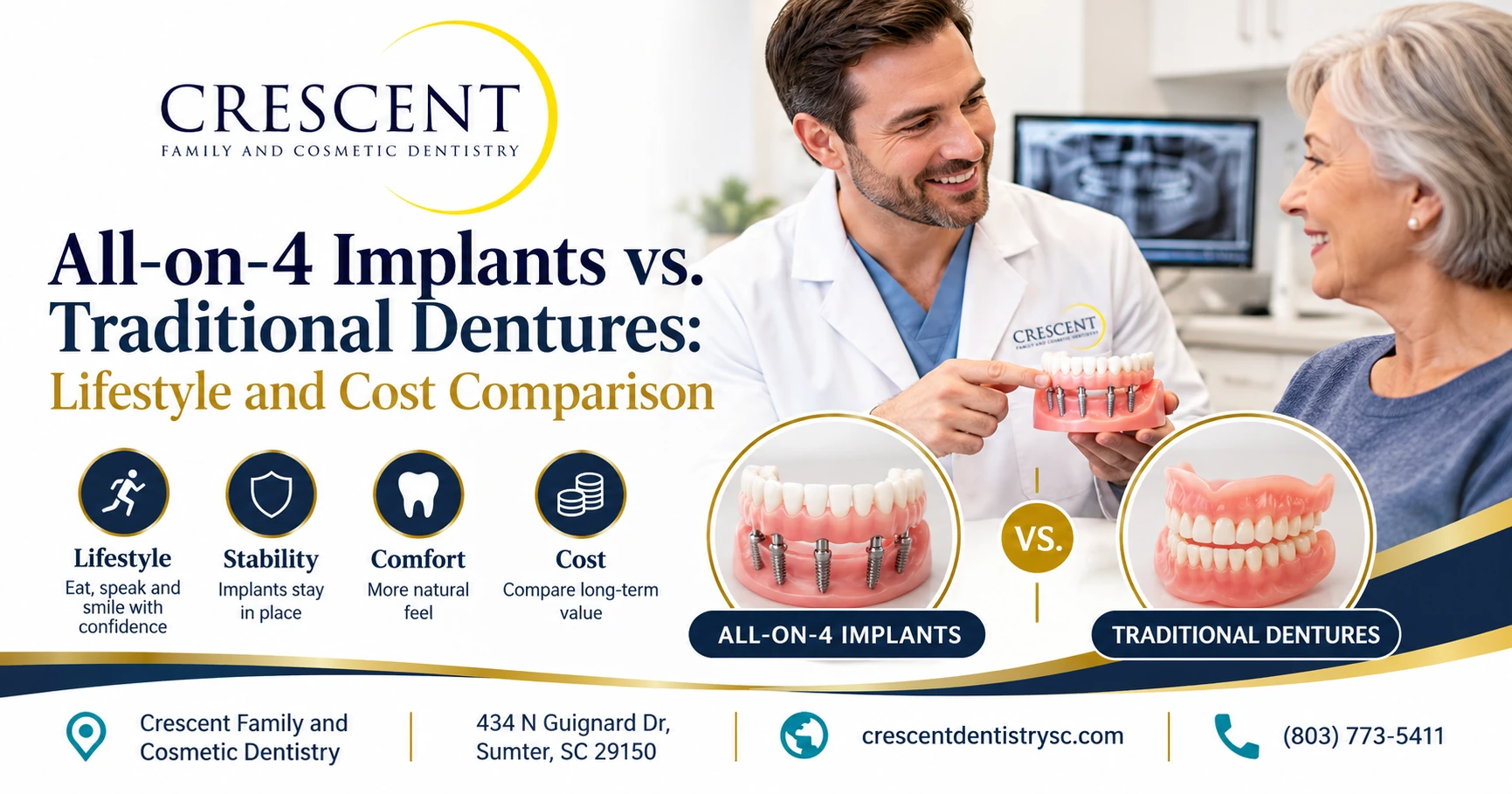
All-on-4 Implants vs. Traditional Dentures: Lifestyle and Cost Comparison
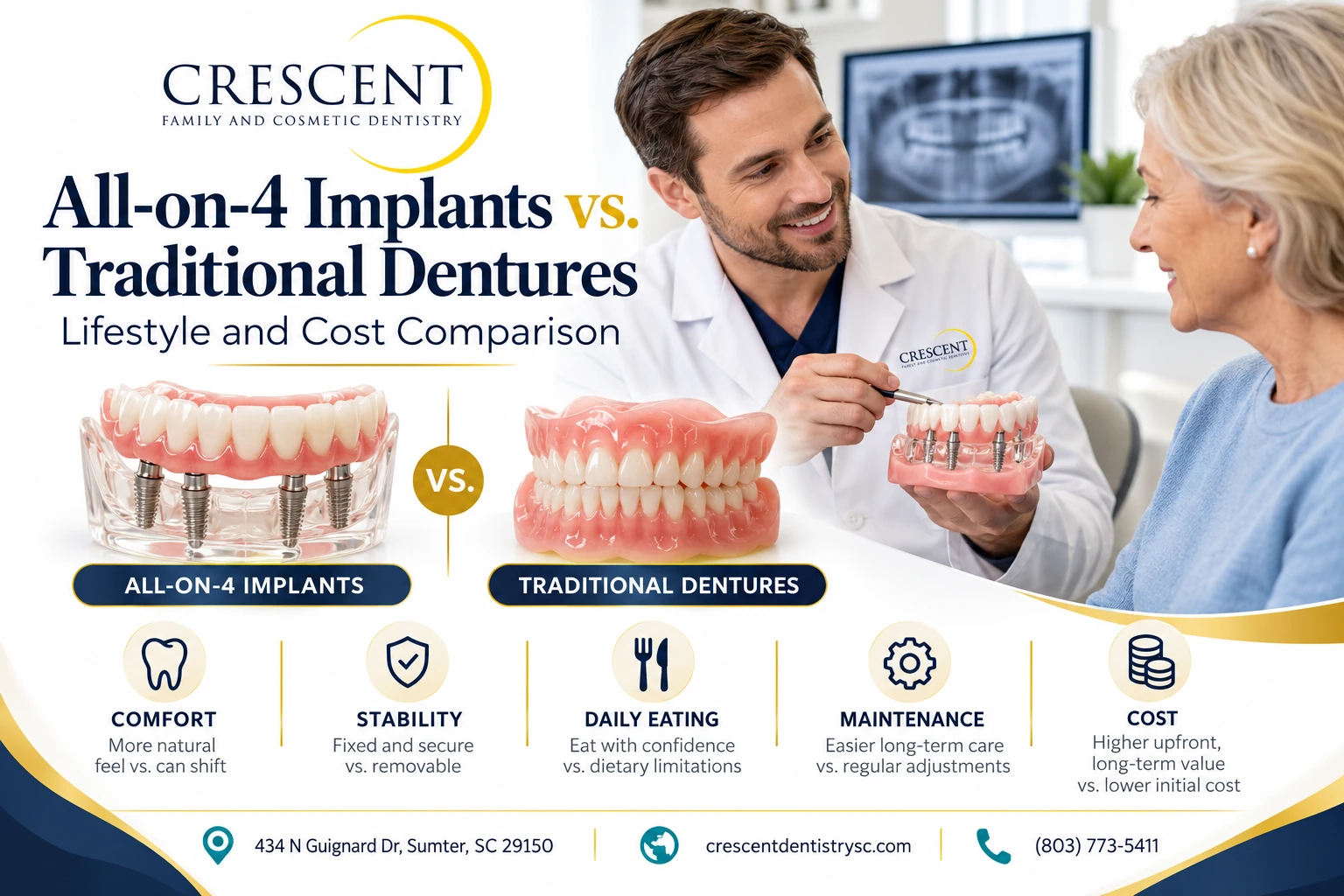
All-on-4 dental implants and traditional dentures can both replace a full arch of missing teeth, but they create very different day-to-day experiences. Traditional dentures are removable and usually cost considerably less upfront, while All-on-4 uses four strategically positioned dental implants to support a fixed full-arch restoration that the patient does not remove at home.
At Crescent Family and Cosmetic Dentistry, we help patients look beyond the initial price and consider eating, speaking, cleaning, maintenance, surgery, comfort, and long-term expectations. Neither option is automatically right for everyone. Your oral health, jawbone, medical history, lifestyle, and budget all matter.
Ready for a Permanent Smile?
Discover the comfort and stability of All-on-4 implants. Call today to explore your tooth replacement options!
What Is the Difference Between All-on-4 and Traditional Dentures?
Traditional complete dentures replace all of the teeth in the upper jaw, lower jaw, or both. They rest on the gum tissue and are removed by the patient for cleaning. Their stability comes mainly from the fit of the denture against the gums and underlying jawbone.
All-on-4 is different.
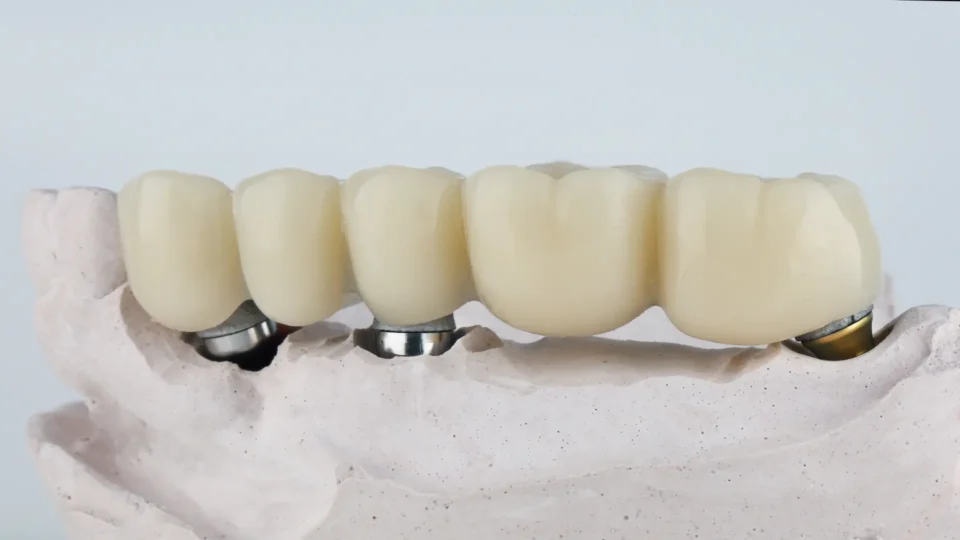
The American College of Prosthodontists explains that All-on-4® is a trademarked treatment concept that replaces all missing teeth in one jaw using four dental implants. The replacement teeth are fixed to those implants rather than simply resting on the gums.
That distinction affects almost every part of the patient experience.
Traditional dentures are removable prosthetic teeth.
All-on-4 is a surgically anchored, fixed full-arch restoration.
At Crescent Family and Cosmetic Dentistry, we also offer implant-supported denture options, which can provide more stability than conventional dentures. The exact implant design recommended depends on the patient’s anatomy and treatment needs.
Which Option Feels More Like Natural Teeth?
For many patients, a fixed implant-supported restoration feels more stable because it is attached to implants in the jaw.
Traditional dentures can restore a person’s smile and improve chewing and speech, but they still rest on movable tissues. As the mouth changes over time, dentures may begin to loosen and require adjustment or relining.
The American College of Prosthodontists notes that lower dentures in particular can be less stable because of the shape of the lower jaw and movement of the tongue. Dental implants can be used to improve denture retention and chewing efficiency.
With All-on-4, the restoration is fixed in place.
That means you do not remove it at night or before meals. Only a dental professional removes the prosthesis when necessary.
This can make an implant-supported fixed arch feel closer to having teeth that are part of your mouth rather than a removable appliance.
However, it is still a dental prosthesis. It does not have the nerves or periodontal ligament of natural teeth, and it requires specific cleaning and professional maintenance.
How Does Eating Compare?
Eating is one of the biggest lifestyle considerations when choosing between the two treatments.
Eating With Traditional Dentures
A properly fitted denture can restore a substantial amount of chewing function, but new denture wearers usually need an adjustment period.
Certain foods may initially be more difficult, particularly:
- Tough meats
- Very hard foods
- Sticky foods
- Nuts and seeds
- Raw vegetables
- Foods requiring strong biting force
Patients may learn to cut food into smaller pieces and chew on both sides to keep the denture balanced.
As a denture becomes looser over time, chewing can become more difficult.
The American College of Prosthodontists recommends periodic evaluation because changes in the jawbone and gums can affect denture stability.
Eating With All-on-4
Once healing is complete and the dentist has cleared the patient for normal function, a fixed implant-supported arch generally provides more stability during chewing.
Patients do not have to worry about the prosthesis lifting in the same way a loose conventional denture might.
However, “fixed” does not mean indestructible.
Very hard or sticky foods can damage prosthetic teeth or other components. Crescent’s own All-on-4 aftercare guidance advises patients to avoid excessively hard or sticky foods that could damage the restoration.
Immediately after implant surgery, dietary restrictions are also necessary while the implants and tissues heal.
Which Is Better for Speaking?
Both treatments can improve speech when missing teeth have been affecting pronunciation.
Traditional dentures may initially feel bulky. Patients often need time to adjust to the position of the tongue and lips around the new appliance.
Some people notice temporary difficulty pronouncing certain words.
With practice and proper fit, speech commonly improves.
All-on-4 restorations are also an adjustment. Even though they are fixed, their shape differs from natural teeth, particularly if significant gum tissue and tooth structure are being replaced.
Patients may initially notice changes in sounds such as “s,” “f,” or “th.”
The difference is that a fixed implant restoration generally does not move around during conversation once it is functioning properly.
For someone whose loose dentures frequently shift while speaking, greater stability may be an important lifestyle advantage.
What Is the Cost of All-on-4 Compared With Dentures?
This is where the difference between the treatments becomes particularly noticeable.
Traditional dentures usually have a much lower initial cost.
According to CareCredit’s August 2026 national pricing data, traditional full removable dentures average about $2,022, with a reported range of approximately $1,493 to $3,309. Premium removable dentures can cost considerably more depending on materials and customization.
All-on-4 treatment requires implant surgery, multiple implants, prosthetic components, laboratory work, and a full-arch restoration.
CareCredit’s 2026 cost guide reports a national average of approximately $15,176 for All-on-4 treatment, with reported prices ranging from roughly $11,640 to $27,500. Its published South Carolina average is approximately $14,324.
Those figures are general consumer cost estimates, not Crescent Family and Cosmetic Dentistry treatment quotes.
Actual fees can differ considerably depending on:
- Whether one or both arches are treated
- Number and condition of remaining teeth
- Extractions
- Implant number and type
- Bone grafting
- Sedation
- Imaging
- Temporary restorations
- Final restoration material
- Laboratory fees
- Complexity of the surgery
- Dental insurance
- Financing arrangements
A consultation and treatment plan are necessary before an accurate cost can be determined.
Why Does All-on-4 Cost So Much More?
Traditional dentures primarily involve designing and fabricating a removable prosthesis.
All-on-4 involves both surgery and prosthetic dentistry.
The treatment may include:
- Comprehensive examination
- Three-dimensional imaging
- Treatment planning
- Removal of failing teeth if required
- Surgical placement of implants
- Placement of a temporary restoration when appropriate
- Healing and implant integration
- Fabrication of a final full-arch prosthesis
- Follow-up care
- Long-term implant maintenance
The implants themselves are titanium fixtures surgically positioned within the jawbone. They serve as artificial roots supporting the replacement teeth.
Because the treatment involves more procedures, materials, technology, and clinical time, the initial investment is much greater.
Are Traditional Dentures Cheaper Long Term?
They may still remain the less expensive option overall, but the comparison is more complicated than the initial purchase price.
Traditional dentures are not necessarily a one-time expense.
Your jaw and gums continue changing after tooth loss.
The American College of Prosthodontists notes that dentures should be professionally checked each year and often need to be remade once they become loose or lose their proper fit, frequently after approximately five to ten years of use.
Potential future expenses may include:
- Relines
- Repairs
- Adjustments
- Replacement dentures
- Denture adhesive
- Professional examinations
All-on-4 restorations also require maintenance.
Implants may remain integrated for many years, but the artificial teeth and prosthetic components can wear, chip, loosen, stain, or require replacement.
The ACP specifically cautions that calling fixed implant teeth “permanent dentures” can be misleading because even fixed restorations can eventually wear or require repair or replacement.
So neither option should be treated as a purchase that will never require future dental care.
Do All-on-4 Implants Prevent Bone Loss?
Dental implants interact with the jaw differently from conventional dentures.
When natural teeth are removed, the bone that previously supported those teeth gradually changes because it no longer receives the same stimulation from tooth roots.
The ACP notes that jawbone shrinkage normally occurs over time after teeth are lost.
Implants transfer chewing forces into the jaw and can help maintain bone around the implant sites.
Traditional dentures sit on top of the gum tissue and do not replace tooth roots.
This difference may be relevant for patients thinking about longer-term jaw support.
However, implants do not prevent every form of bone change, and bone can still be lost around unhealthy implants.
Regular professional care remains necessary.
Does All-on-4 Always Avoid Bone Grafting?
No.
One reason the All-on-4 concept became popular is that implant positioning can sometimes make use of available bone and reduce the need for extensive grafting.
The ACP describes All-on-4 as being particularly useful for some patients who have lost significant bone in the back of the jaw.
But that does not mean bone grafting is never necessary.
A patient’s existing bone quantity and quality, sinus anatomy, implant stability, health history, and treatment plan all affect what can be done.
Some patients may need grafting or another surgical approach.
The only way to know is through examination and imaging.
Which Option Is Easier to Clean?
Neither option eliminates the need for daily oral hygiene.
Cleaning Traditional Dentures
One advantage of removable dentures is that they can be taken out and cleaned directly.
Patients should clean the denture daily while also caring for their gums, tongue, and remaining oral tissues.
Most dentures should be removed overnight unless a dentist specifically advises otherwise.
The denture must also be handled carefully because dropping it can cause damage.

The Science Behind Oral Surgery: How Precision Shapes Every Procedure
Oral surgery is a highly specialized branch of dentistry that requires a perfect blend of technical expertise, cutting-edge technology, and…
Cleaning All-on-4 Teeth
A fixed full-arch restoration stays in the mouth.
That means plaque and food need to be cleaned from underneath and around the prosthesis.
Your dental team may recommend tools such as:
- Water flossers
- Floss threaders
- Specialized implant floss
- Interdental brushes
- Soft toothbrushes
Fixed implant teeth cannot develop cavities, but the tissues surrounding implants can develop inflammation and disease.
The ACP emphasizes that healthy gums and regular professional maintenance are essential to long-term implant success.
Anyone considering implants should be prepared to make daily cleaning a long-term commitment.
What About Comfort?
A well-made conventional denture can be comfortable, but because it rests on gum tissue, sore areas can develop.
As the shape of the mouth changes, pressure may become uneven.
Adjustments or relining can often improve the fit.
All-on-4 distributes support through implants rather than relying entirely on the gums.
After healing, many patients appreciate that the restoration does not shift against the gum tissue during routine use.
The tradeoff is that All-on-4 requires surgery.
Temporary swelling, soreness, and dietary limitations are expected during early healing.
Crescent Family and Cosmetic Dentistry’s All-on-4 postoperative guidance recommends rest, swelling management, modified eating, and careful protection of the implant restoration during recovery.
So the fixed option can offer greater stability later, but the path to that stability is more involved.
Is Surgery Required for Both Options?
Traditional dentures typically do not require implant surgery.
If damaged or failing teeth need to be removed before a denture is made, extractions may still be necessary.
Immediate dentures can sometimes be placed on the same day as extractions, while conventional dentures may be made after the mouth has healed.
All-on-4 requires implant surgery.
This makes overall health particularly important.
Your dentist needs to review factors such as:
- Medical conditions
- Medications
- Smoking
- Diabetes management
- Gum health
- Bone quality
- Previous radiation treatment
- Ability to heal following surgery
Not every person who wants fixed implant teeth is automatically a candidate.
What Happens if an All-on-4 Implant Fails?
Implant treatment has a strong track record, but no surgical procedure has a 100% success rate.
An implant can fail to integrate properly, or problems can develop later because of infection, excessive forces, smoking, uncontrolled medical conditions, or other factors.
Problems can also occur with the prosthetic teeth even when the implants themselves remain healthy.
For example, the restoration may eventually need:
- Screw tightening
- Repair of a chipped tooth
- Replacement of worn components
- Professional removal and cleaning
- Replacement after significant wear
Before treatment, ask what your proposed fee includes and what future repairs or maintenance would cost.
Which Option Is Better for an Active Lifestyle?
This depends on what “active” means to you.
Someone who travels frequently may appreciate not having to remove a full denture every night.
A person who enjoys restaurants may value the greater chewing stability of a fixed restoration.
Someone who has struggled with denture movement during conversation may feel more comfortable with an implant-supported solution.
On the other hand, a patient who wants:
- A lower initial investment
- No implant surgery
- A removable restoration
- A simpler treatment process
may prefer traditional dentures.
Today’s dentures can still offer attractive, functional results. Crescent Family and Cosmetic Dentistry provides complete, partial, immediate, and implant-supported denture options depending on individual needs.
Choosing traditional dentures does not mean choosing “bad dentistry.”
It means selecting a different balance of cost, treatment time, maintenance, and function.
How Long Does Each Treatment Take?
Traditional denture treatment is generally less surgically complex.
The timeline depends on whether teeth need to be extracted and whether immediate or conventional dentures are being made.
Patients who receive immediate dentures can avoid being completely without teeth during healing, although the changing shape of the gums often means additional adjustments are necessary.
All-on-4 typically involves a longer biological healing process.
Some patients may receive a temporary fixed restoration relatively early in treatment, but the implants still need time to integrate with the surrounding bone.
The final restoration is usually planned around healing and stability rather than simply a calendar date.
Treatment timelines therefore vary significantly from patient to patient.
Does Dental Insurance Cover All-on-4 or Dentures?
Insurance varies substantially.
Traditional dentures are commonly included in many dental insurance plans, although patients may still have:
- Deductibles
- Coinsurance
- Annual benefit maximums
- Waiting periods
- Replacement-frequency limits
Implant coverage is more variable.
Some plans provide partial benefits toward implant surgery or the prosthesis, while others limit coverage or exclude certain implant services.
Even when implants are covered, the annual maximum may represent only a small portion of the total All-on-4 cost.
Before starting treatment, ask for a written treatment estimate and review your insurance benefits carefully.
Crescent’s denture information also notes that coverage depends on the patient’s plan and that financing or payment options may be available.
All-on-4 vs. Traditional Dentures at a Glance
| Factor | All-on-4 | Traditional Dentures |
| Attachment | Four implants support a fixed arch | Rests on gums |
| Patient removes it? | No | Yes |
| Surgery | Required | Usually not, aside from needed extractions |
| Upfront cost | Significantly higher | Lower |
| Chewing stability | Generally greater after healing | Depends heavily on fit |
| Cleaning | Requires cleaning under fixed bridge | Removed for cleaning |
| Bone support | Implants stimulate bone at implant sites | Does not replace tooth roots |
| Treatment timeline | Surgical healing required | Usually simpler |
| Future maintenance | Implant and prosthetic maintenance | Relines, adjustments, replacement |
| Best suited for | Patients wanting fixed teeth who qualify for implants | Patients prioritizing affordability or non-surgical care |
The table describes general differences rather than a recommendation for any individual patient.
FAQs About All-on-4 and Dentures
Are All-on-4 teeth removable?
Not by the patient. The full-arch prosthesis is secured to dental implants and can be removed by a dental professional when necessary.
Are traditional dentures much cheaper?
Generally, yes. Current national consumer cost data place conventional dentures substantially below the upfront cost of All-on-4 implant treatment.
Can I eat normally with All-on-4 implants?
After healing and clearance from your dentist, fixed implant teeth can provide strong chewing stability. Extremely hard or sticky foods may still need to be limited to protect the restoration.
Will traditional dentures always become loose?
Changes in the gums and jawbone can affect fit over time. Dentures may eventually need adjustment, relining, or replacement.
Can I switch from traditional dentures to implants later?
Sometimes. Patients who already wear dentures may be able to receive implants to support a removable or fixed restoration, depending on their bone, health, and existing prosthesis.
Is All-on-4 right for every person who has lost all their teeth?
No. Implant candidacy depends on bone anatomy, oral health, medical history, expectations, ability to maintain the restoration, and other clinical factors.
Compare Your Full-Arch Options With Crescent Family and Cosmetic Dentistry
Replacing an entire arch of teeth is a major decision, and price is only one part of it.
Traditional dentures offer a proven, removable solution with a considerably lower initial investment. For many patients, that balance of affordability, appearance, and function makes them a practical choice.
All-on-4 treatment involves a much larger upfront investment and requires surgery, healing, and lifelong implant maintenance. In return, appropriate candidates gain a fixed restoration supported by implants, which can provide greater stability when eating, talking, and going through daily life.
At Crescent Family and Cosmetic Dentistry, we offer both dental implants and denture solutions, including implant-supported options. We can evaluate your remaining teeth, gum health, jawbone, medical history, lifestyle goals, and budget before discussing which approach makes sense for you.
If you are tired of dealing with missing teeth or loose dentures, schedule a consultation with Crescent Family and Cosmetic Dentistry. We can explain the differences between traditional dentures, implant-supported dentures, and All-on-4 treatment and provide an individualized treatment and cost estimate based on your needs.
Tired of Loose Dentures?
Enjoy a more secure, confident smile with All-on-4 implants. Call now to schedule your consultation!