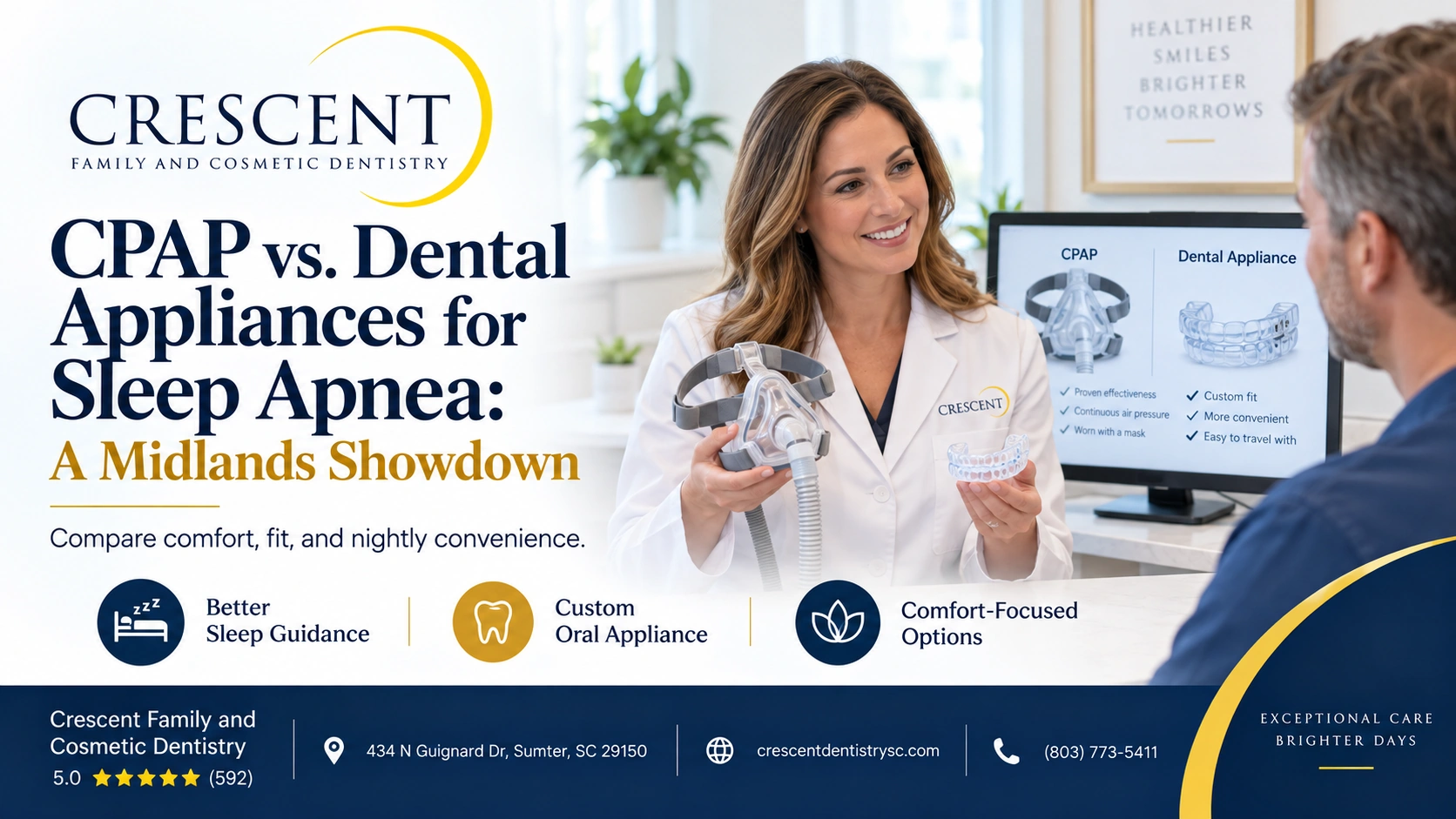
CPAP vs. Dental Appliances for Sleep Apnea: A Midlands Showdown
If you have been diagnosed with obstructive sleep apnea, you have probably heard one treatment recommendation more than any other: CPAP.
Continuous positive airway pressure therapy has been a standard treatment for sleep apnea for years. It works by delivering pressurized air through a mask to help keep the airway open while you sleep.
For many patients, CPAP is highly effective.
But it is not the only option.
At Crescent Family and Cosmetic Dentistry, we often meet adults throughout the Midlands who struggle with CPAP or simply want to understand whether a dental sleep appliance could be an appropriate alternative.
That leads to an important question:
CPAP or a dental appliance? Which one actually makes more sense?
The answer depends on the severity of your sleep apnea, your overall health, your anatomy, your ability to tolerate CPAP, and the recommendations of your medical and dental providers.
Rather than declaring one treatment the universal winner, let’s compare how the two approaches stack up.
First, What Is Obstructive Sleep Apnea?
Obstructive sleep apnea occurs when the upper airway repeatedly becomes partially or completely blocked during sleep.
When the airway closes, breathing may stop temporarily.
Your brain detects the drop in airflow and briefly wakes the body enough to reopen the airway. These awakenings may be so short that you do not remember them in the morning.
But they can happen repeatedly throughout the night.
The result is fragmented sleep and reduced oxygen delivery.
Common signs of obstructive sleep apnea may include:
- Loud snoring
- Gasping or choking during sleep
- Witnessed pauses in breathing
- Morning headaches
- Dry mouth
- Difficulty concentrating
- Daytime sleepiness
- Irritability
- Poor-quality sleep
- Waking frequently during the night
Sleep apnea is more than a snoring problem.
Untreated obstructive sleep apnea has been associated with serious health concerns, which is why proper diagnosis and management matter.
Round One: How CPAP Works
CPAP uses a bedside machine connected to tubing and a mask.
The machine delivers a continuous stream of pressurized air while you sleep.
That air pressure helps prevent the airway from collapsing.
For patients who use CPAP consistently and properly, it can be extremely effective at reducing breathing interruptions.
CPAP may be especially important for people with moderate to severe obstructive sleep apnea or those with other significant health concerns.
The challenge is not usually whether CPAP works.
The challenge is whether patients actually use it.
Why Some Midlands Patients Struggle With CPAP
CPAP can be life-changing when patients tolerate it well.
However, not everyone adjusts easily.
Common complaints may include:
- Mask discomfort
- Air leaks
- Dry mouth
- Nasal dryness
- Skin irritation
- Difficulty sleeping with tubing
- Feeling claustrophobic
- Machine noise
- Difficulty traveling with equipment
Some people remove the mask during the night without realizing it.
Others use CPAP inconsistently because they find it difficult to sleep comfortably while wearing it.
That is an important issue because CPAP only works when it is being used.
A treatment can be clinically excellent but less useful if a patient cannot tolerate it consistently.
Round Two: How a Dental Sleep Appliance Works
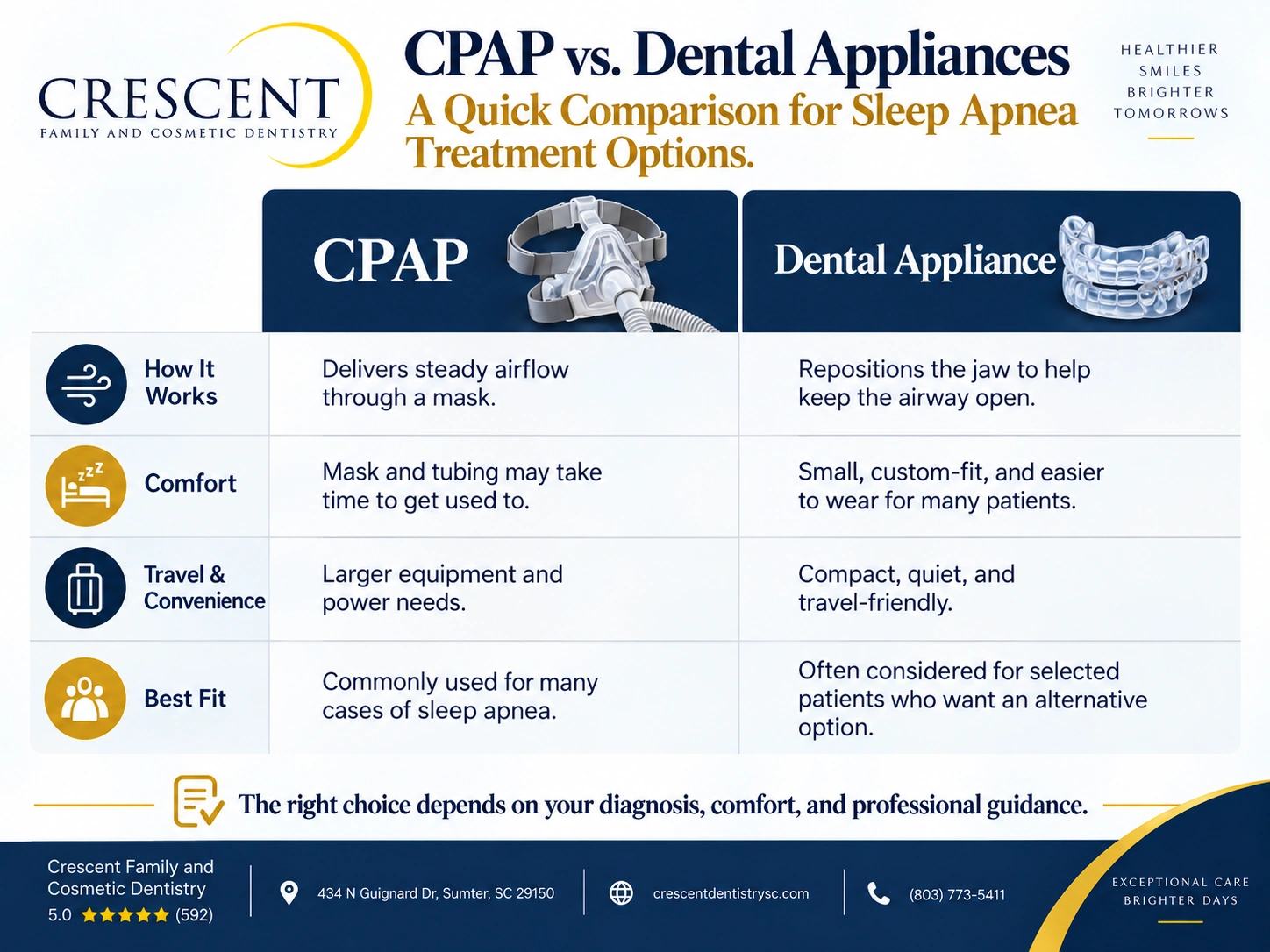
A dental sleep appliance, often called an oral appliance or mandibular advancement device, looks somewhat like a specialized mouthguard.
However, it is not the same as an over-the-counter nightguard.
The appliance is custom designed to reposition the lower jaw slightly forward during sleep.
That change may help prevent the tongue and soft tissues from collapsing backward and blocking the airway.
The device is worn inside the mouth while you sleep.
There is no mask, tubing, or bedside machine.
For certain patients, this can make treatment much easier to incorporate into everyday life.
Who May Be a Candidate for an Oral Appliance?
Oral appliance therapy is not appropriate for every person with sleep apnea.
It may be considered for certain adults with obstructive sleep apnea, particularly those who cannot tolerate CPAP or who have been advised that an oral appliance may be appropriate.
The decision should involve medical diagnosis.
A dentist does not replace a sleep physician.
If you have symptoms of sleep apnea but have never been diagnosed, the first step is usually a medical sleep evaluation or sleep study.
Once the diagnosis is established, we can determine whether your teeth, jaw, gums, and bite are suitable for oral appliance therapy.
CPAP vs. Dental Appliance: Effectiveness
If we are comparing pure ability to keep the airway open, CPAP is generally considered extremely effective when used correctly.
It can provide consistent airway pressure throughout the night and can be adjusted according to the patient’s needs.
Dental appliances work differently.
Rather than using air pressure, they change jaw position to improve airway space.
For appropriately selected patients, oral appliances may significantly reduce sleep apnea events and snoring.
However, they may not be sufficient for every case, particularly more complex or severe forms of sleep apnea.
That is why treatment needs to be personalized.
The Compliance Factor Changes the Competition
Imagine two treatments.
Treatment A is extremely effective but only works if you use it every night.
Treatment B may be appropriate for your condition and is easier for you to tolerate consistently.
Which treatment provides more real-world benefit?
The answer depends partly on adherence.
This is one reason oral appliance therapy can be valuable.
Some patients find a small dental device much easier to wear than a CPAP mask.
If they are more likely to use the appliance every night, treatment may become more consistent.
We never recommend choosing convenience over medical safety.
But comfort and compliance are important parts of successful sleep apnea management.
Round Three: Comfort
This is where dental appliances often appeal to patients.
A custom oral appliance fits inside the mouth and does not cover the nose or face.
There is no hose attached to your head and no machine sitting beside your bed.
For people who feel claustrophobic wearing a CPAP mask, this can make a major difference.
That said, oral appliances can require an adjustment period.
Some patients initially experience:
- Jaw soreness
- Tooth tenderness
- Increased saliva
- Dry mouth
- Temporary bite changes
- Muscle discomfort
These issues can often be addressed through adjustments and professional monitoring.
The goal is to find a jaw position that helps improve the airway while remaining comfortable and protecting the teeth and jaw joints.
Round Four: Travel
For frequent travelers, portability matters.
CPAP machines have become smaller and more travel-friendly over the years, but they still require equipment, tubing, masks, and usually access to power.
A dental appliance fits into a small case.
That can make it particularly convenient for:
- Business travel
- Vacations
- Camping
- Weekend trips
- Air travel
For Midlands patients who spend significant time on the road, portability may be an important factor when considering treatment options.
Round Five: Noise
Modern CPAP machines are often relatively quiet.
However, some patients or their partners still notice machine sounds, mask leaks, or airflow during the night.
Oral appliances do not use a motor or air pump.
That makes them essentially silent.
For couples whose sleep is already being disrupted by snoring and sleep apnea, reducing nighttime equipment noise may be a welcome benefit.
Round Six: Snoring
Snoring is one of the most common reasons patients initially become concerned about sleep apnea.
Both CPAP and oral appliances may reduce snoring when the snoring is related to airway obstruction.
CPAP helps prevent airway collapse through positive pressure.
A mandibular advancement device can help by positioning the jaw and tongue in a way that maintains a more open airway.
However, snoring alone does not confirm sleep apnea.
And eliminating snoring does not necessarily mean sleep apnea is fully controlled.
That is why treatment should not be judged solely by whether your partner says you are quieter.
Medical follow-up may be needed to confirm effectiveness.
Can You Just Buy a Sleep Apnea Mouthguard Online?
We do not recommend treating diagnosed sleep apnea with a random over-the-counter mouthpiece.
Sleep apnea appliances require precise positioning.
Moving the jaw too far forward can create unnecessary discomfort.
Moving it too little may not improve the airway adequately.
A poorly fitting appliance can also place pressure on teeth, gums, or the jaw joints.
A professionally fabricated oral appliance is customized to your mouth and should be monitored over time.
That monitoring allows us to evaluate comfort, appliance fit, jaw function, tooth movement, and bite changes.
This is very different from buying a generic anti-snoring device from the internet.
Why Your Teeth Matter Before Oral Appliance Therapy
A dental sleep appliance places forces on the teeth.
That means oral health matters.
Before considering treatment, we need to evaluate:
- Tooth stability
- Gum health
- Existing dental restorations
- Missing teeth
- Bite relationships
- Jaw joint function
- Tooth decay
- Periodontal disease
A patient with significant untreated gum disease or unstable teeth may require dental treatment before an appliance can be considered.
This is one reason oral appliance therapy needs dental involvement.
The airway is important, but so are the structures supporting the appliance.
What About Jaw Pain?
Because mandibular advancement devices reposition the lower jaw, some patients worry about temporomandibular joint problems.
Mild temporary soreness can occur when beginning treatment.
That does not automatically mean the appliance is causing permanent damage.
The device can often be adjusted gradually to find a comfortable and effective position.
However, persistent jaw pain should never be ignored.
Professional follow-up allows us to monitor the jaw joints and muscles and make adjustments when necessary.
Can a Dental Appliance Change Your Bite?
Yes, long-term oral appliance therapy can sometimes affect tooth position or bite relationships.
These changes may be subtle, but they are one reason regular dental monitoring is important.
Your sleep apnea treatment should not be viewed as a device that is delivered once and forgotten.
The appliance should be checked periodically.
We can evaluate its fit, your bite, your teeth, gum health, and any symptoms that develop.
Ongoing monitoring helps balance airway treatment with long-term oral health.
What If CPAP Works but You Hate Wearing It?
Do not simply stop treatment.
If you have diagnosed obstructive sleep apnea and cannot tolerate CPAP, talk with your sleep physician about your difficulty.
Sometimes CPAP problems can be solved by changing mask styles, adjusting humidity, modifying pressure settings, or improving mask fit.
For some patients, however, oral appliance therapy may be a reasonable alternative.
Your physician and dentist can work together to determine whether that approach makes sense.
The dangerous option is abandoning sleep apnea treatment altogether because one method feels uncomfortable.
What If You Have Severe Sleep Apnea?
Patients with severe obstructive sleep apnea need particularly careful management.
CPAP is often strongly considered because of its ability to maintain airway pressure throughout the night.
That does not mean every severe case is identical, but patients should not switch treatments without medical guidance.
If CPAP intolerance is severe, your physician may discuss alternatives or combinations of treatment.
In some situations, oral appliance therapy may be part of that discussion.
The appropriate choice depends on the individual patient’s diagnosis and medical needs.
Lifestyle Changes May Still Matter
Whether you use CPAP or an oral appliance, other factors may influence sleep apnea.
Depending on your situation, a medical provider may recommend addressing factors such as:
- Weight management
- Alcohol consumption
- Smoking
- Sleep position
- Nasal obstruction
- Sedating medications
Not every person with sleep apnea has the same risk factors.
And not every case can be eliminated through lifestyle changes.
However, managing contributing factors can sometimes improve overall treatment.
How Do You Know Whether an Oral Appliance Is Working?
Feeling better is important, but symptoms alone may not tell the full story.
You may notice:
- Less snoring
- Fewer nighttime awakenings
- More energy
- Fewer morning headaches
- Improved concentration
These are encouraging signs.
However, follow-up testing may be recommended to evaluate whether the device is actually controlling sleep-disordered breathing.
That decision is typically made in coordination with the medical provider managing your sleep apnea.
The goal is not merely to make treatment feel easier.
The goal is to treat the condition effectively.
CPAP vs. Dental Appliance: Which One Wins?
There is no universal winner.
CPAP may have the advantage when maximum airway control is required, particularly in more severe or complicated cases.
Dental appliances may have the advantage for convenience, portability, discretion, and comfort in appropriately selected patients.
The best treatment is the one that is medically appropriate and that you can use consistently.
For some patients, that is CPAP.
For others, it may be an oral appliance.
And for certain individuals, treatment may involve more than one approach.
The Midlands Showdown Comes Down to the Individual Patient
Sleep apnea treatment should never be based solely on which option looks easier.
It should be based on diagnosis, health history, sleep study findings, airway needs, oral health, and treatment compliance.
At Crescent Family and Cosmetic Dentistry, our role is to evaluate the dental side of the equation.
If oral appliance therapy has been recommended or you are struggling with CPAP, we can assess your teeth, gums, jaw, and bite to determine whether a custom dental sleep appliance may be appropriate.
Struggling With CPAP? Let’s Talk About Your Options
Living in the Midlands should not mean choosing between poor sleep and a treatment you cannot tolerate.
If CPAP works well for you, continuing to use it as directed can be an excellent choice.
But if you have been diagnosed with obstructive sleep apnea and struggle to wear your CPAP consistently, it may be worth discussing other medically appropriate options.
At Crescent Family and Cosmetic Dentistry, we can work with you and your medical provider to explore whether a custom oral appliance may fit into your sleep apnea treatment plan.
Schedule a consultation with Crescent Family and Cosmetic Dentistry to learn more about dental sleep appliances and whether this approach could help you sleep more comfortably while protecting your long-term health.