
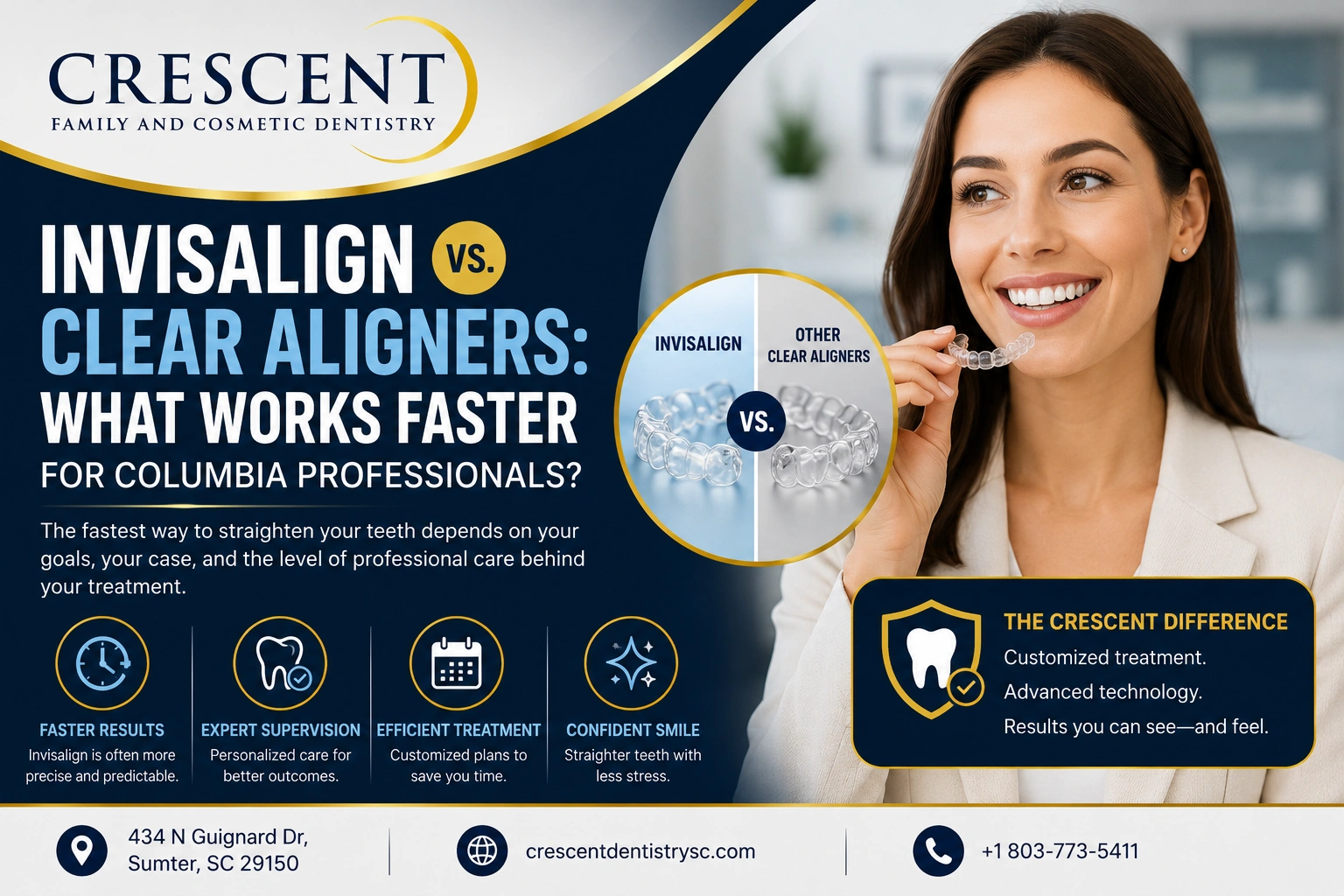
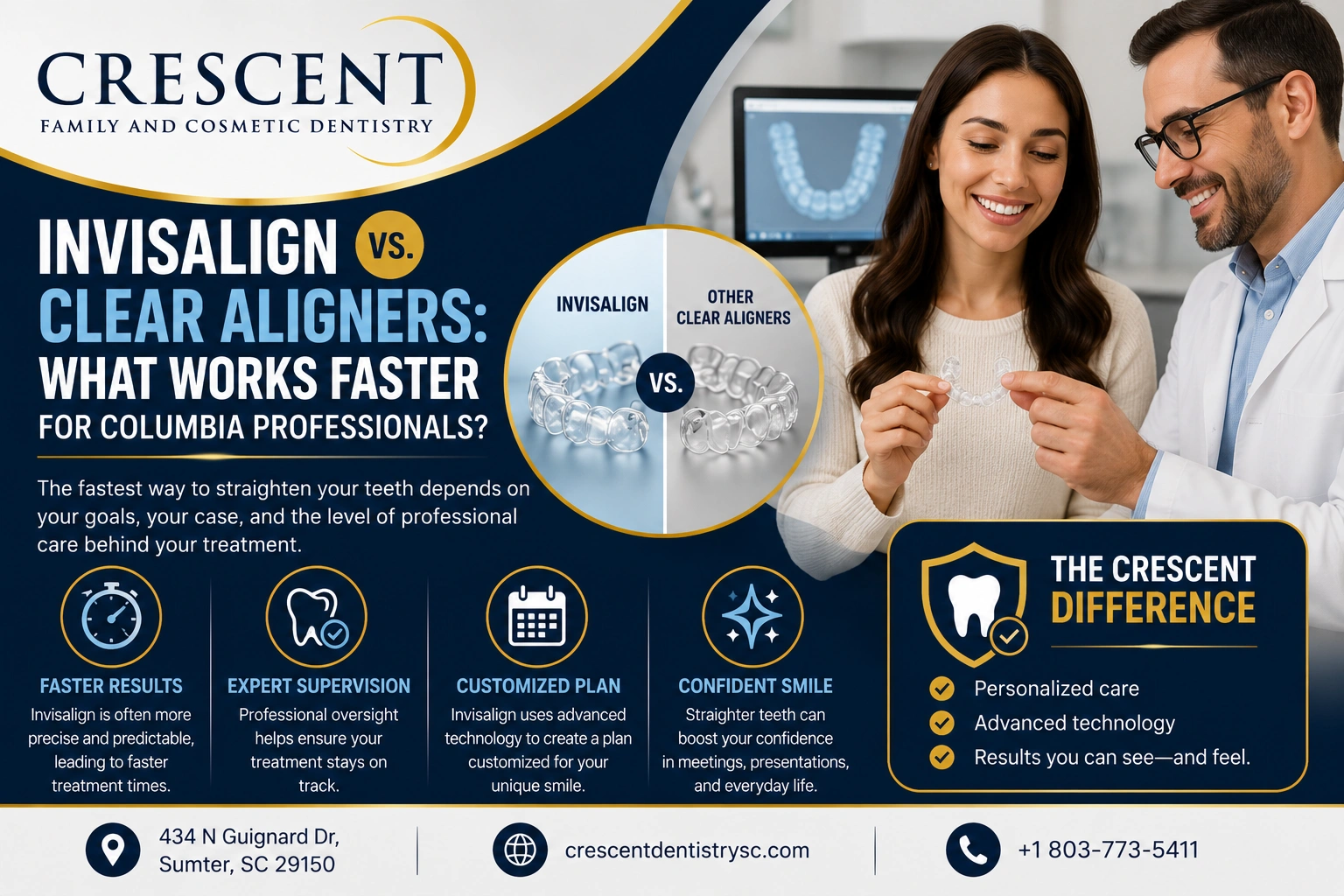
Invisalign vs. Clear Aligners: What Works Faster for Columbia Professionals?
If you’re a busy professional in Columbia, chances are your biggest concern about straightening your teeth isn’t whether it works.
It’s how long it takes.
Whether you’re preparing for a promotion, client-facing role, wedding, speaking engagement, or simply want more confidence in meetings and video calls, you probably want to know:
“What’s the fastest way to straighten my teeth?”
That’s where many patients get confused.
They see advertisements for Invisalign alongside a growing number of mail-order and direct-to-consumer clear aligner brands. Both promise straighter teeth. Both claim convenience. Both use clear plastic trays.
So are they basically the same thing?
Not exactly.
The short answer is that Invisalign is often faster, more predictable, and capable of treating more complex cases than many direct-to-consumer clear aligner systems. However, the fastest option depends on your specific teeth, not the marketing claims.
At Crescent Family & Cosmetic Dentistry, patients frequently ask whether Invisalign is worth the additional investment compared to other clear aligner options. The answer usually comes down to treatment complexity, professional supervision, and long-term results—not just speed alone.
Let’s look at what professionals in Columbia should know before making a decision.
Straighten Your Smile on Your Schedule
Discover whether Invisalign or clear aligners can deliver the results you want. Call today to get started.
First, Let’s Clarify What People Mean by “Clear Aligners”
Technically speaking, Invisalign is a type of clear aligner.
However, when patients compare Invisalign to “clear aligners,” they’re usually comparing:
Invisalign
A professionally supervised orthodontic treatment provided through a dentist or orthodontist.
Direct-to-Consumer Aligners
Systems marketed online that often involve:
- At-home impressions
- Remote monitoring
- Limited in-person evaluations
- Reduced clinical oversight
Although both use transparent aligner trays, the treatment process can be dramatically different.
Why Professionals Usually Care About Speed
Most adults aren’t seeking orthodontic treatment because they’re excited about wearing aligners.
They’re trying to solve a problem.
Common reasons include:
- Crowded front teeth
- Gaps between teeth
- Relapse after braces
- Crooked smiles in professional settings
- Bite issues affecting comfort or function
Many Columbia professionals are balancing:
- Busy careers
- Family obligations
- Community involvement
- Professional networking
- Public-facing responsibilities
They want results—but they also want efficiency.
That makes treatment time an important factor.
Which One Actually Works Faster?
In many cases, Invisalign has the advantage.
Here’s why.
Invisalign Can Move Teeth More Precisely
Invisalign treatment often incorporates features such as:
- SmartTrack® material
- Precision attachments
- Advanced treatment planning
- Optimized tooth movement strategies
These tools allow dentists to guide more complex tooth movements.
The result is often greater predictability and fewer treatment interruptions.
Direct-to-Consumer Systems Have Limitations
Many mail-order aligner systems are designed primarily for mild cosmetic corrections.
They may not effectively address:
- Significant crowding
- Bite problems
- Tooth rotations
- Vertical tooth movement
- More complex alignment issues
When a system is limited in what it can accomplish, treatment may stall or produce incomplete results.
That can ultimately make the process longer.
What Treatment Timelines Typically Look Like
Every patient is different, but general ranges often look like this:
Invisalign
- Minor corrections: 6–12 months
- Moderate cases: 12–18 months
- Complex cases: 18–24 months
Basic Cosmetic Aligners
- Mild cases: 4–12 months
- Often limited to simpler tooth movements
The key issue isn’t which company advertises the shortest timeline.
It’s whether the treatment can actually achieve your desired outcome.
A six-month treatment that leaves you dissatisfied isn’t faster if you eventually need retreatment.
Why Some “Fast” Aligner Claims Can Be Misleading
Many aligner advertisements focus on ideal cases.
You might see promises such as:
- “Straight teeth in six months”
- “Perfect smile in less time”
- “Fast-track orthodontics”
What these advertisements often don’t emphasize is that treatment speed depends on:
- Degree of crowding
- Bite relationship
- Bone biology
- Patient compliance
- Treatment planning
Two people with seemingly similar smiles can have dramatically different treatment timelines.
This is why personalized evaluation matters.
The Hidden Advantage Invisalign Has for Busy Professionals
Many people assume Invisalign’s biggest benefit is cosmetic.
It’s actually supervision.
When treatment is monitored by a dental professional, potential issues can often be identified before they become bigger problems.
Examples include:
- Teeth not tracking properly
- Unexpected movement
- Attachment failures
- Bite changes
- Compliance concerns
Without professional oversight, problems may go unnoticed for months.
That can add significant time to treatment.
What Happens If Teeth Stop Tracking?
This is one of the most common reasons treatment takes longer than expected.
“Tracking” refers to how closely your teeth follow the planned movement inside each aligner.
If a tooth falls behind:
- Future trays may not fit properly
- Additional aligners may be needed
- Refinements may become necessary
With Invisalign, your dentist can often intervene early.
Without routine monitoring, these problems may persist longer before being addressed.
Why Compliance Matters More Than Brand Names
Here’s something many patients don’t realize:
The fastest aligner system in the world won’t work if you don’t wear it.
Most aligners require approximately:
20–22 hours per day of wear
That means removing them only for:
- Meals
- Snacks
- Coffee (in many cases)
- Oral hygiene
Professionals who frequently:
- Travel
- Attend networking events
- Meet clients
- Eat on the go
sometimes struggle with consistency.
Missing wear time can significantly delay progress regardless of which system you choose.
Cost vs. Speed: The Tradeoff Professionals Often Face
One reason direct-to-consumer aligners gained popularity is cost.
Generally speaking:
Mail-Order Aligners
Often marketed at lower price points.
Invisalign
Typically represents a larger financial investment.
However, professionals should evaluate value—not just price.
Questions worth asking include:
- Will this achieve my goals?
- Will I need retreatment later?
- Am I comfortable without in-person supervision?
- How important is predictability?
- What happens if complications arise?
The cheapest option isn’t always the least expensive long term.
Who May Be a Good Candidate for Invisalign?
Invisalign often works well for patients with:
Moderate Crowding
Many adult professionals seek treatment because front teeth have shifted over time.
Previous Braces Relapse
A common issue among adults who stopped wearing retainers years ago.
Bite Concerns
Invisalign can often address issues beyond simple cosmetic alignment.
Professional Appearance Priorities
Many patients appreciate the discreet appearance during meetings and presentations.

How Long Does It Take to Complete Invisalign Treatment?
Want a straighter smile but wondering how long you’ll be wearing aligners? Invisalign can be a simple and discreet way…
Who Might Be Fine With Simpler Clear Aligners?
Some patients have relatively minor cosmetic concerns, such as:
- Small spacing issues
- Mild crowding
- Minor tooth movement goals
In limited situations, simpler aligner systems may provide acceptable results.
The challenge is determining whether your case is truly minor.
That’s difficult to assess without an examination.
The Biggest Mistake Columbia Professionals Make
Many people start with one question:
“What’s the fastest option?”
A better question is:
“What’s the fastest option that can reliably achieve my goals?”
Those are not always the same thing.
For example:
A patient with significant crowding may spend six months using a lower-cost aligner system only to discover they need comprehensive treatment afterward.
Meanwhile, another patient may complete Invisalign in twelve months and achieve the desired result the first time.
Speed without predictability can become expensive.
What About Career Impact?
Let’s address a question many professionals quietly ask.
Will straighter teeth help my career?
No orthodontic treatment can guarantee professional advancement.
However, many patients report feeling more confident during:
- Presentations
- Interviews
- Leadership meetings
- Sales conversations
- Networking events
- Video conferences
Confidence affects communication.
Communication affects perception.
Perception influences professional relationships.
While the impact varies from person to person, confidence is often the most meaningful return on investment patients experience.
Why a Professional Evaluation Usually Saves Time
Ironically, the fastest path to straighter teeth often begins by slowing down.
Instead of choosing an aligner company based on advertisements, start with an evaluation.
A comprehensive assessment can determine:
- Treatment complexity
- Expected timeline
- Suitable aligner options
- Cost considerations
- Potential obstacles
That information helps prevent costly detours.
The Right Choice Isn’t Always the Cheapest or Fastest
For many Columbia professionals, Invisalign provides advantages in treatment planning, supervision, predictability, and the ability to address more complex concerns.
That doesn’t mean every patient needs Invisalign.
Some people may achieve their goals with simpler aligner systems.
The key is understanding what your teeth actually require before deciding which path makes sense.
At Crescent Family & Cosmetic Dentistry, patients receive personalized recommendations based on their goals, oral health, bite relationship, and treatment complexity—not marketing promises. The best orthodontic solution is the one that achieves the desired result efficiently and predictably.
Your Future Smile Deserves More Than a Guess
If you’re comparing Invisalign and other clear aligner options, don’t base the decision solely on advertisements, online reviews, or the shortest quoted timeline.
What works fastest for one person may not work best for another.
A professional evaluation can help determine whether your case is ideal for Invisalign, whether a simpler solution may be appropriate, and what timeline you can realistically expect.
At Crescent Family & Cosmetic Dentistry, our team helps Columbia and Sumter professionals understand all available options, including costs, treatment timelines, limitations, and expected outcomes. The goal isn’t just straighter teeth—it’s helping you choose the treatment path that delivers the results you actually want.
Frequently Asked Questions
Is Invisalign faster than mail-order aligners?
Often, yes. Invisalign’s advanced treatment planning and professional supervision can improve efficiency and predictability, especially in moderate or complex cases.
How long does Invisalign usually take?
Many Invisalign cases take between 12 and 18 months, although minor corrections may be completed sooner.
Are direct-to-consumer aligners safe?
Some patients achieve satisfactory results with direct-to-consumer systems. However, the absence of routine in-person supervision may increase certain risks and limitations.
Can Invisalign fix bite problems?
In many cases, yes. Invisalign can often address bite concerns that simpler cosmetic aligner systems may not effectively treat.
Which option costs less?
Direct-to-consumer aligners are often less expensive upfront. However, long-term value depends on treatment success, predictability, and whether additional treatment becomes necessary later.
Busy Schedule? Get a Smarter Smile Solution
Explore clear aligner options designed to fit your professional lifestyle. Call today for a consultation.