
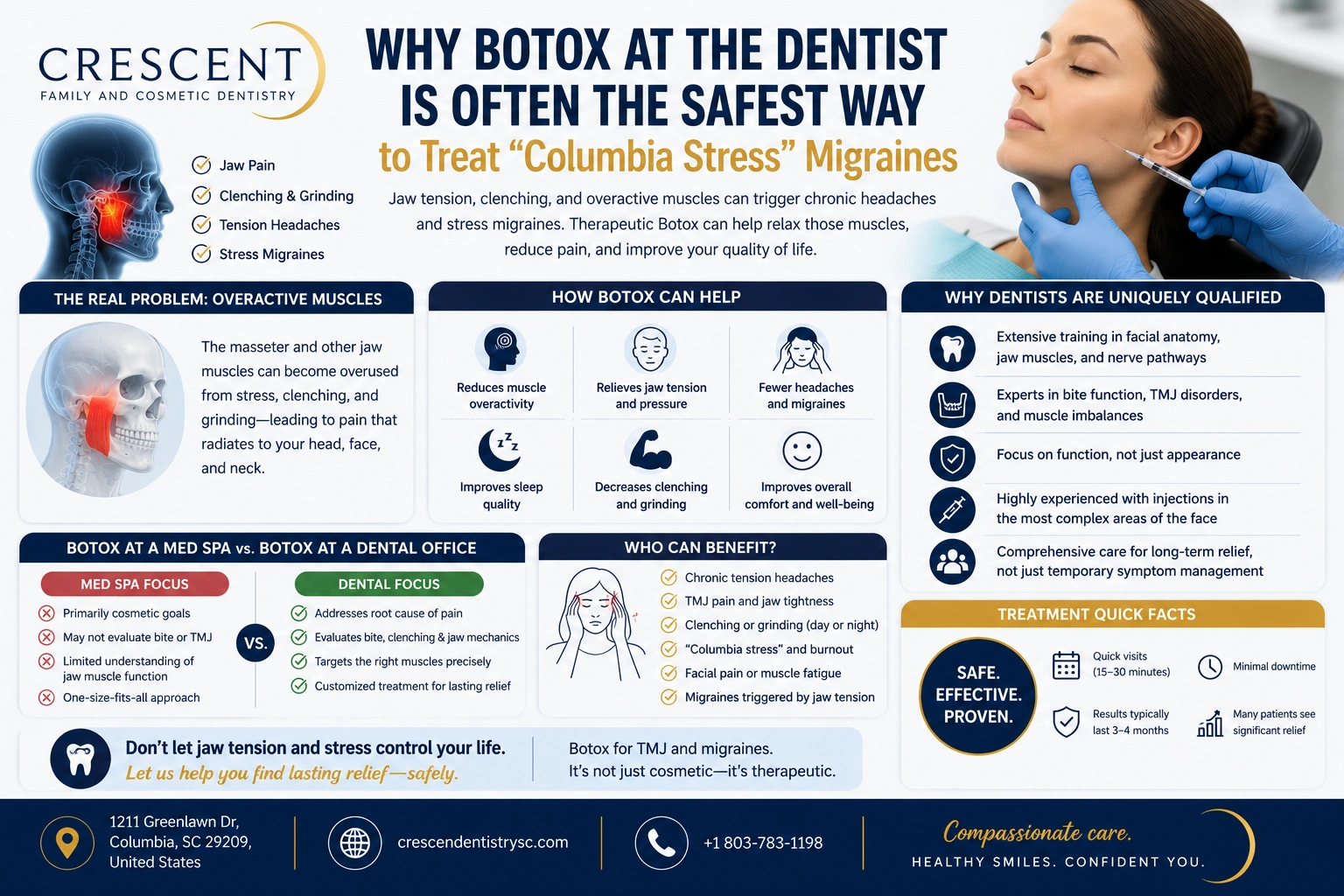
Why Botox at the Dentist Is Often the Safest Way to Treat “Columbia Stress” Migraines
A lot of people in Columbia do not realize their migraines may actually be connected to their jaw.
They think it is:
- stress
- bad sleep
- screen time
- sinus pressure
- posture
- hormones
- work burnout
And sometimes it is.
But many chronic headaches and “stress migraines” are closely tied to clenching, grinding, TMJ dysfunction, and overactive facial muscles.
That is why more patients are turning to dental Botox — not just cosmetic Botox — for relief.
And honestly, dentists are often some of the most qualified professionals to treat these problems safely.
That surprises people.
Most patients still associate Botox with wrinkles, med spas, or cosmetic clinics.
But when Botox is being used to treat:
- jaw tension
- TMJ pain
- clenching
- grinding
- facial muscle overactivity
- tension headaches
- stress-related migraines
…the mouth, jaw, muscles, and bite become the center of the problem.
That is dental territory.
At Crescent Family & Cosmetic Dentistry, patients in Columbia and Sumter frequently ask whether Botox can help with chronic tension headaches, jaw pain, or stress-related migraines.
For many people, the answer is yes.
But more importantly, they want to know:
“Why would I trust a dentist more than a med spa for this?”
Here is the short answer:
Because dentists work with facial anatomy, bite forces, jaw muscles, and muscle dysfunction every single day.
And when Botox is being used therapeutically instead of cosmetically, that experience matters.
Find Relief From Stress Migraines Today
Schedule a consultation with a trusted dental professional trained in Botox treatment.
First: What Are “Stress Migraines”?
A lot of headaches people call migraines are actually muscle-driven tension headaches or TMJ-related headaches.
That does not mean the pain is “all in your head.”
It means the muscles themselves may be contributing to the problem.
Common symptoms include:
- pressure around the temples
- headaches that worsen during stressful periods
- jaw soreness
- clenching during sleep
- tightness near the ears
- morning headaches
- facial tension
- neck pain
- sensitivity while chewing
- clicking or popping jaws
In Columbia especially, many professionals and students deal with chronic stress patterns:
- long commutes
- desk work
- poor sleep
- high-pressure jobs
- nighttime grinding
- constant jaw tension
Your jaw muscles do not always relax just because you are “off the clock.”
Some people clench almost continuously without realizing it.
Botox Does Not “Cure” Migraines — But It Can Reduce Muscle Overactivity
This is important.
Botox is not magic.
And any provider promising permanent migraine elimination should make you cautious.
What Botox can do is temporarily relax overactive muscles contributing to pain and tension.
For many patients, that means:
- fewer headaches
- reduced jaw pain
- less clenching
- decreased muscle fatigue
- improved comfort while sleeping
- fewer stress-triggered flareups
Most therapeutic Botox works by interrupting excessive muscle contraction.
When specific jaw and facial muscles stop overworking, surrounding tension often decreases too.
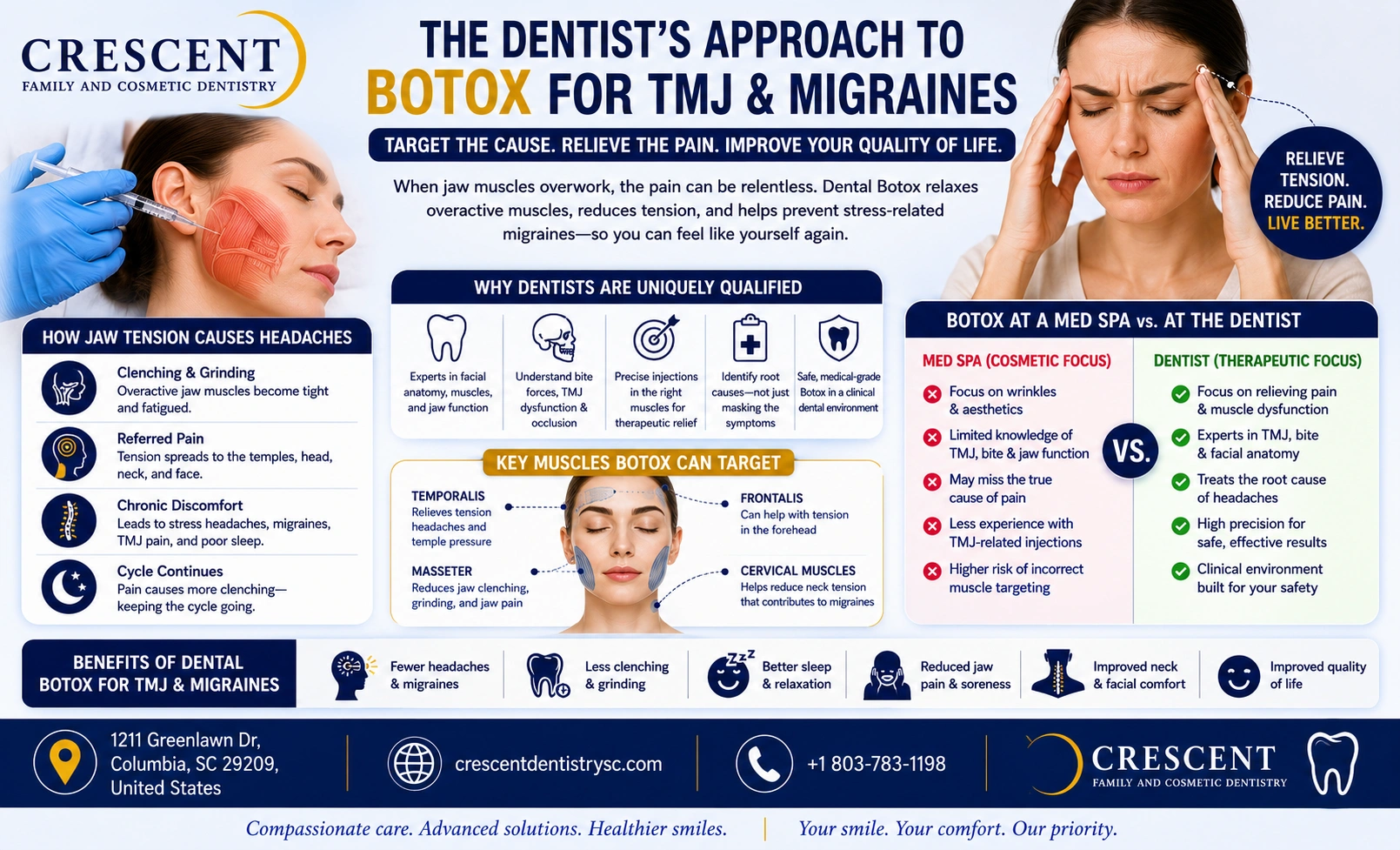
Why Dentists Are Uniquely Qualified for TMJ and Migraine Botox
This is where things become important.
Not all Botox providers approach treatment the same way.
A cosmetic injector may primarily focus on:
- wrinkle reduction
- facial symmetry
- aesthetics
A dentist treating TMJ-related pain is evaluating:
- bite function
- muscle imbalance
- jaw mechanics
- grinding patterns
- occlusion
- temporomandibular joint stress
- chewing muscles
- facial tension patterns
Those are very different evaluations.
Dentists spend years studying:
- facial anatomy
- muscle movement
- nerve pathways
- bite alignment
- jaw function
- oral-facial pain
In fact, dentists routinely administer injections inside one of the most anatomically complex areas of the body every day.
That level of precision matters when injecting muscles connected to headache and jaw pain.
The Masseter Muscle Is Often the Real Problem
One of the biggest culprits behind stress-related jaw headaches is the masseter muscle.
This is one of the strongest muscles in the body relative to size.
It controls jaw closing and chewing.
When patients chronically clench or grind, the masseter can become:
- enlarged
- inflamed
- fatigued
- painful
That tension radiates.
Many patients describe:
- temple headaches
- pressure behind the eyes
- soreness near the ears
- facial aching
- neck tightness
Botox can reduce excessive masseter activity, which may relieve significant tension.
And dentists are exceptionally familiar with this muscle because they evaluate bite forces constantly.
“Columbia Stress” Is Real
People laugh when they hear that phrase.
But chronic stress patterns absolutely affect oral health.
Dentists see stress physically manifest in patients every day through:
- cracked teeth
- worn enamel
- fractured fillings
- jaw pain
- gum inflammation
- nighttime grinding
- cheek biting
- tension headaches
Stress is not just emotional.
It becomes physical.
And the jaw is one of the most common places the body stores that tension.
Some patients in Columbia work high-pressure professional jobs.
Others are balancing school, parenting, caregiving, or multiple jobs.
Many grind heavily while sleeping without realizing it until:
- teeth crack
- headaches worsen
- partners hear grinding noises
- jaw locking develops
Botox can sometimes interrupt that cycle.
Botox at a Med Spa vs. Botox at a Dental Office
This is where patients should ask more questions.
Not all injectors have the same training or treatment goals.
Aesthetic Botox Focuses on Appearance
At cosmetic-focused med spas, Botox treatment may primarily target:
- forehead lines
- crow’s feet
- cosmetic slimming
- wrinkle prevention
That does not automatically mean the provider lacks skill.
But therapeutic jaw treatment requires a different understanding.
Dental Botox Focuses on Function
When dentists use Botox therapeutically, they are often evaluating:
- where the muscle is overfiring
- how the bite functions
- whether clenching patterns exist
- which muscles compensate abnormally
- whether TMJ dysfunction contributes to symptoms
That functional perspective matters.
Especially because improper injection placement can create:
- bite changes
- asymmetry
- speech changes
- chewing difficulty
- muscle imbalance
This is one reason patients with TMJ symptoms often feel more comfortable working with providers who routinely diagnose jaw dysfunction.

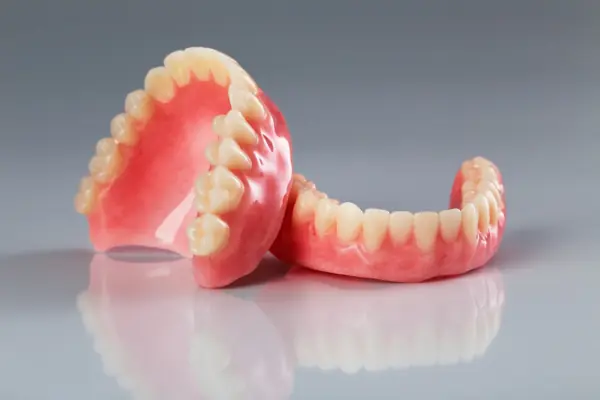
Why Modern Dentures Are Quietly Becoming a Confidence Technology
Most people think dentures are just about replacing missing teeth. That’s no longer the full story. Modern dentures have quietly…
Botox Is Usually Part of a Bigger Treatment Plan
This is another thing patients should understand.
Good TMJ treatment rarely relies on Botox alone.
Sometimes Botox helps tremendously.
But long-term relief may also involve:
- bite guards
- stress reduction
- sleep improvements
- posture changes
- orthodontic evaluation
- restorative dentistry
- muscle habit awareness
A good dentist should evaluate the bigger picture.
Not simply inject and move on.
Who Is a Good Candidate for Dental Botox?
Botox may help patients dealing with:
- chronic jaw tension
- teeth grinding
- clenching
- TMJ discomfort
- tension headaches
- facial muscle pain
- stress-related migraine triggers
It may especially help patients who:
- wake with headaches
- crack dental restorations repeatedly
- experience jaw fatigue
- notice enlarged jaw muscles
- feel temple pressure frequently
Who May Not Be a Good Candidate?
Botox is not right for everyone.
Some headaches are unrelated to muscle tension.
Patients should still seek proper medical evaluation for:
- severe migraines
- neurological symptoms
- vision changes
- sudden intense headaches
- dizziness
- numbness
- unexplained neurological concerns
A responsible provider should never claim Botox treats every headache type.
That is not realistic.
One of the Biggest Benefits: Preventing Damage From Grinding
Patients often focus on headache relief.
But there is another major advantage.
Reducing clenching forces may help protect teeth from long-term damage.
Chronic grinding can contribute to:
- cracked teeth
- chipped enamel
- broken crowns
- worn teeth
- gum recession
- jaw joint strain
And rebuilding heavily damaged teeth can become extremely expensive.
In some cases, reducing muscle force helps preserve restorations and natural tooth structure.
Botox Is Not Permanent
This is important to understand upfront.
Most Botox results are temporary.
Therapeutic effects often last:
- 3 to 4 months
- sometimes longer depending on the patient
Some people require maintenance treatment.
Others experience enough habit interruption that symptoms improve over time.
But Botox is generally not considered a one-time permanent fix.
Patients deserve honesty about that.
The Goal Is Relief — Not a Frozen Face
A lot of people avoid Botox because they imagine an unnatural appearance.
Therapeutic dental Botox is different from aggressive cosmetic over-treatment.
The goal is usually:
- reducing muscle tension
- minimizing pain
- improving comfort
- preserving natural movement
Most patients do not want to “look different.”
They simply want fewer headaches and less jaw pain.
One Thing Many Patients Notice: Better Sleep
Patients who clench heavily at night often wake exhausted.
Not because they were awake consciously.
But because the jaw muscles remained active for hours.
Reducing excessive nighttime clenching can sometimes improve:
- sleep comfort
- morning tension
- facial fatigue
- jaw soreness upon waking
And better sleep often improves overall stress resilience too.
The Safest Botox Is Conservative Botox
This is another reason provider experience matters.
Over-treatment can create problems.
Responsible treatment is usually:
- carefully dosed
- anatomically targeted
- gradual
- monitored over time
A provider who understands jaw mechanics is less likely to overtreat muscles critical for chewing and speech.
That matters more than patients realize.
Why More Dental Practices Are Offering Botox
Modern dentistry increasingly overlaps with:
- facial pain
- airway issues
- TMJ disorders
- sleep-related grinding
- muscle dysfunction
Botox fits naturally into that evolution.
It is no longer viewed only as a cosmetic procedure.
For many patients, it has become part of comprehensive oral-facial care.
The Bottom Line: Your Jaw May Be Causing More Headaches Than You Think
A surprising number of chronic headaches are connected to clenching, grinding, and jaw muscle tension.
And because dentists specialize in the muscles, joints, and bite mechanics involved in those problems, they are often uniquely qualified to provide therapeutic Botox safely and conservatively.
At Crescent Family & Cosmetic Dentistry, the goal is not simply cosmetic injection.
It is helping patients in Columbia and Sumter understand whether stress, grinding, TMJ dysfunction, or muscle overactivity may be contributing to chronic discomfort.
Sometimes the problem is not “just stress.”
Sometimes the stress is physically living in your jaw.
And treating the source can make a meaningful difference.
FAQs About Dental Botox for Migraines and TMJ
Can Botox really help headaches?
For some patients, yes.
Especially headaches related to jaw tension, clenching, TMJ dysfunction, or muscle overactivity.
Is dental Botox safe?
When performed by properly trained providers with strong facial anatomy knowledge, Botox is generally considered very safe.
How long does TMJ Botox last?
Most patients experience effects lasting around 3 to 4 months.
Will Botox stop teeth grinding completely?
Not always.
But it may significantly reduce muscle force and clenching intensity.
Does Botox change your smile?
When performed conservatively and correctly, therapeutic Botox should preserve natural facial movement.
Is Botox painful?
Most patients describe the injections as very manageable and quick.
Can Botox replace a night guard?
Usually no.
Many patients still benefit from bite guards and other TMJ management strategies.
Why would I choose a dentist instead of a med spa?
Dentists treating TMJ and migraine-related issues often have deeper experience with:
- bite mechanics
- jaw muscles
- facial anatomy
- clenching patterns
- oral-facial pain disorders
That functional knowledge can be extremely valuable for therapeutic treatment.
Tired of “Columbia Stress” Migraines?
Get safe, professional Botox treatment from your dentist. Call today for relief you can trust.