
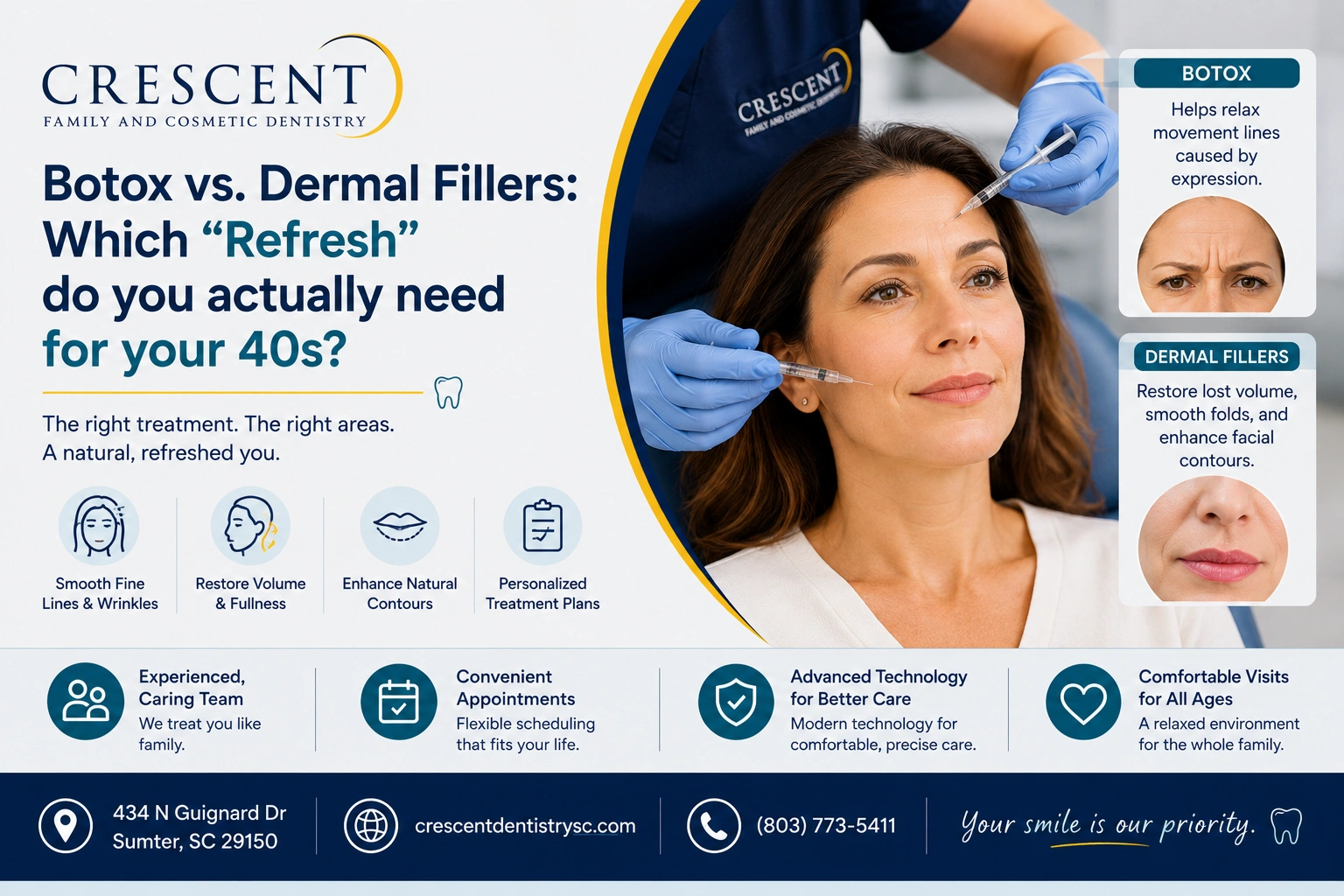
Botox vs. Dermal Fillers: Which “Refresh” Do You Actually Need in Your 40s?
A lot of people hit their 40s and start noticing something different in the mirror.
Not “I look old.”
More like: “I look tired even when I’m not.”
The common question is: Do I need Botox, filler, or both?
Here is the direct answer.
Botox is usually for movement lines. Dermal filler is usually for volume loss. If the wrinkle shows up mostly when you smile, squint, frown, or raise your eyebrows, Botox may be the better fit. If the issue is hollowing, flattening, deeper folds, or lost facial support, filler may make more sense.
Most natural-looking refreshes in your 40s are not about changing your face. They are about choosing the right tool for the right problem.
At Crescent Family & Cosmetic Dentistry in Sumter and Columbia, SC, the goal with facial aesthetic treatments should be the same as cosmetic dentistry: improve what bothers you without making you look overdone.
Ready for a Fresher Look in Your 40s?
Discover whether Botox or dermal fillers are right for your goals. Schedule your consultation today.
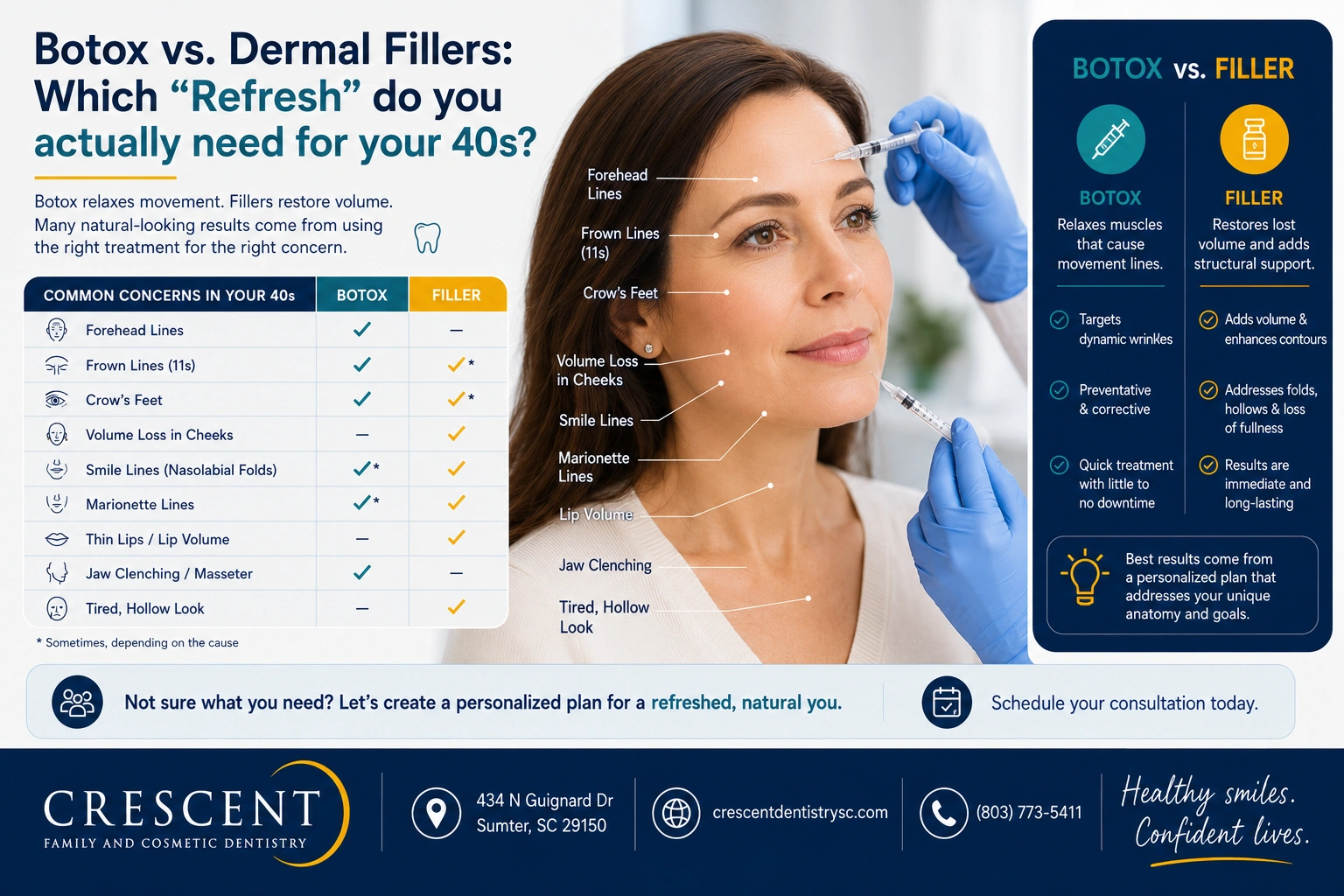
Botox vs. filler: the simple difference
| Concern | Botox may help | Dermal filler may help |
| Forehead lines | Yes | Usually no |
| Frown lines between brows | Yes | Sometimes, but cautiously |
| Crow’s feet | Yes | Sometimes |
| Lip volume loss | No | Yes |
| Smile lines / nasolabial folds | Sometimes indirectly | Yes |
| Marionette lines | Sometimes indirectly | Yes |
| Cheek volume loss | No | Yes |
| Jaw clenching / masseter tension | Sometimes | No |
| Thin lips | No | Yes |
| “Tired” hollow look | No | Often yes |
Botulinum toxin treatments, commonly referred to as Botox, temporarily reduce muscle activity that contributes to facial expression lines. Dermal fillers add volume or support beneath the skin, and the American Academy of Dermatology lists both botulinum toxin and fillers as cosmetic options for wrinkles and facial aging concerns.
That is the foundation.
Botox relaxes. Filler restores.
What Botox actually does
Botox is a brand name, but many people use the word “Botox” to describe a category of botulinum toxin products. The American Society of Plastic Surgeons describes cosmetic botulinum toxin as an injectable treatment used to temporarily reduce or eliminate certain facial fine lines and wrinkles.
Botox is most commonly used for:
- Frown lines between the eyebrows
- Forehead lines
- Crow’s feet around the eyes
- Bunny lines on the nose
- Chin dimpling
- Certain lip lines
- Downturned mouth corners
- Jaw clenching or masseter muscle concerns in selected patients
Botox works best on dynamic wrinkles, meaning wrinkles caused by repeated muscle movement.
A practical example:
When you look relaxed, your forehead looks smooth.
When you raise your eyebrows, lines appear.
That is usually a Botox-type concern.
Botox does not fill hollow cheeks. It does not replace lost facial fat. It does not lift heavy skin in the same way surgery can.
What dermal filler actually does
Dermal fillers are injectable materials placed under the skin to add volume, contour, or support. The FDA describes dermal fillers as soft tissue fillers used for aesthetic correction, while also emphasizing that they should be performed by licensed, experienced healthcare providers because complications can occur.
Fillers are often used for:
- Cheek volume
- Smile lines
- Marionette lines
- Lip volume or lip border definition
- Chin balance
- Jawline contour
- Under-eye hollowing in carefully selected cases
- Facial asymmetry
- Softening deeper folds
Filler works best when the problem is volume loss or structural support, not muscle movement.
A practical example:
Your cheeks used to look fuller.
Now the midface looks flatter, and the lower face looks heavier.
That is usually more of a filler or facial support conversation.
Filler does not stop you from making wrinkles. It does not relax muscles. It does not replace a facelift if the main issue is significant skin laxity.
Why your 40s are different from your 30s
In your 30s, many people are mostly dealing with movement lines.
In your 40s, the picture often changes. Lines may still matter, but volume loss, skin texture, sun damage, hormonal changes, dental changes, and facial support start to matter more.
That is why “just Botox” may not fix the tired look.
You may relax the forehead beautifully and still feel like the lower face looks heavier. Or you may add filler to the cheeks but still have strong frown lines making you look tense.
A natural refresh often requires asking a better question:
Is this a muscle problem, a volume problem, a skin problem, or a tooth/smile support problem?
That last one matters in dentistry. Worn teeth, collapsed bite support, missing teeth, and an aging smile can change the way the lips and lower face look. Sometimes the best “facial refresh” starts with the smile, not an injectable.
When Botox is probably the better first step
Botox may be the better first step if your main concern is:
1. You look angry when you are not
Frown lines between the eyebrows can make people look stressed, stern, or upset. Botox is often a good option when those lines are caused by repeated squeezing of the muscles between the brows.
2. Your forehead lines are getting deeper
If forehead lines are mostly visible when you raise your eyebrows, Botox may help soften them.
The caution: too much forehead Botox can make the brows feel heavy. This is where conservative treatment matters, especially in your 40s when eyelid and brow position may already be changing.
3. Crow’s feet bother you in photos
Crow’s feet are movement lines from smiling and squinting. Botox can soften them, but the goal should not be to erase every smile line. A completely frozen smile does not look younger. It looks treated.
4. You clench your jaw
Some patients benefit from botulinum toxin in the masseter muscles when jaw clenching or muscle overactivity is part of the problem. This should be evaluated carefully because jaw slimming or bite changes are not appropriate goals for everyone.
5. You want a subtle maintenance treatment
Botox can be a good “small refresh” when you are not trying to change facial shape. It is often chosen by patients who want to look less tense or tired without adding volume.
When dermal filler is probably the better first step
Filler may be the better first step if your main concern is:
1. Your face looks flatter than it used to
Cheek and midface volume loss can make the face look tired even if the skin is healthy. Filler can sometimes restore support in a way Botox cannot.
2. Smile lines are deeper
Nasolabial folds, often called smile lines, may deepen because of volume loss and facial descent. Filler may help, but simply filling the fold is not always the best plan. Sometimes the cheek or midface support matters more.
3. Your lips look thinner
Lip filler can restore volume or definition, but the best lip filler in your 40s is usually conservative. Overfilled lips can look obvious quickly, especially when the rest of the face has not been treated.
4. Marionette lines are creating a downturned look
Lines from the mouth corners toward the chin can make the face look sad or tired. Filler may help in some cases, but these lines often involve several factors: volume loss, skin laxity, bite support, and muscle pull.
5. You want contour, not wrinkle relaxation
If you are trying to improve cheek shape, chin balance, or jawline definition, filler is usually the more relevant tool.

The Unexpected Connection Between Professional Dental Cleaning and Heart Health
Getting your teeth cleaned might feel like just another item on the to-do list, but skipping it could have bigger…
When you may need both
Many people in their 40s are not a pure Botox case or a pure filler case.
You may need Botox for frown lines and filler for cheek support.
You may need Botox around the eyes and filler for lips.
You may need neither until your skin health or dental foundation is addressed first.
The mistake is treating every concern with one product.
A good provider should be able to say:
- “Botox will help this part.”
- “Filler would help this part.”
- “This area should be left alone.”
- “This result may require skin treatment or dental treatment instead.”
- “Doing less will look better.”
That last sentence is often the difference between natural and overdone.
What looks most natural in your 40s?
The most natural results usually come from small, strategic changes.
Not a frozen forehead.
Not huge lips.
Not cheeks that look inflated.
Not a face that no longer matches your smile.
In your 40s, the goal is usually:
- Softer expression lines
- Better facial balance
- Less tired appearance
- Natural lip support
- Healthier smile frame
- Preserved movement
- No obvious “work done” look
Most people do not need dramatic filler. Most people do not need maximum-dose Botox. They need a conservative plan that respects their face.
Safety: the part you should not skip
Injectables are medical treatments, not spa tricks.
The FDA warns that dermal fillers can cause side effects such as bruising, swelling, pain, itching, infection, nodules, and rare but serious complications if filler is unintentionally injected into a blood vessel, including tissue death, vision problems, blindness, stroke, or death. The FDA recommends choosing a licensed healthcare provider with appropriate experience.
The CDC also advises that botulinum toxin injections should be given by qualified, licensed healthcare workers using FDA-approved products, and notes that “Botox” is often used casually to refer to a broader category of botulinum toxin products.
That does not mean you should be afraid of injectables. It means you should be selective.
Avoid:
- Bargain injections in non-clinical settings
- “Botox parties” without proper medical screening
- Unlicensed injectors
- Unapproved products
- Anyone who cannot explain risks
- Anyone who pressures you into more than you wanted
- Filler in risky areas without appropriate training
If a price sounds too good to be true, ask what product is being used, who is injecting it, and what happens if there is a complication.
Cost: Botox vs. filler
Pricing varies by provider, product, dose, treatment area, and anatomy.
In general:
Botox is usually priced by the unit or by treatment area.
Filler is usually priced by syringe.
Botox may cost less per visit than filler, but it usually wears off sooner. Filler typically costs more upfront but may last longer depending on the product, area treated, and your body’s metabolism.
A low price is not automatically a good deal. With injectables, you are not only paying for the product. You are paying for judgment, anatomy knowledge, safety, restraint, and the ability to say no.
The cheapest injectable treatment can become expensive if it creates an unnatural result or needs correction.
Botox or filler before a big event?
Be careful with timing.
Botox does not usually show its final effect immediately. Filler can cause swelling or bruising. Neither should be scheduled right before a wedding, reunion, deployment ceremony, family photos, or major work event.
A practical rule: do not try a new injectable treatment for the first time right before something important.
Give yourself time for swelling, bruising, adjustments, and for the result to settle.
Who is not a good candidate?
Botox or filler may not be right for you if:
- You are pregnant or breastfeeding
- You have certain neuromuscular conditions
- You have an active infection at the treatment site
- You have unrealistic expectations
- You want a result that does not match your anatomy
- You are seeking treatment because someone else pressured you
- You are not willing to accept bruising, swelling, or temporary asymmetry
- You are using an unsafe or unlicensed provider
Some patients are better served by skin care, dental treatment, orthodontics, whitening, bonding, veneers, periodontal care, or simply doing nothing.
Doing nothing is a valid choice.
The Crescent way to think about a “refresh”
For patients in Sumter and Columbia, the best cosmetic plan starts with diagnosis, not product selection.
Instead of asking, “How much Botox do I need?” ask:
- What specifically makes me look tired?
- Is this caused by muscle movement?
- Is this caused by volume loss?
- Is this caused by skin quality?
- Is my smile or bite affecting my facial support?
- What is the smallest treatment that would make a noticeable difference?
- What should we avoid?
That approach protects you from being overtreated.
A good refresh should still look like you.
The honest bottom line
If your concern is expression lines, tension, forehead wrinkles, crow’s feet, or frown lines, Botox may be the better fit.
If your concern is hollowing, lip thinning, deeper folds, cheek flattening, or loss of facial support, dermal filler may be the better fit.
If you are in your 40s, the real answer may be a conservative combination—or a completely different starting point, like improving your smile, bite, or skin health first.
Crescent Family & Cosmetic Dentistry in Sumter and Columbia, SC can help you think through facial aesthetic options in a measured, natural-looking way. The goal is not to chase every line. The goal is to help you look rested, balanced, and still like yourself.
FAQs
Is Botox better than filler in your 40s?
Neither is automatically better. Botox is usually better for movement lines. Filler is usually better for volume loss, deeper folds, and contour changes.
Which looks more natural?
Either can look natural when used conservatively. Either can look unnatural when overdone or placed poorly.
Can Botox fix smile lines?
Usually not directly. Smile lines often involve volume loss and facial support, so filler may be more relevant. Botox may help nearby muscle pull in selected cases, but it is not the standard fix for most smile lines.
Can filler fix forehead wrinkles?
Usually no. Forehead wrinkles are typically caused by muscle movement, so Botox is usually the better option.
Should I start with Botox or filler first?
Start with the concern, not the product. If your main issue is frown lines or crow’s feet, Botox may come first. If your main issue is hollowing or volume loss, filler may come first.
Will I look frozen?
You should not look frozen if Botox is planned conservatively. The goal is softening, not removing all expression.
Are injectables safe?
They can be safe when performed by qualified, licensed healthcare providers using appropriate products and techniques. They are still medical procedures with real risks, especially fillers. The FDA specifically warns that rare filler complications can be serious and may be permanent.
Not Sure If You Need Botox or Fillers?
Let our experts help you choose the best refresh for smoother, more youthful-looking results.