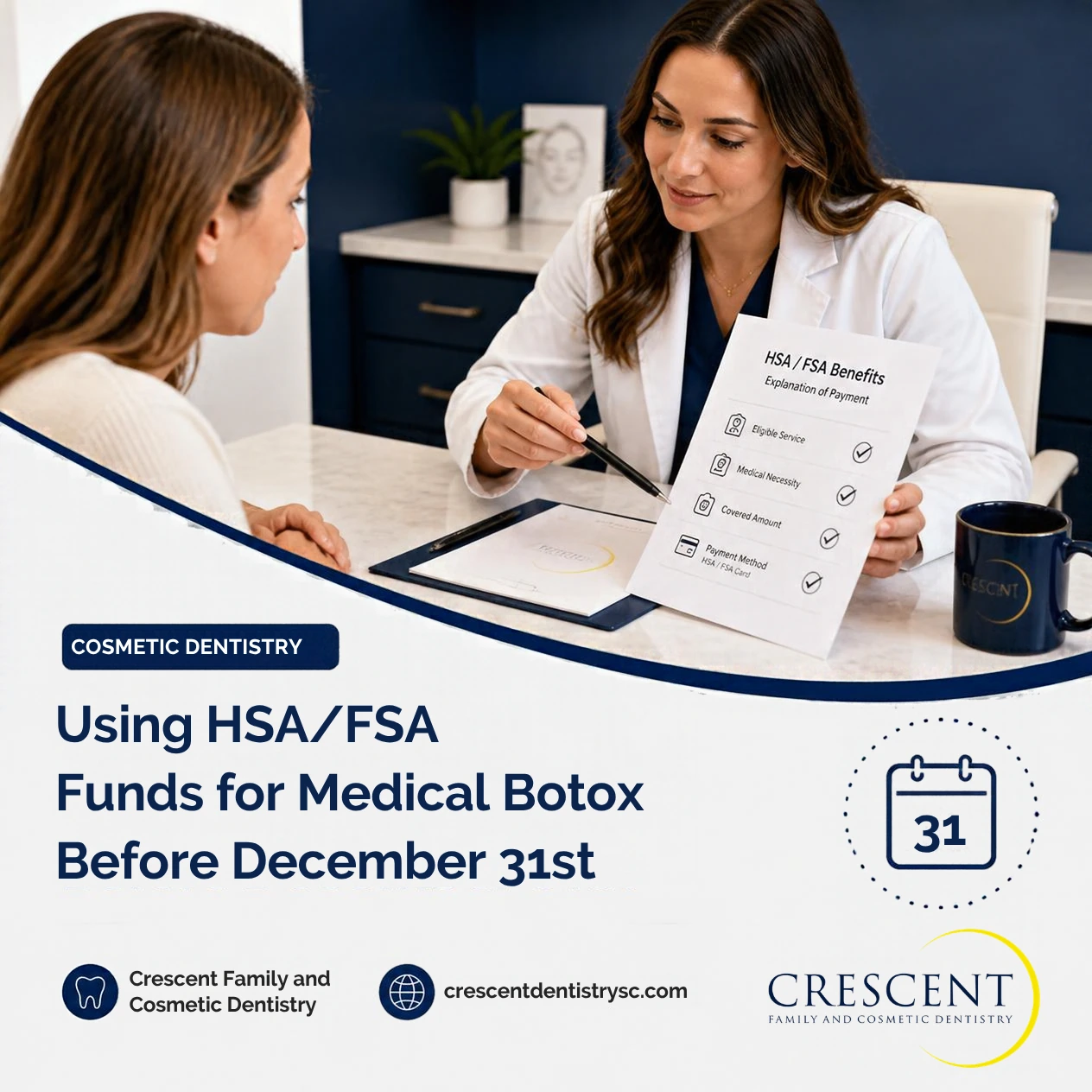
How to use your HSA/FSA funds for “Medical Botox” before December 31st.
Medical Botox may qualify for HSA or FSA reimbursement when it is used to treat a documented medical condition rather than for cosmetic purposes. For patients dealing with jaw pain, teeth grinding, or certain muscle-related conditions, understanding the eligibility requirements before December 31, 2026, can help prevent unexpected expenses.
At Crescent Family and Cosmetic Dentistry, we help patients in Columbia and Sumter explore treatment options for jaw discomfort and related dental concerns. If you have unused healthcare funds, here’s what you should know about medical Botox eligibility, documentation, and year-end deadlines.
Use Your HSA/FSA Before December 31!
Don't let eligible funds go unused. Call now to check if your medical Botox treatment qualifies and schedule your consultation.
Can You Use HSA or FSA Funds for Medical Botox?
Yes, medical Botox may be an eligible HSA or FSA expense when the treatment meets IRS requirements for qualified medical care.
The IRS generally defines qualified medical expenses as costs associated with diagnosing, treating, preventing, or alleviating a disease or medical condition.
This distinction matters because Botox is used for both therapeutic and cosmetic purposes.
Botox injections administered solely to reduce wrinkles or improve facial appearance generally do not qualify for tax-free reimbursement.
However, treatment intended to address a diagnosed medical condition may qualify if the expense meets applicable IRS requirements and, for an FSA, the specific plan’s rules.
Eligibility depends on several factors:
- The condition being treated
- The medical purpose of the injections
- The treating provider’s documentation
- Whether the expense satisfies applicable tax rules
- The FSA administrator’s reimbursement requirements, if applicable
A medical diagnosis or prescription can support an eligibility claim, but neither automatically guarantees that Botox will qualify.
What Is the Difference Between Medical Botox and Cosmetic Botox?
Botox temporarily reduces muscle activity by blocking certain nerve signals. Although the medication is the same, its intended use determines whether treatment is primarily therapeutic or cosmetic.
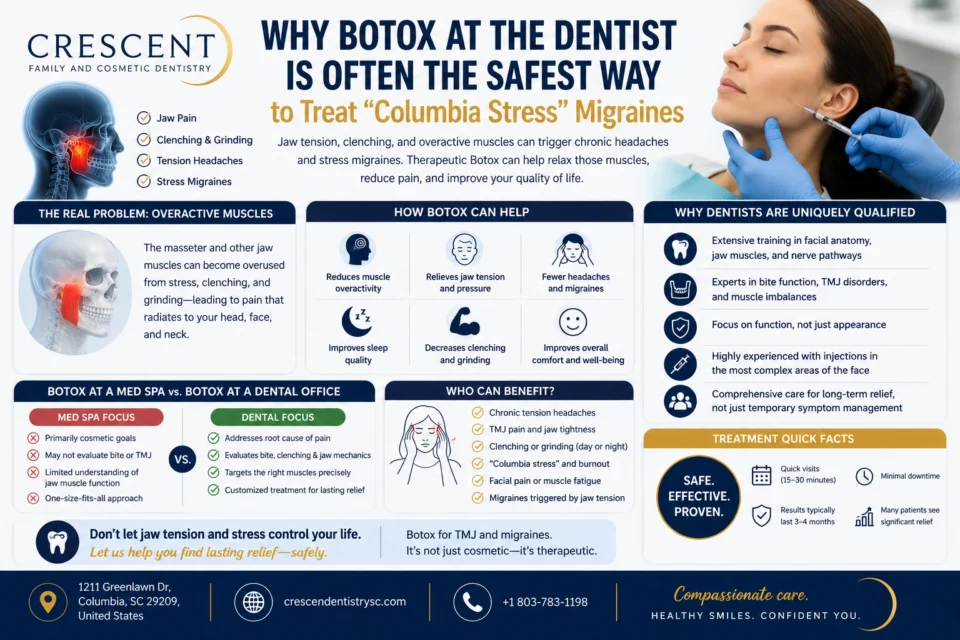
Medical Botox
Medical Botox is used to address an identified health condition or functional problem.
FDA-approved medical uses include chronic migraine prevention in qualifying adults, certain muscle spasms, and specific other conditions.
In dentistry, Botox is also sometimes considered for jaw muscle overactivity associated with temporomandibular disorders (TMD) or bruxism.
However, Botox treatment for TMD and teeth grinding is considered off-label, meaning the FDA has not specifically approved Botox for these conditions. Research into its effectiveness for TMD remains mixed.
At Crescent Family and Cosmetic Dentistry, we evaluate patients’ jaw symptoms and discuss whether Botox or another treatment approach may be appropriate.
Cosmetic Botox
Cosmetic Botox is primarily used to soften facial lines and wrinkles, including:
- Forehead lines
- Crow’s feet
- Frown lines between the eyebrows
- Other expression-related wrinkles
These treatments are generally considered elective cosmetic procedures and are not eligible HSA or FSA expenses.
The purpose of treatment matters more than the product name. A therapeutic injection does not automatically qualify simply because it is described as medical Botox.
What Dental Conditions Might Be Treated With Botox?
Some patients explore Botox because they experience persistent jaw discomfort, muscle tension, or involuntary clenching.
However, these symptoms should be evaluated before deciding whether injections are appropriate.
Temporomandibular Disorders (TMD)
Temporomandibular disorders affect the jaw joints, chewing muscles, and surrounding structures.
Common symptoms include jaw soreness, painful chewing, restricted jaw movement, and facial muscle tenderness.
For selected patients with muscle-related symptoms, a clinician may discuss botulinum toxin injections as an off-label option.
Current evidence does not establish Botox as a consistently effective treatment for TMD. Conservative options, including self-care, physical therapy, and appropriate oral appliances, are generally considered first.
Bruxism and Jaw Clenching
Bruxism involves repeated teeth grinding or jaw clenching, sometimes occurring during sleep.
Signs may include:
- Morning jaw soreness
- Tight or fatigued chewing muscles
- Worn tooth surfaces
- Jaw discomfort when eating
- Headaches associated with muscle tension
Botox may reduce activity in selected jaw muscles, but it does not address every underlying cause of bruxism. It also carries risks, including unwanted muscle weakness.
An individualized examination helps determine whether injections, a nightguard, habit modification, or another treatment would be more suitable.
Chronic Migraines and Headaches
Botox is FDA-approved for preventing headaches in adults with chronic migraine, generally defined as headaches occurring at least 15 days per month, with headaches lasting four hours or longer.
This treatment follows a specific medical protocol.
Jaw-related tension headaches are not necessarily migraines, and patients should not assume that Botox for jaw clenching is equivalent to FDA-approved chronic migraine treatment.
A qualified healthcare provider should determine the correct diagnosis and treatment.
HSA vs. FSA: What’s the Difference for Botox Treatment?
Although both accounts offer tax advantages for qualified healthcare expenses, their rules differ significantly.
| Feature | HSA | Healthcare FSA |
| Unused funds | Generally roll over indefinitely | May expire unless the plan allows carryover or a grace period |
| Account ownership | Individual owns the account | Employer-sponsored benefit |
| December 31 deadline | No general spending deadline | Depends on the plan year and employer rules |
| Medical Botox eligibility | Must satisfy IRS qualified medical expense rules | Must satisfy IRS requirements and plan rules |
| Reimbursement | May cover qualifying expenses incurred after HSA establishment | Covers eligible expenses incurred during the applicable coverage period |
Using a Health Savings Account (HSA)
An HSA allows eligible individuals to save money for qualified healthcare expenses.
You may use existing HSA funds for qualifying medical care, including certain dental treatments.
Importantly, HSA funds do not expire on December 31.
If you have $800 remaining in your HSA at the end of 2026, that balance generally remains available in 2027.
There is no need to schedule medically unnecessary Botox treatment simply to spend HSA money before year-end.
Using a Flexible Spending Account (FSA)
Healthcare FSAs are generally subject to use-it-or-lose-it rules.
Some employer plans allow unused funds to carry over, while others provide a grace period for incurring eligible expenses.
For 2026, the IRS permits a maximum carryover of $680 into the following plan year, if the employer’s plan adopts that provision. Plans may allow less or no carryover.
Because each employer determines its plan provisions, patients should confirm their actual deadline before scheduling treatment.
Also, a limited-purpose FSA may restrict reimbursement to certain dental and vision expenses. Do not assume medical Botox qualifies under a limited-purpose plan.
Why Does December 31 Matter for FSA Funds?
For employees with calendar-year FSAs, December 31, 2026, may be the final day to incur eligible healthcare expenses using the current plan year’s funds.
However, there are important exceptions.
Standard Year-End Deadline
If your FSA plan year ends December 31 and has no grace period, qualifying treatment generally must be provided by that date to count toward the 2026 coverage period.
Simply booking an appointment or paying a deposit for treatment scheduled in January typically does not make the future service a 2026 FSA expense.
FSA Grace Period
Some employers offer a grace period of up to two and a half months after the plan year ends.
For a calendar-year plan, that could extend the eligible treatment period into March 2027.
However, a grace period is not guaranteed.
FSA Carryover
Other plans allow participants to carry over a limited amount of unused money.
If your employer offers this feature, some remaining funds may still be available the following year.
Generally, an FSA cannot offer both a carryover and a grace period for the same plan year.
Claims Submission Deadline
Your deadline for submitting paperwork may be different from the deadline for receiving treatment.
Some plans provide a run-out period after the plan year ends for submitting reimbursement claims relating to earlier expenses.
Check both deadlines with your FSA administrator.
How to Use HSA or FSA Funds for Medical Botox Before Year-End
If you are considering Botox for a legitimate medical concern, preparation can make the payment and reimbursement process easier.
Step 1: Check Your Available Account Balance
Start by reviewing your HSA or FSA account.
Confirm how much money is available and whether your account has specific spending restrictions.
For FSA participants, also identify any carryover provision, grace period, or claims deadline.
Step 2: Confirm Whether Your Condition Needs Treatment
Schedule a professional evaluation rather than assuming injections are necessary.
At Crescent Family and Cosmetic Dentistry, we can assess symptoms such as jaw pain, clenching, and teeth grinding.
We may discuss conservative treatment options and whether Botox deserves consideration based on your condition.
Not every patient is an appropriate candidate.

Top 5 Cosmetic Dentists in the Midlands
Yes, We’re Including Our Peers Choosing a cosmetic dentist is harder than most people admit. Every website says “beautiful smiles.”…

Step 3: Contact Your Account Administrator
Before receiving treatment, ask whether medically indicated botulinum toxin injections for your diagnosed condition meet the account’s eligibility requirements.
For an FSA, ask what documentation the administrator requires and whether an off-label treatment is eligible.
For an HSA, remember that you are ultimately responsible for ensuring distributions meet IRS rules.
If eligibility remains unclear, consult a qualified tax professional.
Step 4: Request Supporting Documentation
Your provider may be able to supply records explaining the diagnosis, treatment purpose, and recommended procedure.
A letter of medical necessity may be requested, particularly when treatment is not a routine covered expense.
However, a letter does not turn cosmetic treatment into an eligible medical expense or guarantee reimbursement.
Step 5: Schedule Treatment Within the Applicable Period
If medically appropriate and eligible, arrange treatment before your FSA’s deadline.
Late-year appointments may be limited, so allowing time for evaluation and eligibility questions is helpful.
For HSA holders, the date is less urgent because unused HSA funds generally remain available.
Step 6: Pay and Retain Your Records
Depending on the provider and account rules, you may be able to pay using an HSA or FSA card or submit a reimbursement claim afterward.
Retain an itemized receipt and relevant supporting documentation.
Never claim reimbursement from both an FSA and HSA for the same expense.
What Documentation Do You Need for HSA/FSA Botox Reimbursement?
Proper records are particularly important for treatments that may serve either medical or cosmetic purposes.
Depending on the account and circumstances, supporting documentation may include:
- A diagnosis or description of the medical condition
- Clinical notes explaining the treatment recommendation
- A letter of medical necessity, if required
- An itemized receipt showing the treatment date and cost
- Relevant insurance explanations of benefits
For an FSA, the administrator may require additional substantiation even when payment is made using an FSA debit card.
For an HSA, retain records supporting the medical purpose and tax eligibility of the expense.
If an appointment combines cosmetic and therapeutic services, request a separate breakdown of charges. Cosmetic portions generally should not be paid using tax-free healthcare funds.
Does Insurance Cover Medical Botox?
Medical insurance and HSA/FSA eligibility are separate issues.
Some insurance policies cover Botox for specific diagnosed conditions, such as qualifying chronic migraine.
However, Botox used for TMD or bruxism is often treated differently because these applications are off-label.
Coverage may be limited or denied.
Before treatment, ask your insurer about:
- Covered diagnoses and procedures
- Prior authorization requirements
- Provider eligibility
- Deductibles and copayments
- Requirements for trying other treatments first
Even when insurance declines to cover a procedure, that does not automatically determine its eligibility as an HSA or FSA expense.
Likewise, HSA/FSA eligibility does not guarantee insurance coverage.
What Happens if You Use HSA Funds for Cosmetic Botox?
HSA distributions used for expenses that do not qualify as medical care are generally subject to income tax.
If you are younger than 65, an additional 20% tax may also apply unless an exception is available.
For example, using $500 from an HSA for purely cosmetic Botox could result in the amount being treated as taxable income, plus a potential $100 additional tax.
FSA administrators may deny reimbursement or require repayment if funds are used for ineligible services.
This is why patients should clarify the intended medical use before paying through either account.
Should You Schedule Medical Botox Before December 31?
Scheduling before December 31 may make sense if you have an existing medical concern, Botox is clinically appropriate, and you have an FSA balance that would otherwise be forfeited.
However, treatment should never be rushed solely because a benefit deadline is approaching.
Botox is not appropriate for everyone. Results are temporary, repeat treatments may be necessary, and side effects can occur.
For jaw-related problems, we recommend evaluating the condition and reviewing conservative treatments before making a decision.
Patients in Columbia and Sumter can use the remaining months of 2026 to review their benefits and arrange an appropriate consultation.
Frequently Asked Questions About HSA/FSA Medical Botox
Can I use my FSA for Botox to treat TMJ pain?
Possibly, but eligibility is not automatic. Botox for TMD is an off-label treatment, and the evidence supporting its effectiveness remains mixed. Confirm your plan’s requirements and the medical necessity of treatment before using FSA funds.
Can I use my HSA for Botox for teeth grinding?
It may qualify if the expense meets IRS medical care requirements. However, a bruxism diagnosis alone does not automatically make Botox eligible. Maintain supporting records and verify eligibility before using HSA funds.
Does my HSA expire on December 31?
No. Unused HSA funds generally carry forward from year to year, so there is no year-end requirement to spend the balance.
Can I use FSA money for Botox in January 2027?
Possibly. If your plan has a grace period or allows an applicable carryover, funds may remain available. Check the plan’s rules because these options are not universal.
Do I need a letter of medical necessity for medical Botox?
Some FSA administrators request one. Supporting documentation can explain the condition and treatment purpose, but it does not guarantee eligibility or reimbursement.
Can I use HSA/FSA funds for cosmetic and medical Botox during one visit?
Only qualifying medical expenses may be paid or reimbursed tax-free. Ask for separately itemized charges so any purely cosmetic treatment is excluded.
Review Your Medical Botox Options With Crescent Family and Cosmetic Dentistry
If you have been dealing with jaw pain, frequent clenching, teeth grinding, or other muscle-related dental discomfort, the end of the year may be a useful time to review your treatment options and remaining healthcare benefits.
At Crescent Family and Cosmetic Dentistry, we help patients throughout Columbia, Sumter, and nearby South Carolina communities understand their symptoms and make informed decisions about dental care.
Our team can evaluate your jaw concerns, discuss available treatments, and explain whether Botox may be appropriate for your individual needs. We can also provide relevant treatment documentation for you to review with your HSA or FSA administrator.
Remember, qualifying for treatment and qualifying for tax-free reimbursement are separate decisions. We encourage every patient to confirm their account’s requirements before scheduling.
Don’t let questions about your year-end benefits keep you from getting your jaw discomfort evaluated.
Contact Crescent Family and Cosmetic Dentistry to schedule a consultation and discuss your medical Botox treatment options before December 31, 2026.
Medical Botox May Qualify for HSA/FSA!
Put your healthcare funds to good use before year-end. Contact us today to discuss treatment eligibility.