
Waterpik vs. String Floss: Why You Probably Need Both in the SC Humidity
If you live in South Carolina, you already know how much the climate can affect daily life. Heat, humidity, dehydration, outdoor activity, and air conditioning can all influence how your mouth feels throughout the day.
That raises an important oral hygiene question we hear often:
Is a Waterpik better than string floss?
The answer is not as simple as choosing one winner.
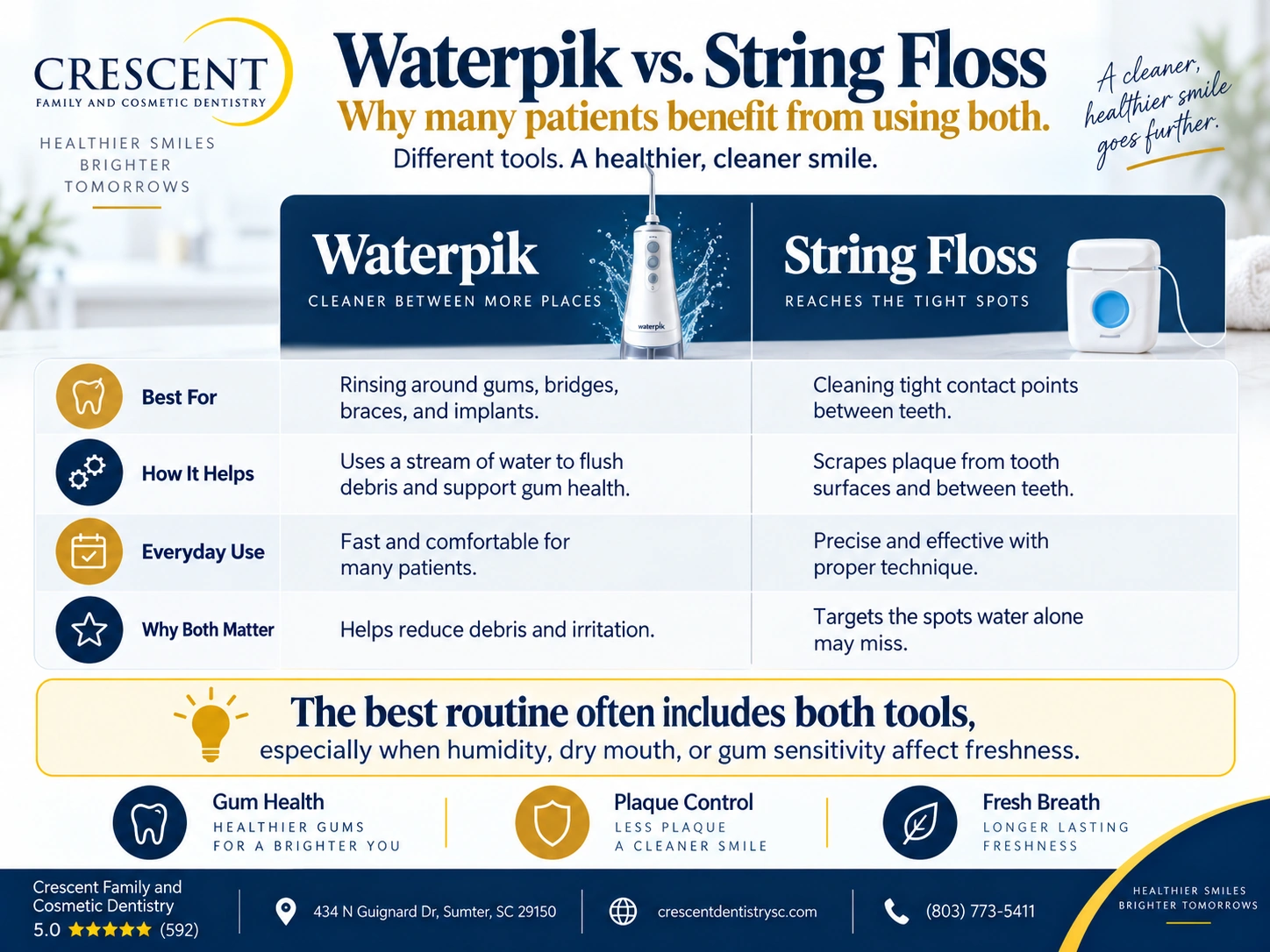
At Crescent Family and Cosmetic Dentistry, we often recommend thinking of these tools as complementary rather than interchangeable. String floss physically scrapes plaque from the sides of teeth, while a water flosser can help flush debris from between teeth, around dental work, and along the gumline.
For many patients, using both can provide a more complete cleaning routine.
And in South Carolina, where hot weather can contribute to dry mouth and dehydration, keeping plaque and food debris under control becomes even more important.
First, Why Does Humidity Matter?
Humidity itself does not directly cause cavities or gum disease.
However, South Carolina’s climate can influence habits that affect oral health.
Hot weather often means:
- More sweating
- Increased risk of dehydration
- More sports drinks and sweetened beverages
- More iced coffee and sugary drinks
- Increased mouth breathing during outdoor activity
- Long periods in air-conditioned environments
All of these factors can influence saliva levels, plaque accumulation, and how the mouth feels.
Saliva is one of your natural defenses against tooth decay.
It helps wash away food particles, neutralize acids, and maintain a healthier environment inside the mouth.
When your mouth becomes dry, bacteria and food debris can remain in contact with teeth longer.
That makes effective brushing and interdental cleaning especially important.
What Does String Floss Actually Do?
Traditional floss works through physical contact.
When used correctly, the floss slides between teeth and wraps around each tooth in a C-shape.
You then move it gently up and down against the tooth surface.
This physical contact is valuable because plaque is sticky.
Simply rinsing an area with water does not always remove attached biofilm.
String floss helps disrupt that film directly.
It can be especially useful for cleaning:
- Tight spaces between teeth
- Contact points
- Areas just below the gumline
- Smooth tooth surfaces where plaque adheres
That mechanical cleaning is why floss remains an important part of many oral hygiene routines.
What Does a Waterpik Do Differently?
A Waterpik is a type of water flosser.
It uses a pressurized stream of water to clean between teeth and along the gumline.
Water flossers can help remove loose food particles and disturb plaque in areas that may be difficult to reach with a toothbrush.
They can be particularly helpful for patients with:
- Braces
- Dental bridges
- Dental implants
- Crowns
- Retainers
- Limited hand mobility
- Difficulty using traditional floss
Many people also find water flossers easier and more comfortable to use consistently.
Consistency matters.
The best cleaning tool in the world provides little benefit if it sits unused in a bathroom drawer.
So, Is Water Flossing Better Than String Floss?
Not necessarily.
Each tool has strengths.
String floss provides direct physical contact with the tooth surface.
A water flosser provides flushing action and can reach around complex dental work or areas that are difficult to access manually.
Think of it this way:
String floss is excellent at wiping.
A water flosser is excellent at rinsing and flushing.
For many patients, those actions work well together.
One does not automatically make the other unnecessary.
Why You Might Need Both
Using both string floss and a water flosser can create a more comprehensive interdental cleaning routine.
String floss helps break up attached plaque.
Water flossing can then help flush loosened debris from between teeth and around the gumline.
This combination may be especially useful for patients who frequently notice food becoming trapped between teeth.
It can also help patients who have dental restorations that create more complicated cleaning areas.
You do not necessarily have to use both tools after every single meal.
The right routine depends on your individual oral health.
But combining methods can be worthwhile if one tool alone is not keeping your gums healthy.
South Carolina Heat Can Make Dry Mouth More Noticeable
Hot weather and dehydration often go together.
If you spend time outdoors in Columbia or elsewhere in the Midlands, you may lose significant fluid through perspiration without realizing how dehydrated you have become.
A dry mouth can make plaque feel thicker and breath smell stronger.
Saliva helps naturally rinse the mouth throughout the day.
When saliva production drops, bacteria may accumulate more easily.
Drinking enough water is therefore an important part of your oral health routine.
A Waterpik is not a substitute for hydration.
It can help clean the mouth, but it does not restore the protective functions of saliva.
Air Conditioning Can Also Contribute to Dryness
South Carolina summers can be hot enough that many of us spend much of the day indoors with air conditioning running.
Air-conditioned environments are often less humid than the outdoor air.
Some people notice increased mouth, throat, or nasal dryness after spending long periods indoors.
If you also breathe through your mouth, especially while sleeping, dryness may become more noticeable.
Dry mouth can increase the importance of cleaning plaque thoroughly and drinking water regularly.
Sports Drinks Create Another Problem
Hot weather means more hydration drinks.
Unfortunately, some sports drinks contain significant amounts of sugar and acid.
These beverages can expose teeth to an environment that supports decay and enamel erosion.
Sipping them over a long period can be particularly problematic because your teeth experience repeated acid exposure.
If you regularly consume sports drinks:
- Drink water as your primary hydration source when possible
- Avoid constantly sipping sugary drinks throughout the day
- Rinse your mouth with water afterward
- Wait before aggressively brushing after acidic drinks
- Maintain consistent interdental cleaning
String floss and water flossers can help remove residue between teeth, but reducing repeated sugar and acid exposure remains important.
Sweet Tea Deserves a Mention
We cannot talk about South Carolina oral health without acknowledging sweet tea.
It may be a regional favorite, but frequent sweet tea consumption can expose teeth to sugar repeatedly throughout the day.
The concern is not necessarily one glass with a meal.
The bigger issue is continuous sipping.
Oral bacteria use sugars to produce acids that attack tooth enamel.
If plaque remains between teeth, those bacteria have an ideal place to thrive.
Cleaning those spaces regularly becomes especially important.
Which Tool Is Better for Gum Health?
Both methods can support gum health when used correctly.
Gum inflammation often begins when plaque accumulates along and below the gumline.
String floss can physically remove plaque from the sides of teeth.
Water flossing can help flush debris and bacteria from areas around the gums.
Some patients find that adding a water flosser improves their ability to clean consistently, especially if traditional flossing is difficult.
The important factor is whether your gums remain healthy.
Healthy gums should generally not bleed regularly during normal brushing and flossing.
Persistent bleeding can indicate inflammation that deserves dental evaluation.
What If Your Gums Bleed When You Floss?
Many patients stop flossing when they see blood.
That may actually make the problem worse if plaque-related gingivitis is the cause.
Inflamed gums often bleed more easily.
As plaque control improves, bleeding may decrease.
However, persistent or heavy bleeding should be evaluated.
Do not assume that bleeding is automatically normal.
It may indicate gingivitis, periodontal disease, aggressive flossing technique, or another issue.
We can help determine the cause.
A Waterpik May Be Easier for Braces
Braces create additional surfaces where food and plaque can collect.
Brackets and wires can make traditional flossing more complicated.
A water flosser can be extremely convenient in this situation.
It can help flush around brackets, wires, and the gumline.
That does not necessarily mean traditional floss becomes unnecessary.
Orthodontic flossers, floss threaders, interdental brushes, and water flossers can all play a role.
The goal is to find a routine that removes plaque effectively without becoming so complicated that you stop doing it.
Dental Implants Need Special Attention
Dental implants cannot develop cavities, but the gums and supporting tissues around them still require excellent hygiene.
Plaque accumulation around an implant can contribute to inflammation.
A water flosser can help clean around implant-supported restorations.
String floss or specialized implant floss may also be recommended depending on the restoration.
If you have implants, ask us which tools are appropriate for your specific situation.
Not every flossing technique is ideal for every type of dental work.
Bridges Are Another Area Where Water Flossers Shine
Traditional floss cannot simply pass vertically between the teeth connected by a dental bridge.
Patients often need specialized tools to clean underneath the replacement tooth.
A water flosser can make this process easier.
It can help flush food and debris from beneath the bridge.
However, specialized floss threaders or interdental brushes may still be useful for physically cleaning the surfaces.
Again, combining methods often provides better results.
Does a Waterpik Remove Tartar?
No.
This is an important limitation.
Once plaque hardens into tartar, also called calculus, home cleaning devices cannot reliably remove it.
Tartar requires professional dental cleaning.
A water flosser may help reduce fresh plaque accumulation, but it cannot replace routine professional care.
If you feel rough deposits near the gumline that do not brush away, schedule a dental cleaning.
Does String Floss Remove Tartar?
No.
String floss can help remove soft plaque before it hardens.
Once calculus forms, floss is not enough.
This is another reason prevention matters.
Daily cleaning keeps plaque from remaining undisturbed long enough to mineralize.
Professional cleanings then remove deposits that home tools cannot.
Which Should You Use First?
There is no single sequence that works for everyone.
Some patients prefer to water floss first to loosen food debris.
They then use string floss for more direct plaque removal.
Others floss first and use the water flosser afterward to rinse away loosened debris.
Either approach can work.
The most important issue is consistency and technique.
If using both tools becomes so complicated that you give up entirely, simplify the routine.
A dental hygiene routine needs to be sustainable.
Don’t Forget the Toothbrush
Interdental cleaning does not replace brushing.
You still need to brush twice daily with fluoride toothpaste.
Brushing cleans the outer, inner, and chewing surfaces of your teeth.
Flossing and water flossing focus on areas your toothbrush cannot reach effectively.
Think of these tools as parts of one system.
Each has a different job.
A Better Routine for South Carolina Patients
For many adults, a practical routine might look something like this:
Morning:
Brush thoroughly with fluoride toothpaste and clean your tongue.
During the day:
Drink plenty of water, especially in hot weather. Rinse with water after sugary or acidic drinks.
Evening:
Brush again and clean between your teeth using string floss, a water flosser, or a combination recommended for you.
If you wear a retainer, nightguard, or other appliance, clean it before putting it back into your mouth.
This does not need to become an hour-long ritual.
The goal is thorough, consistent care.
When String Floss May Be the Better Priority
If your teeth are tightly spaced and you can floss comfortably, string floss can be particularly effective.
It provides direct mechanical contact with the tooth surfaces.
Patients with healthy dexterity and simple dental anatomy may do extremely well with traditional floss.
If your routine is already working and your gums are healthy, there may be no need to complicate it.
When a Water Flosser May Be Especially Helpful
A water flosser may be particularly useful if:
- You have braces
- You have dental bridges
- You have implants
- You struggle with manual dexterity
- You dislike traditional floss
- Food becomes trapped frequently
- You have complicated dental work
- You are more likely to use a water flosser consistently
The best tool is partly the one you will actually use.
When Both May Make the Most Sense
Using both can be particularly helpful if plaque or food consistently remains despite using one method.
Patients with periodontal concerns, dental restorations, orthodontic appliances, or areas that are difficult to access may benefit from combining techniques.
At your dental appointments, we can identify where plaque tends to accumulate.
That allows us to recommend tools based on your actual mouth rather than generic advice.
Humidity Isn’t the Villain. Your Routine Matters More.
South Carolina humidity gets blamed for plenty of things.
Frizzy hair? Fair.
Sweaty clothes? Absolutely.
Gum disease? Not directly.
The climate can influence hydration and lifestyle habits, but plaque remains the real issue.
Whether it is July in Columbia or January somewhere much colder, bacteria still need to be removed regularly.
A good oral hygiene routine works because it controls plaque consistently, not because it fights the weather.
Waterpik vs. Floss: Our Verdict
If we had to summarize the showdown, it would look like this:
String floss: Excellent for physically disrupting plaque between teeth.
Water flosser: Excellent for flushing debris and cleaning around difficult dental areas.
Using both: Potentially the most complete approach for patients who need additional interdental cleaning.
You do not need to turn oral hygiene into a competition between tools.
The better question is whether your current routine is keeping your teeth and gums healthy.
Not Sure Which Flossing Method Is Right for You?
At Crescent Family and Cosmetic Dentistry, we can help you build an oral hygiene routine that actually fits your teeth, restorations, lifestyle, and gum health.
If traditional floss feels impossible, we can show you alternatives.
If you own a Waterpik but are not sure whether you are using it effectively, we can help with technique.
And if your gums keep bleeding despite your best efforts, we can evaluate whether something more than home care is needed.
Schedule a dental examination and cleaning with Crescent Family and Cosmetic Dentistry. We can help you determine whether string floss, a water flosser, or a combination of both gives your smile the best defense against plaque, no matter how humid South Carolina gets.